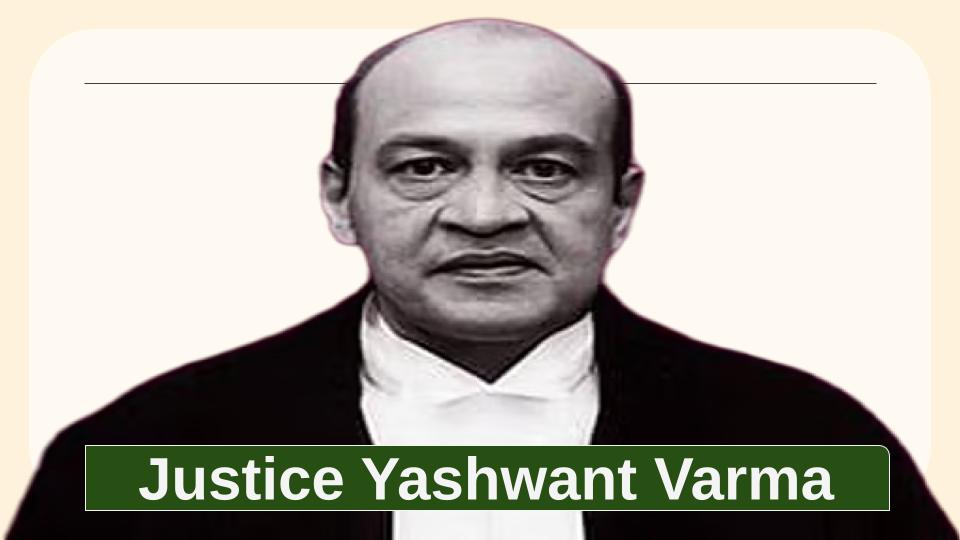
January 16 , 2026 : The Supreme Court on Friday declined to interfere with the Lok Sabha Speaker’s decision to constitute a three-member inquiry committee to examine corruption allegations against Allahabad High Court judge Justice Yashwant Varma.
A Bench comprising Justice Dipankar Datta and Justice Satish Chandra Sharma dismissed Justice Varma’s petition, which questioned the Speaker’s procedural authority under the Judges (Inquiry) Act, 1968.
The controversy arose after a fire broke out at Justice Varma’s official residence in Delhi on March 14, 2025. During firefighting operations, large amounts of alleged unaccounted cash were reportedly recovered, triggering allegations of corruption and serious misconduct. Justice Varma has denied the allegations. Following the incident, he was transferred from the Delhi High Court to his parent court, the Allahabad High Court, and was divested of judicial work pending further action.
Thereafter, the then Chief Justice of India, Justice Sanjiv Khanna, invoked the Supreme Court’s in-house procedure and ordered a preliminary inquiry. Upon completion of that process, Justice Varma was advised to either resign or face removal proceedings under the constitutional framework. He chose not to step down.
In August, the Lok Sabha Speaker admitted a motion moved by Members of Parliament seeking Justice Varma’s removal under Articles 124(4) and 217(1)(b) of the Constitution, read with the Judges (Inquiry) Act, 1968. Acting on the admitted motion, the Speaker constituted a statutory inquiry committee as required under Section 3 of the Act.
Challenging this step, Justice Varma approached the Supreme Court, arguing that the Speaker had violated the proviso to Section 3 of the Act. His counsel contended that since impeachment notices had been submitted in both Houses of Parliament, the Speaker could not constitute the committee without prior consultation with the Chairman of the Rajya Sabha. According to the petitioner, such consultation was mandatory when parallel motions were pending.
Counsel for the Lok Sabha Secretariat countered this argument by pointing out that the Rajya Sabha had not admitted the motion. It was submitted that the Deputy Chairman of the Rajya Sabha had rejected the impeachment notice on August 11, 2025, after the resignation of the then Vice-President and Chairman, Jagdeep Dhankhar, in July. In the absence of an admitted motion in the Upper House, the proviso to Section 3 was said to be inapplicable, leaving the Speaker competent to proceed on her own.
During the hearing, the Bench considered whether any constitutional or statutory prohibition prevented the Lok Sabha Speaker from moving ahead with the impeachment process merely because the Rajya Sabha had declined to admit a similar motion. The Court expressed prima facie doubt over the argument that rejection of a motion in one House would automatically stall proceedings in the other, noting that the Constitution assigns distinct and independent roles to each House in judicial removal proceedings.