News Citation : 2026 LN (HC) 67 | 2026:CGHC:4151-DB
Bilaspur, January 23, 2026 : The High Court of Chhattisgarh has dismissed two first appeals and a cross-appeal arising from a long-running land dispute in Janjgir-Champa district, affirming that purchasers who built houses on land belonging to others must remove the encroachment and hand back vacant possession to the rightful owners.
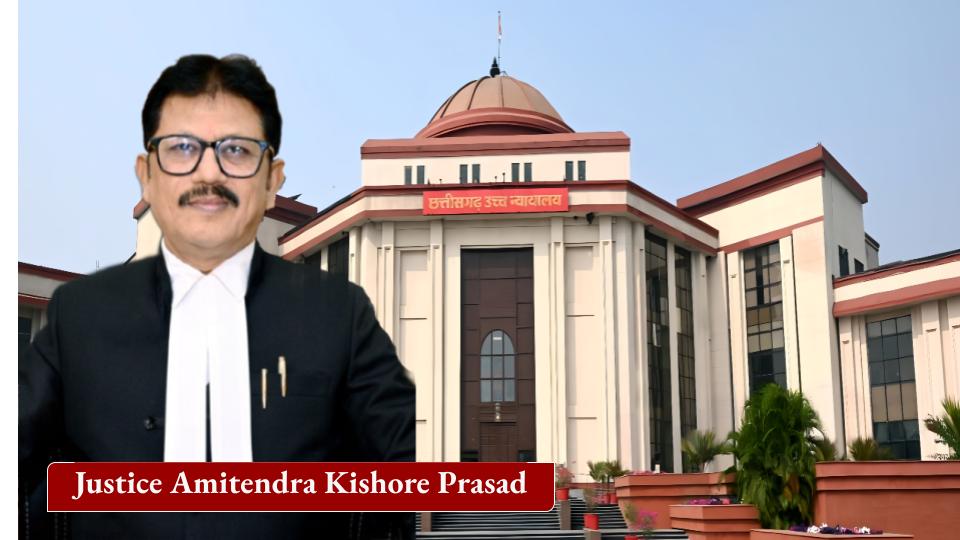
In a detailed judgment delivered on January 23, 2026, a Division Bench comprising Justice Rajani Dubey and Justice Amitendra Kishore Prasad upheld the core findings of a trial court decree passed in October 2023. The court held that while sale deeds executed by the original owner were valid to the extent of her own land, any construction raised beyond that area amounted to unlawful encroachment and could not be protected.
The dispute involved several parcels carved out of a larger tract of land bearing original Khasra No. 1485 at Champa. Four plaintiffs had purchased separate portions of this land in the mid-1990s through registered sale deeds, obtained mutation in their favour, and were allotted distinct sub-divided Khasra numbers. Another purchaser, Dayamati, had acquired a different portion of the same original holding and later sold parts of her land to multiple buyers between 2018 and 2020.
The plaintiffs approached the civil court after discovering that the subsequent purchasers had taken possession and constructed houses on areas that allegedly fell within the plaintiffs’ own holdings. They argued that incorrect boundaries were shown at the time of sale and that land beyond Dayamati’s entitlement had been delivered to the buyers. The suit sought a declaration of rights, correction of boundaries, and restoration of possession after demolition of the superstructures.
Dayamati contested the claim by asserting that the sales were carried out with the knowledge and consent of the plaintiffs, relying on an alleged agreement to sell and claims of substantial expenditure on development and levelling of the land. However, the courts noted that this alleged agreement was never produced, and Dayamati did not step into the witness box to support her defence.
A crucial factor in the case was an unchallenged order passed by the Tahsildar in July 2021, which corrected the revenue map after finding that incorrect demarcation had resulted in possession of the plaintiffs’ land being handed over to the purchasers. The High Court held that this order had attained finality and could not be ignored, especially as the defendants led no evidence to rebut it.
After examining the pleadings, evidence, and settled principles of law on burden of proof and adverse inference, the High Court concluded that the plaintiffs had clearly established their title and the extent of encroachment. The bench agreed with the trial court that Dayamati was competent to sell only her own land, and that the buyers could not retain possession of areas falling outside that limit.
While rejecting the plaintiffs’ cross-appeal seeking complete cancellation of the sale deeds, the court modified the operative part of the decree to bring clarity. It expressly declared the sale deeds valid only in respect of Dayamati’s land and directed the purchasers to remove the constructions standing on the encroached portions and hand over vacant possession to the plaintiffs, as marked in the suit map. With this clarification, all appeals and cross-appeals were dismissed.
Case Reference : FA No. 17 of 2024 (Dayamati vs. Barnabas Lakda and Others) and FA No. 28 of 2024 (Gajanan Prasad Banjare and Others vs. Barnabas Lakda and Others); Counsel for the appellants: Mr. Manoj Paranjape, Senior Advocate, with Mr. Arpan Verma, Advocate; Counsel for the respondents: Mr. Rajeev Shrivastava, Senior Advocate, with Ms. Anu Mishra, Advocate; Counsel for the State: Mr. Devesh G. Kela, Public Prosecutor.