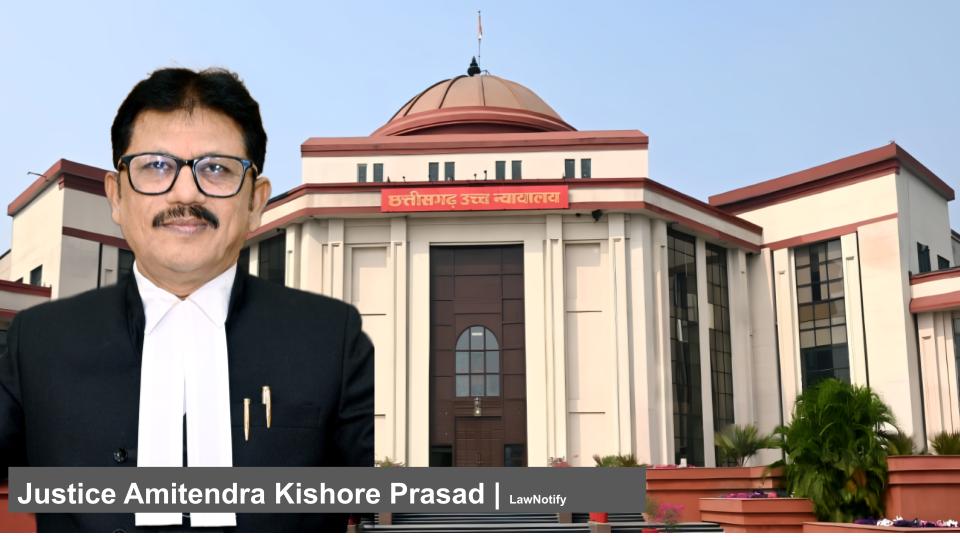
News Citation : 2026 LN (HC) 119 | 2026:CGHC:6910
February 06, 2026 : The High Court of Chhattisgarh has allowed a second appeal in a long-running land dispute from Janjgir-Champa district, setting aside a first appellate court ruling that had treated the Shikari caste as a Scheduled Tribe in the region. The court held that the Shikari community is not notified as a Scheduled Tribe in Pamgarh tehsil and that revenue authorities had wrongly invoked special tribal land protection provisions.
Justice Bibhu Datta Guru delivered the judgment while hearing Second Appeal No. 125 of 2015, filed by Tek Ram, who had challenged the reversal of a trial court decree that protected his possession over agricultural land in village Dhangaon.
The dispute traces back to a registered sale deed executed in March 1977, through which Tek Ram purchased the land from its recorded owners and later secured mutation in his name. He claimed continuous possession since then. In 2004, the defendants asserted ownership by claiming Scheduled Tribe status and obtained a revenue order under Section 170(B) of the Chhattisgarh Land Revenue Code, directing restoration of the land to them.
The trial court had ruled in favour of Tek Ram, holding that the Shikari caste was not notified as a Scheduled Tribe in Janjgir or Pamgarh tehsils. On that basis, it declared the Section 170(B) proceedings without jurisdiction and granted a permanent injunction protecting the plaintiff’s possession.
However, the first appellate court overturned this finding, relying on an earlier notification under Section 165 of the Land Revenue Code and holding that Shikari was an aboriginal tribe at the time of the original transfer. It further ruled that civil court jurisdiction was barred under Section 257 of the Code.
Allowing the second appeal, the High Court disagreed with this approach. The court emphasised that Scheduled Tribe status is strictly area-specific and can only be determined on the basis of Presidential Orders issued under Article 342 of the Constitution. Referring to the Constitution (Scheduled Tribes) Order, 1950 and its amendment in 1976, the court noted that the Shikari community was recognised as a Scheduled Tribe only in Bilaspur and Katghora tehsils of Bilaspur district, not in Janjgir-Champa.
The court also relied on official revenue records and findings of the Naib Tahsildar, Pamgarh, which confirmed that Shikari was not recognised as a Scheduled Tribe in the concerned area. In the absence of statutory recognition, the High Court held that the essential condition for invoking Section 170(B) was missing, rendering the revenue proceedings void.
Citing Supreme Court precedents, including State of Maharashtra v. Milind, the court reiterated that courts have no power to expand or modify the list of Scheduled Tribes beyond what is notified by the President. It further held that a first appellate court’s finding based on an incorrect reading of statutory notifications raises a substantial question of law warranting interference in second appeal.
Accordingly, the High Court restored the 2010 trial court decree granting permanent injunction in favour of Tek Ram and set aside the appellate judgment dated January 20, 2015.
Case Reference : SA No. 125 of 2015, Tek Ram vs Prahlad (deceased) and Others; Counsel for the Appellant: Mr. Somnath Verma, Advocate; Counsel for the State: Mr. Malay Jain, P.L.; Counsel for Respondents Nos. 2 and 4 to 6: Mr. Shashi Kumar Kushwaha, Advocate.