News Citation : 2026 LN (HC) 139 | 2026:CGHC:3789-DB
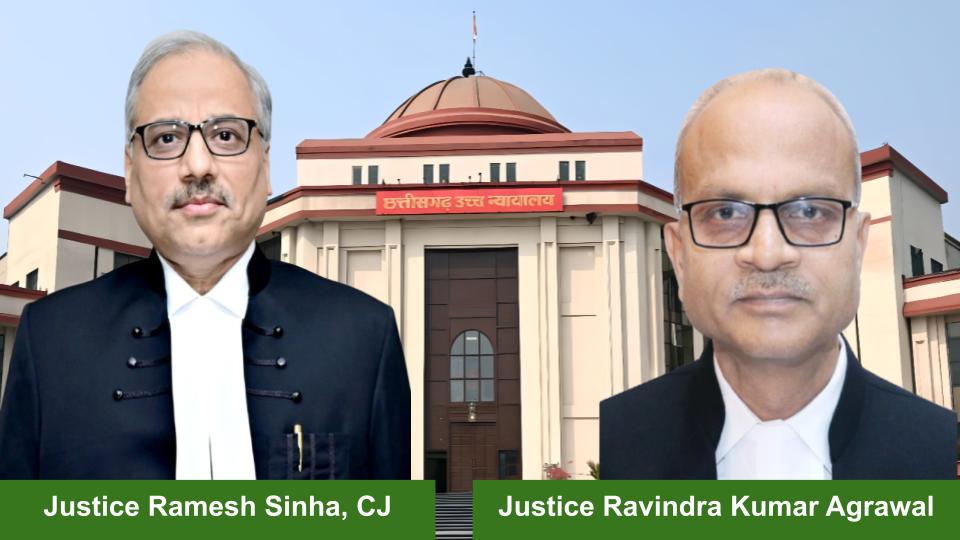
January 22, 2026 : The Chhattisgarh High Court has upheld the life sentence of a 78 year old man convicted of murdering his daughter in law and staging her death as a suicide in Kabeerdham district. The Division Bench of Chief Justice Ramesh Sinha and Justice Ravindra Kumar Agrawal dismissed the criminal appeal filed by Dashrath Chandrawanshi, affirming the trial court’s findings that the chain of circumstantial evidence clearly pointed to his guilt.
The case dates back to 26 November 2021, when Maharani Chandrawanshi was reported missing after she left home for agricultural work. Later that evening, her body was found hanging from a tree in a field near her village. Initially, it appeared to be a case of suicide. However, the postmortem told a different story.
Doctors found multiple fresh abrasions and contusions across her body, including on her abdomen, knees, limbs and face. There were pressure marks below the breasts and a fracture of the hyoid bone in the neck, an injury often associated with strangulation. The medical opinion suggested that the injuries were caused by a hard and blunt object and were ante mortem. The viscera report ruled out poisoning. The High Court agreed with the trial court that these findings established homicidal death rather than suicide.
The prosecution case rested entirely on circumstantial evidence. Witnesses testified that the accused was last seen with the deceased in the afternoon when both were heading toward the fields. By evening, her body was discovered hanging. The Court relied on the “last seen together” principle, noting that the proximity in time between the two events placed a burden on the accused to explain the circumstances. He failed to provide a satisfactory explanation.
Medical evidence also showed that the accused himself had multiple injuries, including abrasions on his chest, knees and neck, and a cut on his finger. The examining doctor assessed the injuries as around eight days old, consistent with the date of the incident. Witnesses confirmed seeing him injured and visibly disturbed shortly after the time of the alleged crime. The Court observed that these injuries were not adequately explained by the defence.
Forensic reports revealed that human blood of group O was found on the saree of the deceased as well as on the shirt and pants seized from the accused. Although DNA profiles did not match, the Court referred to Supreme Court precedent to clarify that the absence of DNA evidence does not automatically weaken the prosecution case if other reliable evidence exists.
The Court also examined motive. Testimony from the victim’s mother and brother indicated that she was allegedly harassed for giving birth to five daughters and had disputes over money given for tractor repairs. While acknowledging that motive is often difficult to prove, especially in cases based on circumstantial evidence, the Court held that the prosecution had shown sufficient background to explain strained relations within the family.
In its judgment, the High Court reiterated settled principles laid down by the Supreme Court on evaluating circumstantial evidence. It stressed that every link in the chain must be firmly established and must point only to the guilt of the accused. After reviewing the entire record, the Bench concluded that the prosecution had successfully established an unbroken chain of circumstances.
The appeal was dismissed, and the life sentence under Section 302 of the Indian Penal Code, along with five years’ rigorous imprisonment under Section 201 for causing disappearance of evidence, was upheld. The Court directed that the appellant, who has been in jail since December 2021, must serve the remaining part of his sentence. It also informed him of his right to approach the Supreme Court with the assistance of legal services authorities.
Case Reference : CRA No. 1242 of 2024, Dashrath Chandrawanshi vs State of Chhattisgarh; For Appellant: Mr. Sunil Sahu and Mr. Sumit Shrivastava, Advocates; For State/Respondent: Mr. Priyank Rathi, Government Advocate.