News Citation : 2026 LN (HC) 147 | 2026:CGHC:4751
January 28, 2026 : The High Court of Chhattisgarh has dismissed an appeal challenging the acquittal of a young man accused of circulating an allegedly objectionable video involving a Class 12 student, holding that the prosecution failed to prove any offence under the IPC, the POCSO Act or the Information Technology Act.
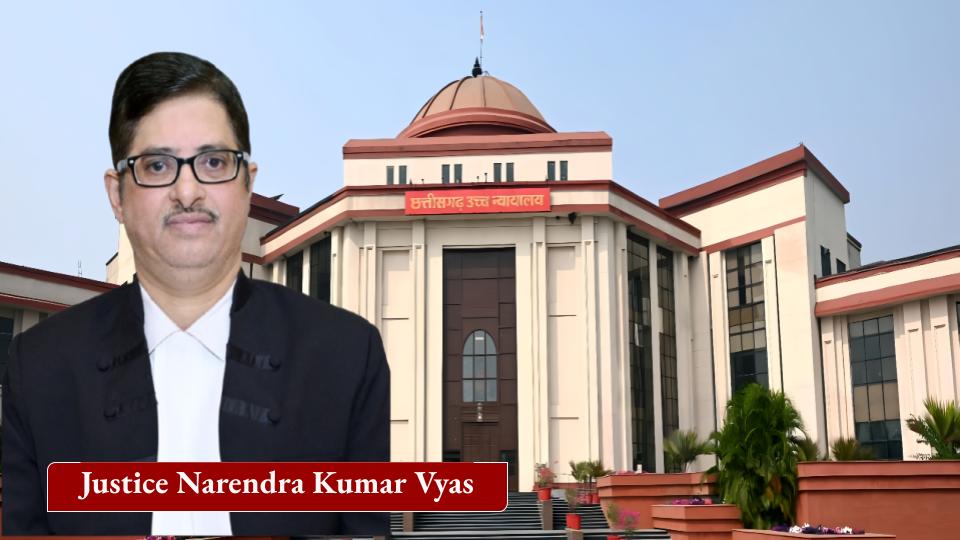
In its judgment dated January 28, 2026, in ACQA No. 537 of 2019, Justice Narendra Kumar Vyas upheld the trial court’s decision, finding no perversity or illegality in the acquittal order. The appeal had been filed by the victim’s father under Section 372 of the Code of Criminal Procedure after the Special Judge under the POCSO Act acquitted the accused in 2019.
According to the prosecution, an FIR was lodged on June 23, 2016 at Kasdol police station in Baloda Bazar district. The complainant alleged that the accused, a fellow student at Shubh Sai Public School, had taken a video of his daughter in class and circulated it on a WhatsApp group with obscene remarks.
Charges were framed under Sections 354(C) and 509 of the IPC, Section 12 of the Protection of Children from Sexual Offences Act, 2012, and Sections 67 and 67A of the Information Technology Act, 2000.
During trial, the prosecution examined 14 witnesses and placed several documents on record, including seizure memos, the FIR and a certificate under Section 65B of the Evidence Act.
The High Court noted that the complainant himself admitted in cross-examination that the video showed students sitting together in class and did not depict any private act. He also acknowledged that there were no obscene visuals and no specific objectionable comments naming his daughter.
The victim stated that she and her classmates were discussing a project file in the classroom and confirmed that no illicit activity had taken place. She further admitted that the accused belonged to the same community and was known to the family.
Crucially, the witness who was supposed to have issued the mandatory Section 65B certificate for electronic evidence stated that he had signed a blank paper at the instruction of police and had neither printed nor certified any WhatsApp chat. This significantly weakened the prosecution’s case under the IT Act.
The court examined the ingredients of voyeurism under Section 354(C) IPC, which require capturing or disseminating images of a woman engaged in a private act. It referred to the Supreme Court’s ruling in Tuhin Kumar Biswas @ Bumba vs. The State of West Bengal, which clarified that the offence is attracted only when the image involves a private act as defined in the statute.
After reviewing the evidence, the High Court concluded that the classroom video did not depict any such private act. Students were simply seated together, and there was no material to suggest otherwise. The trial court’s finding on this point was based on proper appreciation of evidence and did not warrant interference.
On the charge under Section 12 of the POCSO Act, the court held that the prosecution failed to establish sexual harassment as defined under Section 11 of the Act. The victim did not support the allegation of sexual intent, which is a necessary element of the offence.
Regarding Sections 67 and 67A of the Information Technology Act, the court observed that there was no proof of transmission of obscene or sexually explicit material. In the absence of a valid Section 65B certificate and given the admissions of key witnesses, the ingredients of the offence were not satisfied.
The court also relied on the Supreme Court’s decision in Constable 904 Surendra Singh & Another vs. State of Uttarakhand, reiterating that appellate courts should interfere with an acquittal only if the judgment is perverse, based on misreading of evidence, or if no reasonable view other than guilt is possible.
Finding that the prosecution had failed to prove the charges beyond reasonable doubt and that the trial court’s view was a reasonable one, the High Court dismissed the appeal and affirmed the acquittal. The ruling reinforces the principle that criminal convictions, especially under serious provisions like the POCSO Act and IT Act, must rest on clear and legally admissible evidence.
Case Reference : ACQA No. 537 of 2019, Kiran Kumar Dewangan vs State of Chhattisgarh and Another : For Appellant: Mr. Rajendra Patel, Advocate, on behalf of Mr. Sunil Sahu, Advocate; For State: Mr. Suresh Tandon, Panel Lawyer, with Ms. Prachi Singh, Panel Lawyer.