News Citation : 2026 LN (HC) 151 | 2026:CGHC:5487
January 31, 2026 : The High Court of Chhattisgarh has set aside orders passed by a Raipur court and the Appeal Committee of the Municipal Corporation in a long-running dispute over mutation of a residential property in Raipur, directing that the matter be heard afresh after giving all legal heirs an opportunity to be heard.
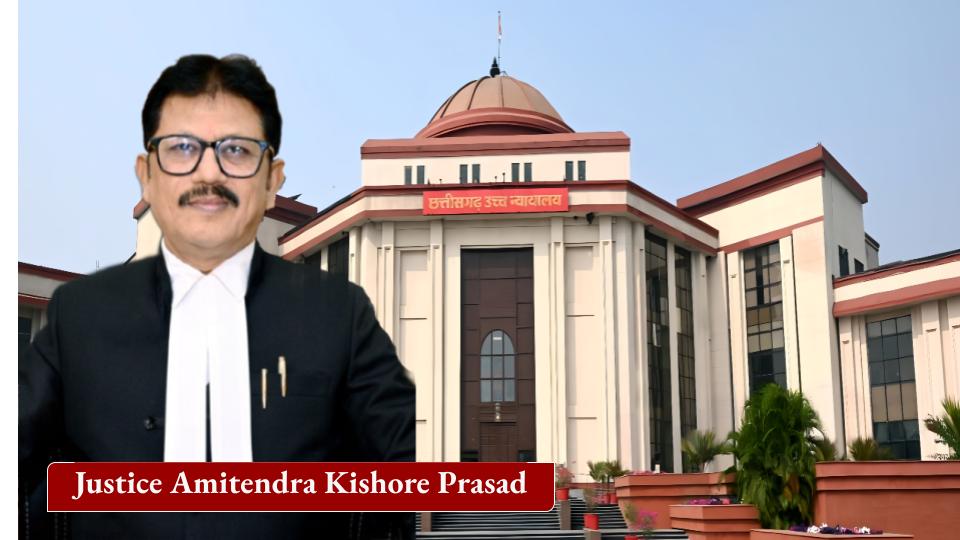
In its judgment delivered on January 31, 2026, in Civil Revision No. 100 of 2024, Justice Amitendra Kishore Prasad remanded the dispute back to the Appeal Committee under Section 403 of the Chhattisgarh Municipal Corporation Act, 1956, holding that substantial justice should prevail over procedural technicalities.
The case revolves around the mutation of House No. 14/281/1 in Indira Gandhi Ward, Naharpara, Raipur. The property was originally recorded in the name of late Kuldeep Narayan Shrivastava. After his death in 1993, his son Ramesh Chandra Shrivastava applied for mutation of his name on the basis of a purported partition deed.
Smt. Indira Shrivastava, one of the daughters of the deceased, challenged the mutation, alleging that no valid will had been executed and that the partition deed was forged. She claimed that several legal heirs, including four daughters and two sons, were not made parties to the mutation proceedings and had not consented to the transfer. She also contended that she had no knowledge of the newspaper notice regarding the mutation.
Although the Appeal Committee of the Municipal Corporation allowed her appeal in April 2016 and directed that the names of all legal heirs be recorded instead of just one son, the respondent later filed a Municipal Judicial Case before the Third Additional District Judge, Raipur. The District Judge allowed the MJC on the ground that the appeal before the Committee had been filed beyond the 30-day limitation period prescribed under Section 403 of the Act, and no formal application for condonation of delay had been filed.
Challenging this decision, the applicant approached the High Court. Her counsel argued that the delay should be computed from the date of knowledge and that the Committee had the power under Section 403(5) to extend the limitation period for sufficient cause. It was also argued that the dispute involved family property and should not be dismissed purely on technical grounds.
On the other hand, the respondent maintained that the appeal was filed well beyond the statutory 30-day period from the date of communication of the order and that in the absence of a condonation application, the Appeal Committee could not have entertained it.
After examining the record, the High Court noted that the mutation had been carried out on the basis of a partition deed that did not bear the signatures of all legal heirs. It also observed that the applicant and other heirs were not impleaded during the mutation process. The Court found that the Appeal Committee had the statutory authority to extend the limitation period and that the matter involved a substantive dispute among legal heirs over family property.
Relying on judicial precedents emphasizing that procedural defects should not defeat substantive rights, the Court held that the dispute should be adjudicated on merits rather than dismissed solely on limitation grounds.
The High Court therefore set aside both the District Judge’s order and the earlier order of the Appeal Committee. It directed the Appeal Committee to rehear the appeal afresh after issuing notice to all legal heirs. The applicant has been granted liberty to file a proper application seeking condonation of delay with sufficient reasons and to implead all legal heirs in the proceedings. With these directions, the civil revision was disposed of.
Case Reference : CR No. 100 of 2024, Indira Shrivastava vs Ramesh Chandra Shrivastava : For Applicant: Mr. Karunendra Narayan Singh, Advocate (on behalf of Mr. B.P. Sharma, Advocate); For Respondent: Mr. Pawan Kesharwani, Advocate.