News Citation : 2026 LN (HC) 155 | 2026:CGHC:8245
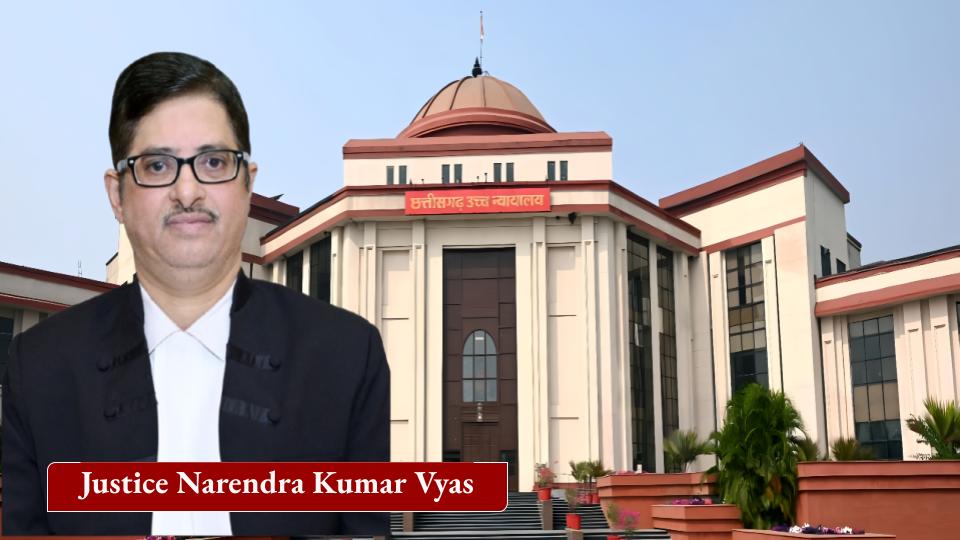
February 16, 2026 : In a significant ruling, the High Court of Chhattisgarh at Bilaspur has partly allowed a criminal appeal and altered a conviction for rape to one for attempt to rape, reducing the sentence from seven years to three years and six months of rigorous imprisonment. The judgment was delivered on February 16, 2026, by Justice Narendra Kumar Vyas in Criminal Appeal No. 355 of 2005.
The appellant, Vasudeo Gond, had challenged the April 6, 2005 judgment of the Additional Sessions Judge, Dhamtari, which had convicted him under Section 376(1) and Section 342 of the Indian Penal Code. He was originally sentenced to seven years of rigorous imprisonment for rape and six months for wrongful confinement, with both sentences to run concurrently.
According to the prosecution, the incident occurred on May 21, 2004. The victim alleged that the accused forcibly dragged her to his house, removed her clothes and committed sexual intercourse against her will. She further stated that she was locked inside a room with her hands and mouth tied until her mother later rescued her.
The prosecution examined 19 witnesses and relied on medical evidence and forensic reports. The doctor who examined the victim noted that the hymen was not ruptured but observed redness and signs consistent with possible partial penetration. The forensic science laboratory report detected human sperm on certain articles seized during investigation.
The High Court closely examined the victim’s testimony and found inconsistencies regarding penetration. In one part of her statement, she spoke of penetration, while elsewhere she clarified that the accused had only kept his private part over hers without full penetration.
The medical evidence did not conclusively establish complete penetration. The doctor stated that there was a possibility of partial penetration but could not give a definite opinion regarding rape.
Referring to precedents of the Supreme Court of India, including State of U.P. v. Babul Nath and other judgments, the Court reiterated that even slight penetration is sufficient to constitute rape. However, where penetration is not clearly proved, but acts go beyond preparation and show clear intent, the offence may fall under attempt to commit rape.
After assessing the evidence, the High Court concluded that the prosecution had proved an attempt to commit rape, but not the completed offence of rape.
The defence argued that the prosecution failed to conclusively prove the victim’s age and questioned the reliability of school records. The Court rejected this argument, holding that entries in official school registers maintained in the course of duty are admissible under the Evidence Act unless strong reasons exist to doubt their authenticity. The Court also noted that the accused had not raised a plea of consent during trial proceedings.
Setting aside the conviction under Section 376(1) IPC, the High Court convicted the appellant under Section 376 read with Section 511 IPC for attempt to commit rape. He was sentenced to three years and six months of rigorous imprisonment and a fine of Rs. 200. The six-month sentence under Section 342 IPC was affirmed, with both sentences to run concurrently.
The Court directed the appellant, who is currently on bail, to surrender before the trial court within two months to serve the remaining part of his sentence, after adjusting for the period already spent in custody. The appeal was accordingly partly allowed.
Case Reference : CRA No. 355 of 2005, Vasudeo Gond v. State of Chhattisgarh; Counsel for the Appellant: Mr. Rahil Arun Kochar and Mr. Leekesh Kumar, Advocates; Counsel for the State: Mr. Manish Kashyap, Panel Lawyer.