News Citation : 2026 LN (HC) 166 | 2026:CGHC:9424-DB
February 24, 2026 : The High Court of Chhattisgarh has set aside a trial court’s acquittal in a child sexual assault case and convicted a school principal under the Protection of Children from Sexual Offences Act, holding that the testimony of a minor victim, if credible and consistent, is sufficient to sustain a conviction.
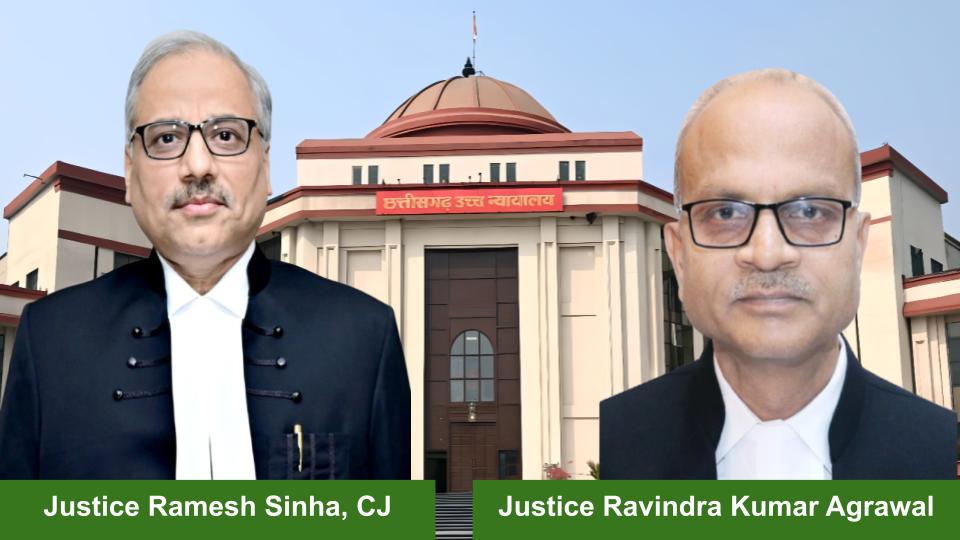
In a judgment delivered on February 24, 2026, a Division Bench comprising Chief Justice Ramesh Sinha and Justice Ravindra Kumar Agrawal allowed the State’s appeal against an acquittal order passed in 2017 by the Additional Sessions Judge (Fast Track Court), Baikunthpur.
The case arose from a complaint lodged in September 2015 by the mother of an eight-year-old girl studying in Class 4 and residing in a hostel at a mission school in Korea district. According to the prosecution, the child reported that an unknown person had assaulted her at night in the hostel premises. Medical examination conducted the next day noted swelling and injuries in her genital area and on her wrist. Forensic analysis later detected semen stains and human sperm on the underwear seized from the victim.
During investigation, a Test Identification Parade was conducted before a Magistrate in which the child identified the school principal, Joseph Dhanna Swami. The trial court, however, acquitted him and two other staff members, giving the benefit of doubt and citing inconsistencies in the prosecution’s case.
On appeal, the High Court undertook a fresh appraisal of the evidence. It noted that the victim’s date of birth established she was below 18 years at the time of the incident, attracting the rigours of the POCSO Act. The Bench held that the child’s testimony remained consistent on core aspects of the assault and inspired confidence.
The Court emphasised that in cases of sexual assault, particularly involving minors, the victim is not an accomplice and her evidence does not require corroboration as a rule of law. Corroboration, it said, is a matter of prudence, not a legal necessity. If the testimony is natural, credible and free from material infirmities, it can form the sole basis of conviction.
Addressing the medical evidence, the Bench observed that the first examination, conducted immediately after the incident, recorded swelling, bruising and bleeding in the genital region, which indicated recent trauma. A later examination conducted six days afterward did not find visible injuries, but the Court held that such healing was consistent with the passage of time and did not negate the earlier findings.
The High Court also found no material to discredit the Test Identification Parade. It ruled that the identification of the accused by the victim, coupled with medical and forensic evidence, established the prosecution case beyond reasonable doubt.
Setting aside the acquittal, the Court convicted Joseph Dhanna Swami under Section 6 of the POCSO Act, as applicable in 2015, and Section 376(2) of the Indian Penal Code. He was sentenced to rigorous imprisonment for life and fined ₹10,000.
Two other accused, Philomina Kerketta and Kismariya, who were staff members at the school, were convicted under Section 119 of the IPC for intentionally concealing the design to commit an offence they were legally bound to prevent. The Court held that their conduct went beyond mere negligence and amounted to deliberate concealment. Each was sentenced to seven years’ rigorous imprisonment and fined ₹5,000.
The Bench described the trial court’s reasoning as perverse and based on misappreciation of material evidence. It reiterated that appellate courts can interfere with acquittals where the lower court’s view is not plausible or results in miscarriage of justice. The convicts have been directed to surrender before the trial court within two weeks to serve their sentences.
Case Reference : ACQA No. 227 of 2018, State of Chhattisgarh v. Philomina Kerketta D/o Guruwaro Kerketta & Ors.; Counsel for Appellant: Mr. Priyank Rathi, Government Advocate; Counsel for Respondents: Mr. Aishwarya Kumar Dubey, Advocate.