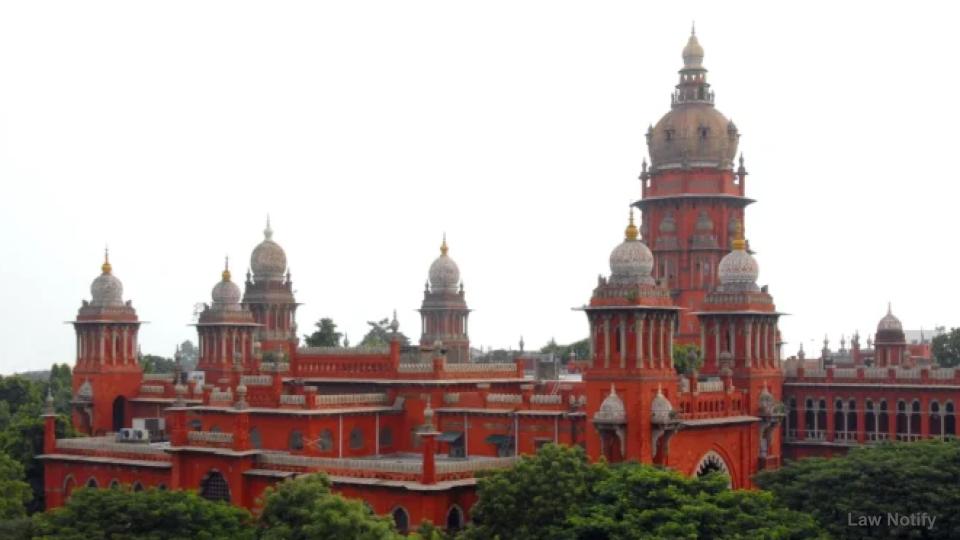
June12, 2026 : The Madras High Court on Friday issued notices to the Union Government and the Tamil Nadu Government on a public interest litigation (PIL) challenging the alleged relegation of Tamil Thai Vaazhthu, the officially recognised State Song of Tamil Nadu, during official government and constitutional ceremonies.
A Division Bench comprising Chief Justice S.V. Gangapurwala Dharmadhikari and Justice G. Arul Murugan directed the respondents to place their stand on record and scheduled the matter for further hearing after eight weeks.
The PIL, filed by Ananya Radhakrishnan through Advocate R. Prabhakar, challenges a circular issued by the Union Ministry of Home Affairs on January 28, 2026, titled “Orders Relating to the National Song of India.” The petitioner argued that the circular should not be interpreted in a manner that alters the long-established practice in Tamil Nadu of commencing official State functions with Tamil Thai Vaazhthu.
The petition was prompted by the swearing-in ceremony of Chief Minister C. Joseph Vijay and his Council of Ministers on May 10, 2026. According to the plea, Tamil Thai Vaazhthu was rendered only after Vande Mataram and the National Anthem during the ceremony, placing the State Song third in the sequence of events.
The petitioner contended that this departure from long-standing ceremonial practice caused concern among the public and was perceived as diminishing the dignity and status traditionally accorded to Tamil Thai Vaazhthu.
The plea highlighted that Tamil Thai Vaazhthu, composed in 1891 by Manonmaniam Sundaram Pillai, has evolved into a symbol of Tamil language, culture, heritage, and regional identity. The song was officially recognised as the State Song of Tamil Nadu through a government notification issued on December 17, 2021.
According to the petition, government functions and public ceremonies in Tamil Nadu have historically begun with the rendition of Tamil Thai Vaazhthu, while the National Anthem is played at the conclusion of the event. The petitioner argued that this practice reflects a constitutional balance between national unity and regional cultural identity.
The PIL further stated that the Ministry of Home Affairs circular only prescribes that when both Vande Mataram and the National Anthem are rendered, the National Song should precede the National Anthem. It does not contain any provision governing officially recognised State Songs or prescribing their position in ceremonial proceedings.
The petitioner argued that there is no constitutional provision, statutory law, or binding executive instruction prohibiting the commencement of official State functions with an officially recognised State Song. Therefore, the existing practice in Tamil Nadu remains legally valid and constitutionally permissible.
Invoking the principles of federalism, cultural diversity, and linguistic plurality, the petition also relied on Article 29(1) of the Constitution, which protects the right of citizens to conserve their distinct language, script, and culture, and Article 51A(f), which imposes a fundamental duty to preserve India’s composite cultural heritage.
The petitioner maintained that any interpretation of the Union Government’s circular that displaces Tamil Thai Vaazhthu from its traditional position at the beginning of official State functions would be inconsistent with constitutional values and the historical practices followed in Tamil Nadu.