News Citation : 2026 LN (HC) 436
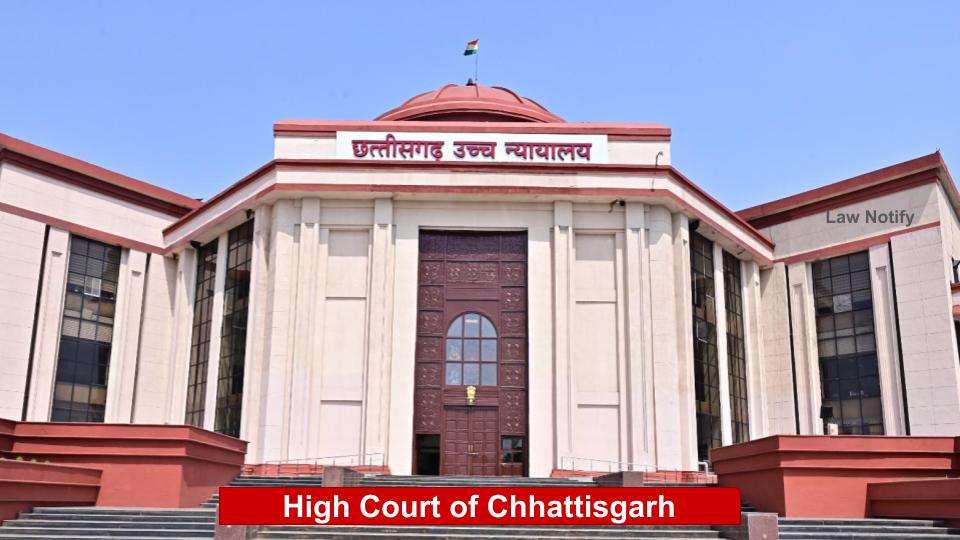
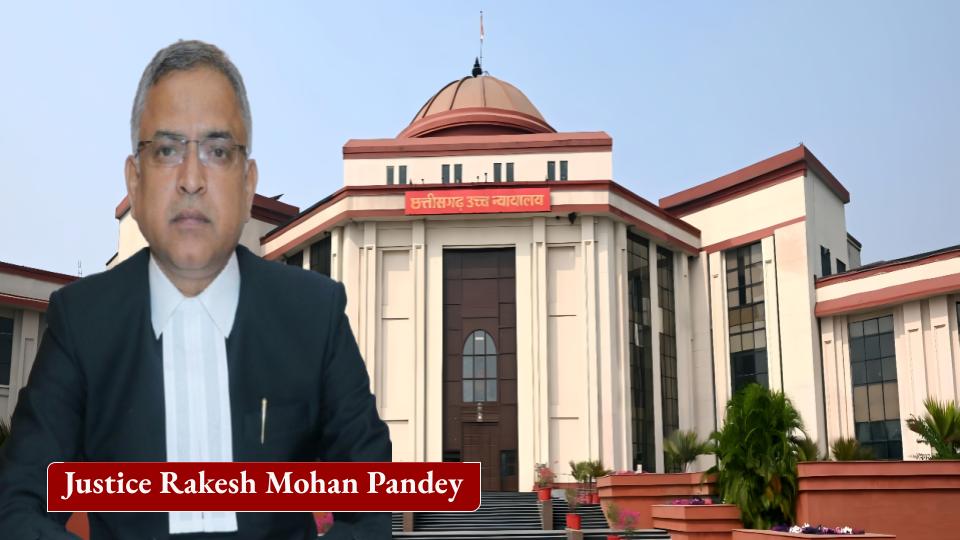
The Chhattisgarh High Court has upheld the State Government’s authority to levy water charges on industrial units extracting groundwater through their own borewells, holding that such levies are supported by the Chhattisgarh Irrigation Act, 1931 and the Chhattisgarh Irrigation Rules, 1974. Justice Rakesh Mohan Pandey dismissed two writ petitions filed by M/s J K Lakshmi Cement challenging demands exceeding Rs 1 crore for groundwater extracted from seven borewells at its cement plant in Durg district.
The common order was passed on August 25, 2026, in WPT No. 114 of 2019 and WPT No. 48 of 2020. The petitions arose from water-charge demands issued by the Water Resources Department. The first demand, issued through notices dated June 6, 2019 and July 18, 2019, amounted to Rs 38,57,459 for the period from September 27, 2016 to March 31, 2019. A subsequent demand dated February 14, 2020 raised the amount to Rs 61,58,707 for the period from 2016-17 to 2019-20 following revision of the applicable rates.
JK Lakshmi Cement argued that the State had no legal authority to impose charges on groundwater independently extracted through borewells. The company contended that it already held No Objection Certificates from the Central Ground Water Authority (CGWA) under the Environment (Protection) Act and that groundwater regulation was governed by the central framework. According to the company, the State could not impose a tax or charge merely through executive action in the absence of specific State legislation dealing with groundwater extraction.
The company also relied on Article 265 of the Constitution, which provides that no tax can be levied or collected except by authority of law. It argued that Sections 26, 37 and 40 of the Chhattisgarh Irrigation Act, 1931 could not be applied to groundwater because those provisions were essentially concerned with water supplied through Government irrigation systems and canals. The company further maintained that it had not received any physical supply of groundwater from the State and instead extracted the water through its own borewells.
The State Government opposed the petitions and maintained that the statutory framework expressly permits charges for industrial utilisation of water from natural or privately created sources. It relied particularly on Rule 71-A of the Chhattisgarh Irrigation Rules, 1974, which provides rates for industrial use of water from “Natural/Created Own Source”. According to the State, groundwater extracted through borewells falls squarely within this category.
The High Court accepted the State’s interpretation. It held that Article 265 was not violated because the levy was not based merely on an executive order. The Court found that the Chhattisgarh Irrigation Act, 1931 was a legislative enactment and that Rule 71-A had been framed under the rule-making powers contained in Sections 92 and 93 of the Act. The Court therefore concluded that the impugned charges had the necessary legislative backing.
Explaining the constitutional position, the Court referred to Entry 17 of List II of the Seventh Schedule, which gives State Legislatures legislative competence concerning water, including water supplies, irrigation and canals, drainage and embankments, water storage and water power. The Court also considered Articles 48-A and 51-A(g), along with the Public Trust Doctrine, in recognising the State’s responsibility to regulate natural resources.
A key issue before the Court was the meaning and scope of Section 26 of the Chhattisgarh Irrigation Act. The petitioner argued that the provision referred to rivers, natural streams, drainage channels, lakes and other natural collections of water, but did not expressly mention groundwater. The High Court rejected this narrow interpretation, holding that the expression “other natural collection of water” was sufficiently broad to cover natural water resources, including groundwater.
The Court further held that Section 40 of the Act could not be restricted to water physically supplied through Government canals. Reading Section 40 together with Rule 71-A, the Court found that the statutory scheme specifically contemplated industrial users obtaining water from their own natural sources. The Court observed that the fact that the State did not physically transport the water to the industrial premises did not eliminate its statutory authority to regulate and charge for the appropriation of a natural resource.
In a significant observation, the Court held that the expression “supply” in Section 40 must be understood in the broader statutory context and includes permitting or allowing an industrial establishment to extract and appropriate water from natural sources. Rule 71-A’s separate provision for water utilised from “Natural/Created Own Source”, according to the Court, reinforced this interpretation.
The High Court also relied on a consistent line of judicial precedents. It referred to the Madhya Pradesh High Court’s decisions in Century Textiles & Industries Ltd. v. State of Madhya Pradesh and Orient Paper & Industries Ltd. v. State of Madhya Pradesh, which had upheld the applicability of the statutory framework to industrial users drawing water from natural sources, including borewells.
The Court also relied heavily on its earlier decision in ACC Ltd. v. State of Chhattisgarh, which had upheld the applicability of Section 40 read with Rule 71-A to industrial utilisation of water from natural or own sources. The Supreme Court subsequently affirmed the legal framework in ACC Limited v. State of Chhattisgarh, Civil Appeal No. 316 of 2022, decided on January 11, 2022, while interfering only with the computation of charges.
The High Court consequently held that the legal question had already been settled and that the petitioner could not reopen an issue that had been judicially determined. It observed that “the question of the applicability of the Act of 1931 and Rule 71-A to industrial users extracting groundwater from natural or own sources is, therefore, no longer res integra.”
The Court also rejected the company’s reliance on its CGWA NOCs. While the NOCs permitted groundwater extraction for specified purposes, the Court noted that the permission operated in the field of environmental regulation and groundwater conservation. The NOC itself was subject to applicable Central, State and local laws. The Court therefore held that obtaining CGWA approval did not confer ownership rights over groundwater or exempt the company from State water charges.
The company’s claim that the groundwater was used exclusively for domestic, drinking and greenbelt purposes was also not accepted. The Court noted that the CGWA permission allowed extraction of approximately 3,20,000 litres of groundwater per day through seven borewells. It found the quantity disproportionate to ordinary domestic requirements and noted that the petitioner had not produced contemporaneous records establishing exclusive domestic or greenbelt use. The Court also referred to what it described as inconsistent positions taken by the company in the two writ petitions concerning the actual use of the extracted groundwater.
The Court further rejected the company’s Article 14 argument. The petitioner had relied on an RTI response indicating that the State had not executed similar agreements with other industries for withdrawal of underground water. The High Court held that the State’s failure to take action against other persons in comparable circumstances did not create a right for the petitioner to avoid a statutory obligation.
The Court observed that “the failure of the State to proceed against others in the same position does not confer upon the petitioner a vested right to escape its statutory obligations.” It held that selective enforcement, by itself, would not establish hostile discrimination, mala fide action or a colourable exercise of power sufficient to invalidate the demand.
The Court also upheld the revised rates introduced through the notification dated January 16, 2020 and the consequential demand dated February 14, 2020. It relied on Section 92 of the Chhattisgarh Irrigation Act, which empowers the State Government to give retrospective effect to rules, and concluded that the revised demand for the assessed period had statutory backing.
The ruling is significant for industrial establishments in Chhattisgarh that extract groundwater or otherwise utilise water from their own natural sources. The judgment makes clear that a CGWA NOC should not be treated as a complete exemption from State-level water regulation. Environmental permission to extract groundwater and liability to pay charges under State water legislation operate in different spheres.
The decision also reinforces the principle that groundwater, as a natural resource, remains subject to State regulation where valid statutory authority exists. At the same time, the Court’s reasoning rests specifically on the statutory framework of the Chhattisgarh Irrigation Act, 1931 and the Rules of 1974, particularly Section 40 and Rule 71-A, rather than on executive power alone.
Justice Rakesh Mohan Pandey ultimately held that the demands dated June 6, 2019, July 18, 2019 and February 14, 2020 were within the statutory authority of the State and did not violate Articles 14 or 265 of the Constitution. Both writ petitions were dismissed, and JK Lakshmi Cement was directed to comply with the impugned demand. The Court made no order as to costs.
Case Reference: M/s J K Lakshmi Cement v. State of Chhattisgarh & Others, WPT No. 114 of 2019 with WPT No. 48 of 2020.