News Citation : 2026 LN (HC) 437
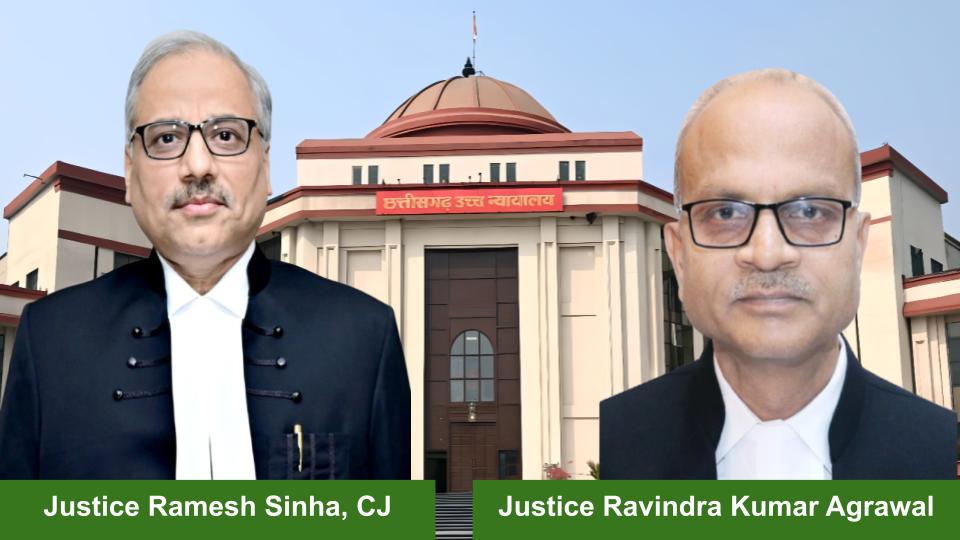
The Chhattisgarh High Court has dismissed a writ petition filed by Dr. Rahul Agrawal and Pacifica Hotels India Private Limited challenging the Enforcement Directorate’s provisional attachment of Hotel Westin Goa in connection with an alleged money-laundering case arising from the Chhattisgarh liquor scam. A Division Bench comprising Chief Justice Ramesh Sinha and Justice Ravindra Kumar Agrawal held that the petition could not be entertained at the provisional attachment stage because the Prevention of Money Laundering Act, 2002 provides a complete statutory mechanism for adjudication.
The order was passed on August 25, 2026, in WPCR No. 473 of 2026, reported as 2026:CGHC:38226-DB. The petition challenged the provisional attachment order dated May 28, 2026, issued by the ED under Section 5(1) of the PMLA in ECIR/RPZO/04/2024. Through the impugned order, the ED had attached Hotel Westin Goa, treating it as property connected with proceeds of crime to the extent of ₹110 crore. According to the ED, ₹60 crore represented the alleged direct proceeds of crime used in the hotel acquisition, while another ₹50 crore was attached as the value of the remaining proceeds of crime.
The case arises from the investigation into an alleged liquor scam in Chhattisgarh. The ED claimed that proceeds of crime were generated through several mechanisms involving the Chhattisgarh State Marketing Corporation Limited, including alleged illegal commissions on accounted liquor sales, clandestine manufacture and sale of unaccounted country liquor through State-run outlets and cartel commissions from distillers. The predicate FIR was registered by the EOW/ACB, Raipur on January 17, 2024, under Sections 420, 467, 468 and 471 of the IPC, Section 120B of the IPC and Sections 7 and 12 of the Prevention of Corruption Act. The ED subsequently registered its ECIR on April 11, 2024.
The petitioners argued that they had no connection with the alleged liquor scam and that neither Rahul Agrawal nor Pacifica Hotels had been arrayed as accused in the FIR, prosecution complaints or charge-sheets. Their principal defence concerned the ₹60 crore cash component allegedly paid for acquisition of the Goa hotel. They relied upon proceedings before the Income Tax Department, pointing out that an initial assessment had treated the amount as unaccounted income, but the CIT(A) later deleted the addition and the ITAT upheld that decision. According to the petitioners, these findings established that the cash had originated from legitimate business operations and could not subsequently be characterised by the ED as proceeds of crime without an independent money trail.
The ED disputed that interpretation. It relied on statements recorded during its investigation, including that of Laxmi Narayan Bansal, who allegedly stated that ₹40 crore in cash had been paid to Vijay Kumar Agrawal in 2019 from liquor-scam proceeds and that another ₹70 crore had been supplied through Probir Kumar Sharma. The ED claimed that the total ₹110 crore was ultimately connected with the acquisition of a hotel in Goa. The agency also relied upon statements concerning the ₹60 crore cash payment made to the vendor and the subsequent role of Vishal Saxena, who allegedly collected the cash and was later appointed as a director of Pacifica Hotels.
The ED further told the High Court that Rahul Agrawal himself had admitted in a statement recorded under Section 50 of the PMLA that he personally delivered ₹60 crore in cash in multiple instalments. The agency claimed this admission was corroborated by the statements of Sameer Biyani and Vishal Saxena as well as material contained in an Income Tax Department appraisal report. On this basis, the ED maintained that the attachment was not founded merely on a numerical coincidence between ₹110 crore of alleged proceeds of crime and the stated consideration connected with the hotel.
A central issue before the High Court was whether it should exercise its extraordinary jurisdiction under Article 226 of the Constitution to interfere with a provisional attachment order when the statutory PMLA adjudication was already underway. The Court noted that Section 5(1) permits provisional attachment where the authorised officer has reason to believe, based on material in possession and reasons recorded in writing, that a person is in possession of proceeds of crime and that they are likely to be concealed, transferred or dealt with in a manner that could frustrate confiscation proceedings. The attachment is provisional and is subject to adjudication under Section 8.
The Bench emphasised that the PMLA provides a graded statutory remedy. After an attachment, the ED is required to file a complaint before the Adjudicating Authority under Section 5(5). The Authority then issues notice under Section 8(1), considers the response and material produced by the affected person and determines whether the property is involved in money laundering. A confirmation order can be challenged before the Appellate Tribunal under Section 26 and subsequently before the High Court under Section 42. The Court therefore found that the statutory remedy available to the petitioners was not illusory.
The Court also rejected the petitioners’ contention that the alleged absence of a direct banking trail between Vijay Kumar Agrawal and Rahul Agrawal required the provisional attachment to be quashed. It observed that the questions concerning the provenance of the ₹60 crore, the alleged receipt of ₹110 crore by Vijay Kumar Agrawal, the connection between those funds and the hotel acquisition, and the applicability of the relevant PMLA provisions involve disputed questions of fact and evidence. Those matters, the Court held, are primarily for the statutory adjudicating process rather than summary determination under Article 226.
The Bench also dealt with the petitioners’ challenge to the composition of the PMLA Adjudicating Authority. The petitioners had argued that the Authority could not validly function through a single member, particularly where the member did not have a legal background, and had described the proceedings as coram non judice. The High Court declined to use this argument to invalidate the provisional attachment. It noted that the attachment order had been passed by the ED’s authorised officer under Section 5(1), whereas the Section 8 adjudication is a subsequent proceeding before a separate authority. Therefore, even if a question concerning the constitution of the Adjudicating Authority arose, it would not retrospectively invalidate the earlier provisional attachment.
The Court also referred to its earlier decision in Mr. Sourabh v. Directorate of Enforcement, where the issue of a single-member bench of the Adjudicating Authority had been considered. The Bench noted that earlier judicial decisions had recognised the possibility of single-member benches under the statutory scheme and concluded that the issue did not provide a basis for quashing the provisional attachment in the present case.
Importantly, the High Court clarified that it was not making a final finding that the ₹60 crore was proceeds of crime or that the petitioners had committed money laundering. The Court expressly confined its examination to whether the provisional attachment order warranted interference in writ jurisdiction at that stage. It left open for the competent statutory authorities all questions concerning the actual provenance of the ₹60 crore, the alleged ₹110 crore payment to Vijay Kumar Agrawal, the connection with the hotel acquisition and the ultimate applicability of Sections 2(1)(u), 3, 5, 8, 23 and 24 of the PMLA.
The Court observed that even an alleged factual error in the ED’s order, such as the description of Vijay Kumar Agrawal’s position in relation to Pacifica, was not sufficient by itself to nullify the provisional attachment when the order was supported by other material. Similarly, the Court declined to direct the ED regarding the precise evidence it should have collected, observing that the adequacy or manner of investigation did not ordinarily warrant intervention under Article 226 unless the action was shown to be manifestly arbitrary, mala fide or without jurisdiction.
The practical effect of the judgment is that the ED’s provisional attachment of Hotel Westin Goa survives for the time being and the dispute will proceed through the statutory PMLA adjudication process. The dismissal does not amount to a final judicial determination that the hotel is conclusively proceeds of crime. The petitioners retain the opportunity to contest the attachment before the Adjudicating Authority and, if necessary, pursue the appellate remedies provided by the PMLA.
In its concluding order, the Division Bench held that there was no ground to exercise its extraordinary jurisdiction under Article 226 to quash the May 28, 2026 provisional attachment order. The writ petition was accordingly dismissed, pending applications were disposed of and the Court made “No order as to costs.”
Case Reference: Dr. Rahul Agrawal & Anr. v. Union of India & Anr., WPCR No. 473 of 2026.