News Citation : 2026 LN (HC) 441
September 9, 2026 : The Chhattisgarh High Court has set aside an inquiry into a workplace sexual harassment complaint after finding that the Internal Complaints Committee (ICC) constituted to examine the allegations was not formed in accordance with the mandatory requirements of the Sexual Harassment of Women at Workplace (Prevention, Prohibition and Redressal) Act, 2013, commonly known as the PoSH Act. The Court held that an inquiry conducted by an improperly constituted committee could not be treated as a valid statutory inquiry and directed the authorities to constitute a fresh committee strictly in accordance with Section 4(2) of the Act and conduct the inquiry afresh.
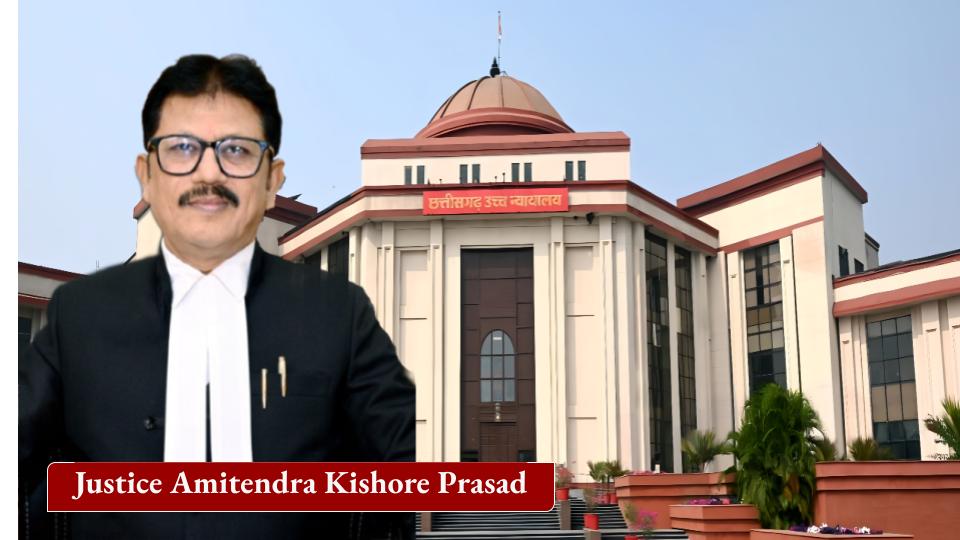
Justice Amitendra Kishore Prasad passed the order on September 9, 2026, in WPC No. 2224 of 2022, Jageshwari Thakur v. State of Chhattisgarh and Others. The petitioner, a Steno-Typist serving with the Chhattisgarh Textbook Corporation since her appointment in 2008, had challenged an order dated March 2, 2022, through which an Internal Complaints Committee was constituted following her complaint of workplace sexual harassment.
According to the petitioner, while she was posted in the Establishment Branch, the newly appointed General Manager frequently called her to his office ostensibly for official work. She alleged that, despite attempting to avoid visiting his chamber, her official responsibilities required her to meet him for briefing and dictation work. She alleged that the General Manager took advantage of the situation and subjected her to continuous workplace harassment, including inappropriate advances, indecent gestures and unwelcome proposals. She subsequently submitted a written complaint before the competent authorities.
Following the complaint, the respondent authorities constituted a five-member Internal Complaints Committee through the amended order dated March 2, 2022. The petitioner was subsequently directed to appear before the committee. However, she challenged its composition, alleging that several members were subordinate in rank to the officer against whom the allegations had been made. She apprehended that such a committee could not conduct a fair and impartial inquiry and requested that the concerned General Manager be transferred and that the committee be reconstituted with senior members.
The petitioner also alleged that she was being pressured and coerced to withdraw her complaint and change her statement. She therefore made a further representation seeking the transfer of the concerned officer and constitution of a fresh committee comprising senior members. Before the High Court, she sought quashing of the March 2, 2022 order and a direction to the Corporation to constitute the committee in strict compliance with Section 4 of the PoSH Act.
Advocate Ms. Zainab Mustafa Vanak, appearing for the petitioner, argued that the committee had not been constituted in accordance with the mandatory requirements of Section 4(2)(a) of the PoSH Act. Her contention was that an inquiry conducted by a committee whose very constitution was contrary to the statute could not replace an inquiry by a lawfully constituted ICC. She argued that any report resulting from such an inquiry would have no legal validity.
The respondents contended that the committee had been constituted because of the non-availability of female employees within the Corporation and that available staff members had therefore been nominated. However, the respondents did not dispute that Section 4(2)(a) permits nomination from other offices or administrative units where the required senior-level woman employee is not available. They further argued that the committee had already completed its inquiry and submitted its report and, therefore, the writ petition had become infructuous. The State also submitted that although the committee had not been constituted in accordance with law, its inquiry had already concluded.
The High Court rejected the argument that completion of the inquiry and submission of the report could cure the defect in the committee’s constitution. The Court examined the object of the PoSH Act, noting that the legislation was enacted to protect women from sexual harassment at the workplace and to provide a mechanism for prevention and redressal of such complaints. The Court also referred to the statutory recognition that sexual harassment can violate a woman’s fundamental rights to equality under Articles 14 and 15 of the Constitution, her right to life and dignity under Article 21, and her right to practise a profession or carry on an occupation in a safe environment free from sexual harassment.
A central issue before the Court was the mandatory composition of the Internal Complaints Committee under Section 4 of the PoSH Act. The provision requires the employer to constitute an Internal Committee by order in writing. Where a senior-level woman employee is unavailable at the workplace, the statute permits the Presiding Officer to be nominated from another office or administrative unit of the workplace. If such an employee is still unavailable, the Presiding Officer may be nominated from another workplace of the same employer or another department or organisation. The committee must also include at least two employees preferably committed to the cause of women or having experience in social work or legal knowledge, along with one member from an NGO or association committed to the cause of women or a person familiar with issues relating to sexual harassment. At least half of the total members must be women.
The Court relied upon the Supreme Court’s decision in Aureliano Fernandes v. State of Goa and Others, reported in (2024) 1 SCC 632. In that case, the Supreme Court emphasised the central role of properly constituted Internal Complaints Committees under the PoSH Act and observed that an improperly constituted committee can obstruct a lawful inquiry into a sexual harassment complaint. The Supreme Court cautioned against allowing an inadequately prepared committee to conduct an incomplete inquiry that could have serious consequences, including major penalties and termination of service.
The High Court also referred to the 2026 Delhi High Court judgment in Prof. Rasal Singh v. University of Delhi, Through its Vice Chancellor and Others, reported in 2026 SCC OnLine Del 1905. The Court noted the principles of natural justice applicable to sexual harassment proceedings, including the requirement of impartiality and a fair opportunity of hearing. It further relied on the observation that the PoSH Act creates a specific statutory mechanism through the Internal Complaints Committee or Local Committee for adjudicating complaints of sexual harassment and that a parallel or extra-statutory fact-finding body would fall outside that statutory framework.
Another important principle relied upon by the High Court came from the Supreme Court’s decision in Independent Sugar Corporation Limited v. Girish Sriram Juneja and Others, reported in (2025) 5 SCC 209. Referring to the established principle in A.R. Antulay v. Ramdas Sriniwas Nayak, the Court reiterated that where a statute requires an act to be performed in a particular manner, it must be performed in that manner and not through some alternative procedure. The judgment records the principle that “where a statute requires to do a certain thing in a certain way, the thing must be done in that way or not at all.”
Applying these principles to the present case, the Chhattisgarh High Court found that the Internal Complaints Committee constituted through the March 2, 2022 amended order did not comply with the statutory requirements of the PoSH Act. The Court specifically noted that the legislation provides for nomination of a senior-level woman employee from other offices or administrative units when necessary, indicating that the absence of an appropriate woman employee within the particular office could not by itself justify an unlawful committee composition.
The Court consequently held that the defect went to the root of the inquiry. In clear terms, it observed that “If the primary constitution of a Committee is defective, any inquiry conducted by it is devoid of jurisdiction” and cannot be taken into consideration because it is “non est in the eyes of law.” The Court therefore concluded that the entire inquiry was vitiated solely because of the improper constitution of the Internal Complaints Committee.
The writ petition was accordingly allowed. The High Court set aside both the inquiry conducted by the disputed committee and the report submitted by it. The concerned authorities were directed to constitute a fresh Internal Complaints Committee in accordance with Section 4(2) of the PoSH Act and to have the newly constituted committee conduct the inquiry afresh.
The ruling has wider significance for employers and institutions covered by the PoSH Act. It makes clear that compliance with the statutory requirements governing the composition of an Internal Complaints Committee is not a mere procedural formality. The validity of the inquiry itself can be affected when the committee is constituted contrary to the statutory framework. The decision also reinforces the importance of providing a legally compliant and impartial mechanism for dealing with workplace sexual harassment complaints.
For employees, the ruling underscores that a complaint under the PoSH Act must be examined through the statutory mechanism created by Parliament. For employers and government institutions, it serves as a reminder that difficulties such as the non-availability of eligible women employees must be addressed through the alternatives expressly provided under Section 4 rather than by constituting a committee that does not satisfy the statutory requirements. The judgment also demonstrates that completion of an inquiry cannot automatically cure a foundational defect in the authority conducting it.
The judgment is particularly relevant because the Court did not decide the underlying allegations of sexual harassment on their merits. Instead, the decision focused on the legality of the committee’s constitution and the consequent validity of the inquiry and report. The allegations raised by the petitioner will therefore have to be examined afresh by the newly constituted Internal Complaints Committee in accordance with the PoSH Act.
Case Reference: Jageshwari Thakur v. State of Chhattisgarh and Others, WPC No. 2224 of 2022. For the Petitioner: Ms. Zainab Mustafa Vanak, Advocate. For the Respondents: Mr. Arijit Tiwari, Advocate; Mr. Anway Tiwari, Panel Lawyer; and Ms. Pratibha Sahu, Advocate.