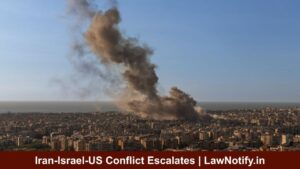
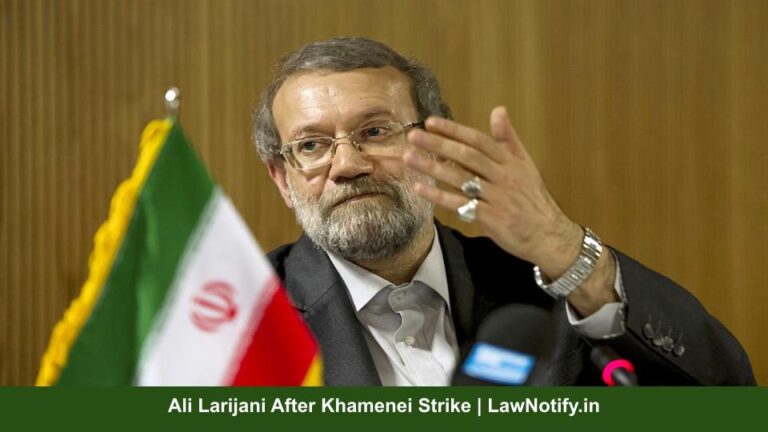
March 01, 2026 : Veteran Iranian politician Ali Larijani has moved to the center of Iran’s power structure following the reported killing of Supreme Leader Ayatollah Ali Khamenei in a wave of air strikes. On Sunday, Larijani announced that a temporary leadership council would be formed to steer the country through the crisis, signaling a rapid consolidation of authority at the top of the Islamic Republic.
Larijani, long regarded as a loyal insider with deep roots in Iran’s clerical establishment, had already reemerged over the past year as one of the most influential figures in the country’s security hierarchy. In August, he was appointed Secretary of the Supreme National Security Council, placing him at the core of decision making on defense, nuclear negotiations, and regional strategy. His return to that post, which he previously held two decades ago, followed last year’s 12-day air war between Iran and Israel that drew in the United States and reshaped the regional security landscape.
State media also reported that Iran’s Armed Forces Chief of Staff, Abdolrahim Mousavi, was killed in the strikes, further intensifying uncertainty within the country’s military leadership.
In recent months, Larijani had been managing a broad portfolio. He oversaw indirect nuclear talks with the United States through mediation by Oman, even as Washington increased military deployments in the Middle East and imposed sanctions on him in January. The U.S. Treasury accused him of directing a violent crackdown on anti-government protests earlier that month, alleging he acted at Khamenei’s behest. Rights groups say thousands were killed in what they describe as the most severe internal unrest since the 1979 Islamic Revolution.
Despite sanctions, Larijani maintained a pragmatic tone on the nuclear issue. In an interview with Oman state television, he described the dispute as “resolvable,” suggesting that if U.S. concerns centered on Iran acquiring a nuclear weapon, those could be addressed. At the same time, he has consistently defended Tehran’s right to enrich uranium and has argued that technological knowledge cannot be erased. “Once you have discovered a technology, they can’t take the discovery away,” he said in a 2025 interview with PBS Frontline.
Larijani has also been active on the diplomatic front beyond Washington. He made repeated visits to Moscow, meeting President Vladimir Putin as part of efforts to strengthen strategic ties with Russia, which Tehran views as a counterweight to U.S. pressure. He was similarly involved in advancing negotiations with China that culminated in a 25-year cooperation agreement signed in 2021.
Domestically, his record remains polarizing. While he acknowledged economic grievances behind public protests, he sharply condemned what he described as armed actions influenced by Israel, drawing a clear line between what he called legitimate demonstrations and “urban quasi-terrorist” activity. Washington, however, characterized him as among the first senior officials to call for force against protesters.
A former member of Iran’s Revolutionary Guards, Larijani served as chief nuclear negotiator from 2005 to 2007 and later as speaker of parliament from 2008 to 2020. During his tenure as speaker, Iran reached the 2015 nuclear agreement with six world powers, an accord later abandoned by U.S. President Donald Trump in 2018. Though often described as a pragmatist within the system, Larijani has remained firmly aligned with the Islamic Republic’s core institutions.
Born in Najaf, Iraq, in 1958 into one of Iran’s leading clerical families, he moved to Iran as a child and earned a PhD in philosophy. Several of his brothers have held senior positions in the judiciary and foreign ministry. He ran unsuccessfully for president in 2005 and was barred from contesting the 2021 and 2024 presidential elections by the Guardian Council, which cited concerns including family ties abroad.
His family has also faced scrutiny abroad. One of his daughters was dismissed in January from a medical teaching role at Emory University in the United States following protests by Iranian-American activists over his alleged role in the crackdown on demonstrations.
Now, with Khamenei reportedly dead and senior military leadership struck down, Larijani’s influence appears set to expand dramatically. Whether he can stabilize Iran’s political system while managing external confrontation and internal dissent will shape the country’s trajectory in the months ahead. – Reuters