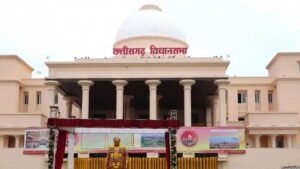
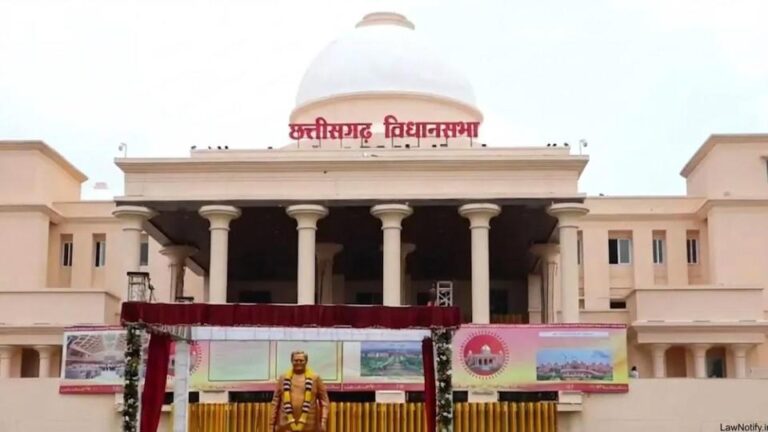
March 19, 2026 : The Chhattisgarh Legislative Assembly on Thursday passed the Chhattisgarh Freedom of Religion Bill, 2026 by voice vote, introducing stringent provisions to curb unlawful religious conversions. The legislation was cleared in the absence of the opposition, which staged a walkout after its demand to refer the Bill to a Select Committee was rejected.
The Bill, introduced by State Home Minister Vijay Sharma, seeks to prohibit religious conversions carried out through force, fraud, inducement, coercion, marriage, or digital means. It significantly expands the scope of existing law, replacing the earlier 1968 legislation that the government считает outdated in light of evolving technological and social conditions.
During the debate, Leader of the Opposition Charan Das Mahant objected to the Bill, calling it a “hasty” move. He pointed out that similar laws in multiple states are currently under consideration before the Supreme Court and argued that the state should await judicial clarity. He also urged that the Bill be examined by a Select Committee with inputs from legal experts and stakeholders to avoid potential social discord.
Despite these objections, the House proceeded with the legislation after Speaker Dharamlal Kaushik allowed its introduction. Congress members subsequently walked out in protest. Responding to the Opposition’s exit, Vijay Sharma remarked that it was not a walkout but “the opposition running away.”
Defending the legislation, Sharma maintained that the Constitution empowers states to enact such laws and emphasized that the Supreme Court has not stayed similar statutes. BJP legislator Ajay Chandrakar also dismissed the opposition’s concerns as politically motivated, noting that comparable laws have been enacted in other states.
Key Provisions of the Bill
The newly passed law makes religious conversion through fraudulent means, coercion, allurement, or digital platforms a cognizable and non-bailable offence. It prescribes stringent penalties, including imprisonment ranging from seven to ten years and a minimum fine of ₹5 lakh. In more serious cases, such as mass conversions, punishment may extend from ten years to life imprisonment along with fines up to ₹30 lakh.
The Bill broadens the definition of “inducement” to include promises of free education, medical treatment, employment, gifts, or improved lifestyle. It also brings online and social media-based influence campaigns within its ambit.
Conversions involving minors, women, persons with disabilities, or individuals from Scheduled Castes, Scheduled Tribes, and Other Backward Classes attract enhanced penalties, including imprisonment ranging from 10 to 20 years and fines up to ₹10 lakh. Public servants found complicit in such activities may face up to 20 years in prison.
Importantly, the legislation excludes “reconversion” to one’s ancestral religion, commonly referred to as “ghar wapsi,” from the definition of religious conversion.
Regulatory Framework and Compliance
The law mandates prior declaration for voluntary religious conversion. Individuals seeking to convert, along with the concerned religious officiant, must submit an application to the District Magistrate. The administration will publicly display details of such applications to invite objections. If the conversion is not completed within 90 days, the application will lapse.
The Bill also declares marriages conducted solely for the purpose of conversion, or conversions carried out for marriage, as null and void.
To ensure enforcement, investigations will be conducted by officers of at least sub-inspector rank, and cases will be tried in designated courts with a target to conclude proceedings within six months. The law also empowers the government to suspend funding, including foreign contributions, to institutions found violating its provisions.
Protests and Political Reactions
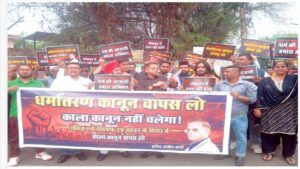
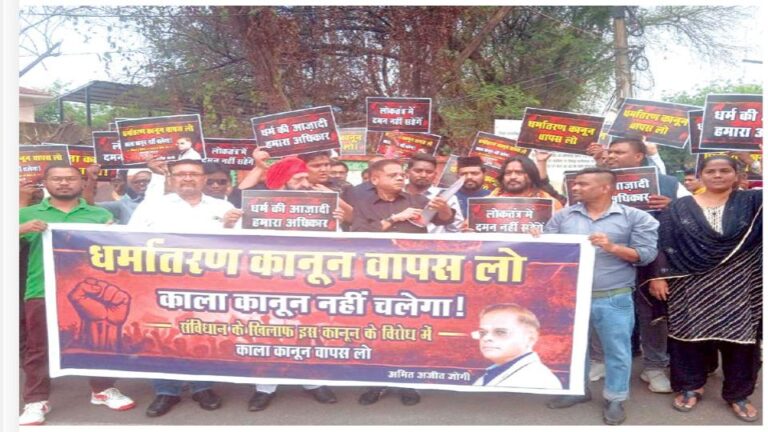
Outside the Assembly, protests were held against the legislation. Janata Congress Chhattisgarh (J) leader Amit Jogi staged a demonstration, alleging that the Bill infringes upon fundamental rights and was introduced without adequate deliberation. He urged the Governor to withhold assent and return the Bill for reconsideration.
Critics have also raised concerns about the broad definition of inducement, warning that it could potentially criminalize welfare activities such as education and healthcare services linked to religious groups.
Meanwhile, the Assembly session also witnessed heated exchanges on unrelated issues, including alleged voter list revisions and shortages of doctors in government health facilities.
The passage of the Bill marks a significant legislative move by the state government, placing Chhattisgarh among several states that have enacted laws regulating religious conversions, even as the broader constitutional validity of such laws remains under judicial scrutiny.