News Citation : 2026 LN (HC) 209 | 2026:CGHC:13575-DB
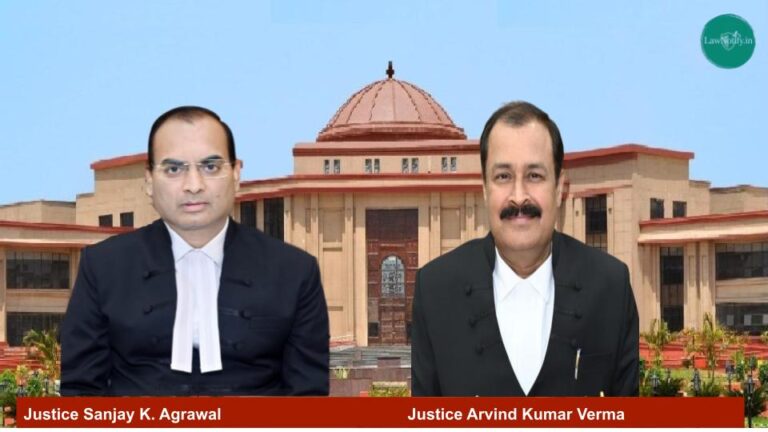
March 20, 2026 : The Chhattisgarh High Court, in a judgment delivered by Justice Sanjay K. Agrawal and Justice Arvind Kumar Verma, has issued a significant ruling on the structure of municipal services in the state, rejecting a challenge brought by a group of Chief Municipal Officers (CMOs) against the state’s promotion rules. The case focused on whether Revenue Inspectors could be considered for promotion to higher municipal posts alongside CMOs, and whether the state government had acted within its legal authority.
The petitioners, who were serving as Chief Municipal Officers (Class C at the time of filing), had questioned the constitutional validity of provisions in the Chhattisgarh State Municipal Services Rules, 2017. They argued that the rules wrongly treated two distinct categories of employees as equals by allowing Revenue Inspectors to be considered for promotion to the post of Chief Municipal Officer (Class B). According to them, CMOs are part of the State Municipal Service and hold civil posts, while Revenue Inspectors are municipal employees governed under a separate statutory framework.
The dispute also involved a state government order issued in February 2018, which relaxed the eligibility requirement for Revenue Inspectors by reducing the qualifying service period from six years to five. The petitioners contended that this relaxation was arbitrary and unconstitutional, claiming it unfairly expanded the pool of candidates eligible for promotion.
Initially, the High Court had ruled in favour of the petitioners and struck down the contested provision. However, the matter reached the Supreme Court, which set aside that decision in September 2025 and directed the High Court to reconsider the case after hearing all affected parties. Following fresh arguments from the state and private respondents, the case was reheard and decided again.
Defending its position, the state government argued that it has broad authority to determine service conditions, including recruitment methods and promotion avenues. It maintained that the inclusion of Revenue Inspectors as a feeder cadre for promotion was a policy decision aimed at addressing administrative needs, including a shortage of eligible officers in certain categories. The state also relied on its statutory power to relax rules in specific cases, describing the 2018 order as a one-time measure taken in public interest.
The private respondents, many of whom were Revenue Inspectors or similarly placed officials, supported the state’s stand. They argued that without such provisions, they would have no viable promotional pathway within the municipal system. They also questioned whether the petitioners had suffered any real legal injury, suggesting that the challenge was based more on perceived disadvantage than actual violation of rights.
After examining the legal framework and precedents, the High Court emphasized that laws and rules carry a strong presumption of constitutionality. It reiterated that courts should interfere only when a provision clearly violates constitutional limits or fundamental rights. The bench noted that decisions regarding classification of posts, eligibility criteria, and promotion channels largely fall within the executive domain, unless shown to be manifestly arbitrary or discriminatory.
The court also observed that promotion is not a fundamental right, but only a right to be considered under the applicable rules. It found that the state’s decision to include multiple feeder cadres, including Revenue Inspectors, did not automatically amount to unconstitutional equality. The judgment further clarified that the power to relax rules, when exercised based on objective considerations and within statutory limits, is legally permissible.
In conclusion, the High Court upheld the validity of the 2017 Rules and the 2018 relaxation order, effectively dismissing the writ petition. The ruling reinforces the state’s discretion in structuring service rules and highlights the limited scope of judicial review in matters of administrative policy, particularly in public employment and promotion frameworks.
Case Reference : WPS No. 3793 of 2018, Pushpa Khalko and Others v. State of Chhattisgarh and Others; Counsel: Mr. Kishore Bhaduri, Sr. Advocate with Mr. Sajal Kumar Gupta for the Petitioners; Mr. Prasun Kumar Bhaduri, Deputy Advocate General for Respondents No.1 & 2/State; Mr. Chandresh Shrivastava for Respondents No.3 & 4; Mr. Manoj Paranjpe, Sr. Advocate with Mr. Rishabh Gupta for Respondents No.5 to 17; Mr. Rajesh Kumar Kesharwani for Respondents No.18, 19 & 20; Mr. Amrito Das for Respondents No.21 & 22; Mr. Santosh Bharat for Respondents No.23 to 45; and Mr. Vikas Dubey for Respondent No.46.