 1112
1112 3
3 4
4 5
5 678
678 9
9 10
10
News Citation : 2026 LN (HC) 95 | 2026:CGHC:1838-DB
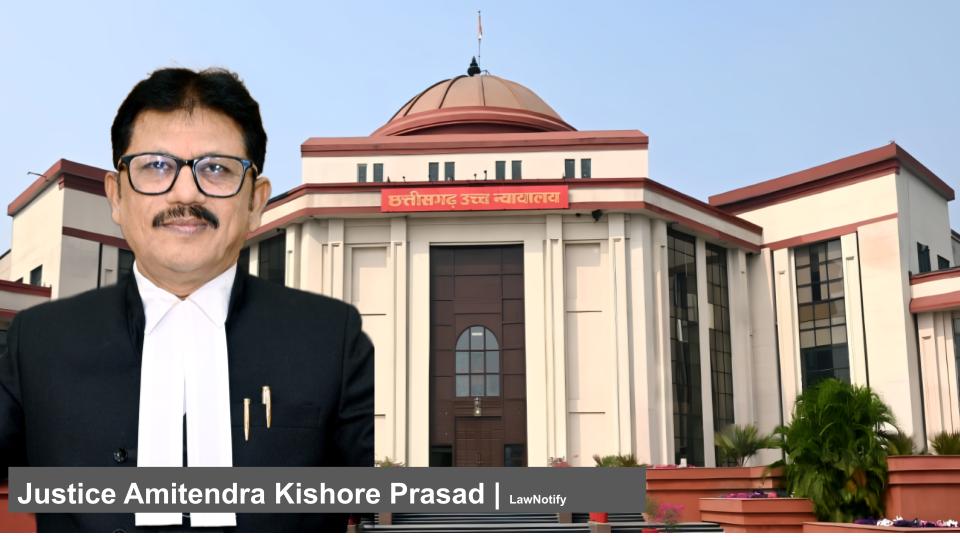
January 13, 2026 : The High Court of Chhattisgarh has dismissed an appeal filed by the State government challenging the acquittal of three family members accused of murdering a man over allegations of witchcraft, holding that the prosecution failed to prove its case beyond reasonable doubt.
The Division Bench of Justice Rajani Dubey and Justice Radhakishan Agrawal upheld the 2014 judgment of the Sessions Court, Bemetara, which had acquitted the accused of charges under Section 302 read with Section 34 of the Indian Penal Code.
The case arose from the death of Parasram Satnami, who was found dead on the morning of March 14, 2013, in village Khairi, Chhattisgarh. According to the prosecution, Parasram was sleeping on a cot outside his house when he was allegedly assaulted during the night by his sons and sister, who suspected him of practicing witchcraft. The post-mortem examination concluded that death was homicidal, caused by strangulation and injury to the trachea.
The State argued that the accused lived in the same household as the deceased, had quarreled with him earlier, and that incriminating articles were recovered from the scene. It contended that these circumstances formed a complete chain of evidence pointing to guilt and that the trial court had wrongly extended the benefit of doubt.
The High Court, however, found that the case was entirely based on circumstantial evidence and that the prosecution failed to meet the strict legal standards required for conviction in such cases. The Court noted that there were no eyewitnesses to the incident and that the first informant had admitted his knowledge was based on hearsay.
Several key prosecution witnesses, including seizure witnesses, turned hostile and did not support the alleged recoveries. The Court also noted serious inconsistencies regarding the presence of the accused at the relevant time, with evidence suggesting that at least two of them were not in the village when the incident occurred.
The Bench further observed that the deceased had been mentally unstable in the months preceding his death and frequently quarreled with villagers. It also noted that the place where the deceased slept was easily accessible, making the possibility of involvement by someone else impossible to rule out.
Importantly, the prosecution failed to establish any motive. The accused were close family members, and no evidence of prior enmity or dispute was brought on record.
Relying on settled Supreme Court jurisprudence governing appeals against acquittal, the High Court held that the trial court’s view was a plausible one and did not warrant interference. It emphasized that an acquittal strengthens the presumption of innocence and can be overturned only where the findings are perverse or unsupported by evidence. Finding no such infirmity, the Court dismissed the State’s appeal and affirmed the acquittal of all three accused.
Case Reference : ACQA No. 617 of 2019, The State of Chhattisgarh vs. Shiv Kumar Satnami and Others; Counsel for the Appellant: Mr. Rishi Raj Pithwa, Deputy Government Advocate; Counsel for the Respondents: Mr. Vipin Singh, Advocate.