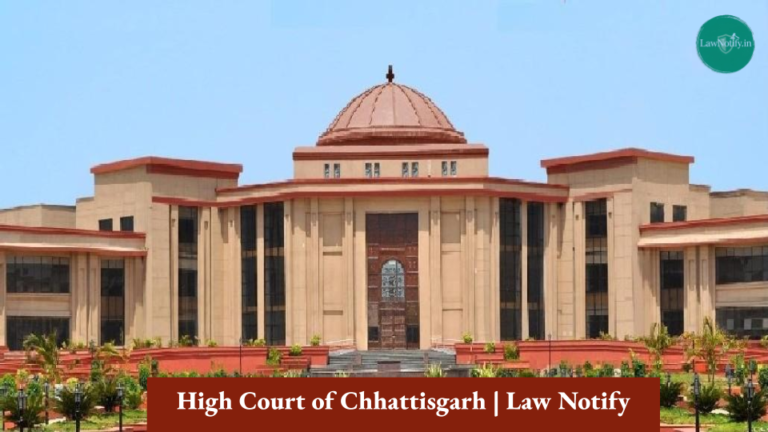
March 10, 2026 : The Chhattisgarh High Court has held that forcing a spouse to face a prolonged criminal trial on serious allegations that ultimately end in acquittal can amount to mental cruelty, setting aside a family court order that had earlier refused to dissolve the marriage.
A division bench of Justice Sanjay K. Agrawal and Justice Arvind Kumar Verma ruled that the distress caused by defending one’s reputation in a criminal case that is later found to be unsupported by evidence can constitute cruelty under the Hindu Marriage Act.
The court noted that the husband and his family members had undergone a criminal trial for nearly seven years under Section 498A of the Indian Penal Code and the Chhattisgarh Tonhi Pratadna Nivaran Adhiniyam, 2005. The bench observed that such prolonged proceedings, when the accusations remain unproven, cause serious mental suffering and damage to reputation.
The judges also found that the parties had been living separately for about seven years and that the wife had refused to resume cohabitation without reasonable cause. This, the court said, also satisfied the legal requirement of desertion.
The case arose from a divorce petition filed by the husband under Sections 13(1)(ia) and 13(1)(ib) of the Hindu Marriage Act, 1955 before the Family Court in Balodabazar. He claimed that the marriage, solemnised on February 15, 2015, lasted only a short period of about 10 to 11 days before the wife returned to her parental home.
According to the husband, the wife insisted that he live separately from his aged and ailing parents and threatened to implicate him in a criminal case if he refused. He further stated that she had been residing separately since July 2017 without any valid reason.
A key part of his claim was the FIR lodged by the wife in 2018 against him and several members of his family under Section 498A read with Section 34 IPC and under the anti-tonhi law. He argued that the criminal prosecution itself amounted to mental cruelty.
He also pointed to counselling proceedings before the Family Welfare Committee on July 23, 2018, where, according to him, the wife expressed unwillingness to live in the matrimonial home if it meant leaving her parents. The husband contended that the long period of separation also constituted desertion.
However, the Family Court dismissed the divorce plea on January 18, 2023, holding that the allegations of cruelty and desertion had not been proved.
During the pendency of the appeal before the High Court, a significant development occurred. On June 16, 2025, the Judicial Magistrate First Class at Bhatgaon acquitted the husband, his parents and his two brothers of the charges under Section 498A/34 IPC and Section 5 of the Chhattisgarh Tonhi Pratadna Nivaran Adhiniyam.
The husband then filed an application seeking to place the acquittal judgment on record as additional evidence, arguing that it confirmed his claim that the criminal case was false and had caused him mental cruelty. He relied on Supreme Court decisions which recognise that false criminal proceedings and baseless allegations can amount to cruelty in matrimonial law.
The wife opposed the application, arguing that an appeal against the acquittal was proposed to be filed and therefore the acquittal should not be treated as conclusive. She also raised a procedural objection, contending that Order 41 of the Civil Procedure Code, which allows additional evidence in appeals, does not expressly apply to appeals under the Family Courts Act.
The High Court rejected this objection. It observed that although Order 41 CPC is not expressly incorporated in appeals under Section 19 of the Family Courts Act, the High Court retains inherent appellate powers to admit additional evidence when necessary for doing justice.
The bench explained that a first appeal is a continuation of the original proceedings and carries incidental powers to ensure effective adjudication. Relying on the doctrine of ex debito justitiae, the court held that additional evidence may be admitted when the issue has already been pleaded and the material is necessary for deciding the case.
Since the husband had already pleaded that the criminal case was false and constituted cruelty, the court held that the subsequent acquittal was directly relevant and allowed it to be taken on record.
Referring to the findings of the criminal court that allegations of cruelty, dowry demand and tonhi-related harassment were not proved, the High Court concluded that the husband and his family had been subjected to serious accusations and a long criminal trial without evidence.
The court held that the sustained mental distress caused by such proceedings amounted to cruelty under matrimonial law.
Finding both cruelty and desertion established, the High Court allowed the appeal, set aside the Family Court’s judgment dated January 18, 2023, and granted a decree of divorce to the husband, dissolving the marriage solemnised on February 15, 2015.
The bench also recorded that the wife had not sought permanent alimony either through an application or in her written statement. However, it clarified that she remains free to pursue a separate claim for permanent alimony under Section 25 of the Hindu Marriage Act.