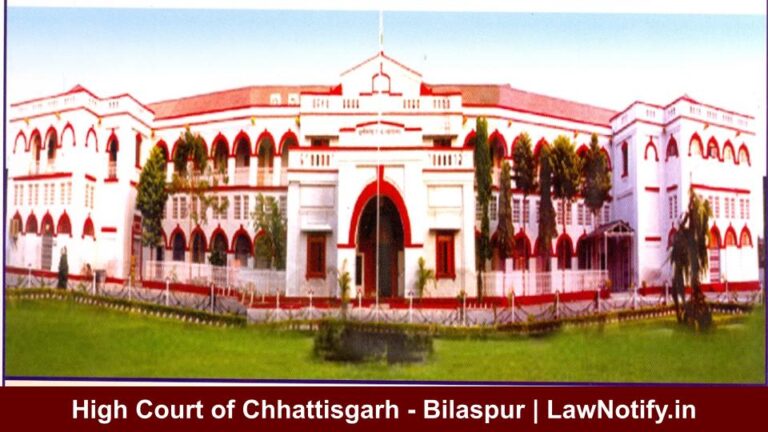
April 04, 2001 : The Chhattisgarh High Court has granted partial relief to a liquor contractor who challenged the state’s demand for full licence fees despite several days of forced shop closures due to political agitations and elections.
Justice R.S. Garg delivered the judgment on a writ petition filed under Articles 226 and 227 of the Constitution of India. The petitioner, a liquor contractor in Raipur district, argued that he should not have to pay licence fees for days when his shops were closed either due to administrative delays or undeclared dry days.
The petitioner was awarded the liquor vending contract for Raipur district for the financial year 2000–2001. However, the contract and licence were issued on April 3, 2000, even though the contract period officially began on April 1. Citing this delay, the petitioner sought exemption from licence fees for April 1–3, arguing that no licence was in effect during that time.
He further claimed that he was forced to shut his shops on several occasions during the year—due to political demonstrations related to the creation of the new state of Chhattisgarh, elections in neighboring districts, and other public events—resulting in losses for which he sought compensation or fee exemption.
The state excise authorities, however, rejected his plea, insisting that he was bound by the general licence conditions and the sale memo. They argued that the petitioner was not entitled to any refund or deduction unless closures were officially declared as dry days by the government or the Collector.
After reviewing the case, Justice Garg held that the petitioner could not be charged for the period before the licence was granted. The court ruled that as the auction bid was confirmed and the permit issued only on April 3, 2000, no contractual relationship existed before that date. Therefore, the state could not lawfully demand the licence fee for April 1–3.
The court also examined the closures ordered by the Collector of Raipur during local elections held in Durg and Bhilai. It found those orders illegal, as they violated the terms of the sale memo, which allowed closures only in areas where elections were actually being held. Since Raipur was not one of those areas, the Collector had exceeded his authority.
On the issue of political agitations, the court made a crucial distinction. It held that “political agitations” did not fall within the meaning of “social disturbances” or “demonstrations” as used in the excise sale memo. Since earlier sale memos had treated political agitations separately, their omission from the current year’s conditions indicated that the government no longer intended to exclude such cases from compensation.
The court concluded that the petitioner was entitled to an exemption or refund for a total of 11 days—three days for the delay in licence issuance, five days for closures due to political agitations, and three days for closures ordered unlawfully by the Collector. However, his claim for additional days, including officially declared dry days like Moharram and Independence Day, was rejected.
“If the shops are closed for any reason not covered under Condition No. 18 of the sale memo, then the petitioner is entitled to exemption from paying the licence fee or to be compensated,” Justice Garg wrote in the judgment.
The writ petition was partly allowed, and the court directed that the petitioner be granted remission or refund for the 11 days in question.
Case Reference : Writ Petition No. 6021 of 2000, Sun Bright Marketing Pvt. Ltd., Raipur v. The Commissioner (Excise), Gwalior (M.P.) & Ors.; Counsel for the Petitioner: Shri N.C. Jain, Senior Advocate; Counsel for the Respondents: Dr. N.K. Shukla, Deputy Advocate General.