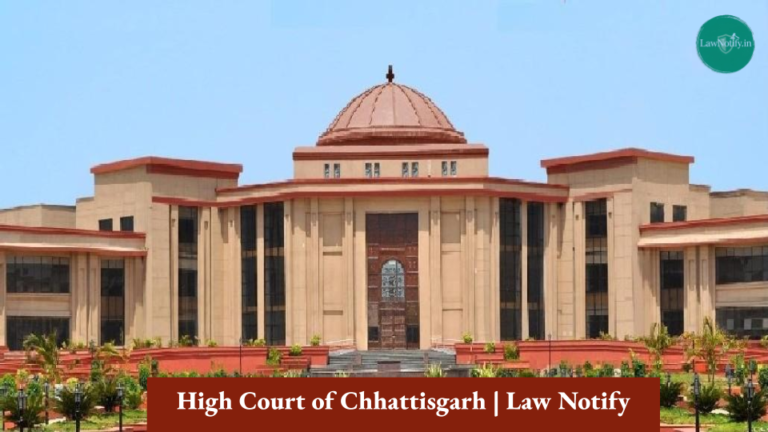
News Citation : 2026 LN (HC) 186 | 2026:CGHC:10989-DB
March 03, 2026 : The Chhattisgarh High Court has directed the competent authority to decide within ten days the parole application of a 68-year-old convicted prisoner suffering from a serious medical condition, emphasizing that the right to life under Article 21 of the Constitution includes the right to timely and adequate medical treatment.
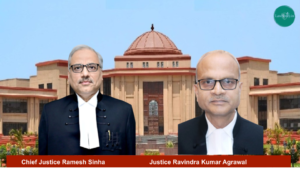
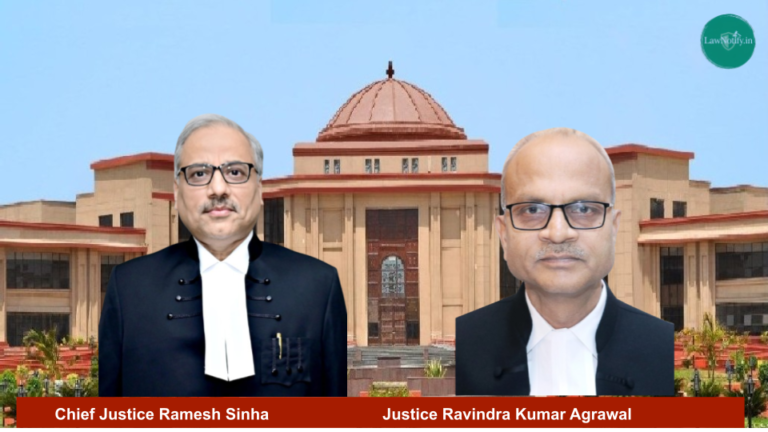
The Division Bench of Chief Justice Ramesh Sinha and Justice Ravindra Kumar Agrawal passed the order while hearing a writ petition filed on behalf of Dheluram, who is currently lodged in Central Jail, Bilaspur. The petition was filed through his next friend, seeking parole to enable him to obtain medical treatment in a private hospital of his choice.
According to the plea, the prisoner is suffering from gangrene and had earlier undergone amputation of one toe at Dr. B.R. Ambedkar Memorial Hospital. Medical reports placed before the court indicated that the infection had spread further and that he now faces the risk of amputation of his legs. Concerned about the line of treatment and having lost confidence in the government hospital, he sought permission to pursue treatment at a private hospital at his own expense.
The petitioner had submitted an application for parole under the Chhattisgarh Prisoner’s Leave Rules, 1989. Jail authorities forwarded the application to the District Magistrate for consideration, but no decision was taken despite the urgency of the prisoner’s medical condition.
Counsel for the petitioner argued that the continued pendency of the application amounted to arbitrary inaction and violated the prisoner’s fundamental rights under Articles 14 and 21 of the Constitution, particularly when he required urgent medical care.
Opposing the plea, the State submitted that parole is not a matter of right and is governed by statutory rules and administrative satisfaction. It argued that the prisoner’s application was under consideration and that the authorities were committed to ensuring necessary medical treatment within the prison system.
After examining the record and medical documents, the High Court observed that the petitioner was suffering from a serious medical condition requiring urgent attention. The Bench noted that while parole cannot be claimed as an absolute right, the competent authority has a statutory duty to consider such applications within a reasonable time, especially when they are based on serious medical grounds.
The Court further stated that the right to life guaranteed under Article 21 encompasses the right to timely and adequate medical treatment. It observed that the prisoner had already undergone amputation of a toe and was presently facing the risk of further amputation due to the spread of infection.
Taking note of the pending application, the Bench remarked that such inaction, particularly in matters concerning health and life, cannot be countenanced. Without expressing any opinion on the merits of the parole request, the court directed the concerned competent authority to consider and decide the pending application by passing a reasoned and speaking order within ten days from the receipt of the order.
The petition was argued by advocate Chandrakaditya Pandey for the petitioner, while N. K. Jaiswal, Deputy Government Advocate, appeared for the State.
Case Reference : WPCR No. 133 of 2026, Dheluram S/o Motiram vs State of Chhattisgarh & Others; Counsel for Petitioner: Mr. Chandrakaditya Pandey, Advocate; Counsel for State: Mr. N. K. Jaiswal, Deputy Government Advocate.