News Citation : 2026 LN (HC) 181 | 2026:CGHC:10664-DB
The Chhattisgarh High Court has dismissed a writ petition seeking refund of ₹73.14 lakh deposited for allotment of commercial plots under the “Devendra Nagar Commercial Complex Scheme” in Raipur, holding that the dispute arises out of a contractual arrangement and cannot be adjudicated in writ jurisdiction under Article 226 of the Constitution.
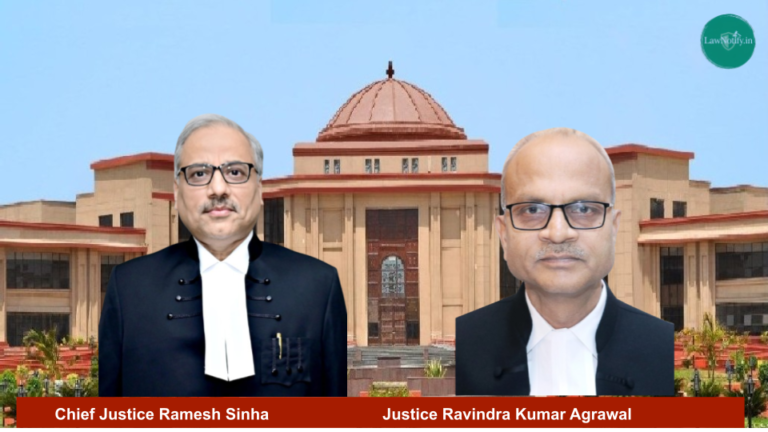
The case was heard by a division bench comprising Chief Justice Ramesh Sinha and Justice Ravindra Kumar Agrawal, which observed that the petitioners’ claim for refund essentially relates to enforcement of contractual rights and involves disputed questions of fact that cannot be examined in writ proceedings.
The dispute relates to a commercial development project floated in 2018 by the Raipur Development Authority (RDA) at Cloth Market, Pandri, Raipur, under the “Devendra Nagar Commercial Complex Scheme.” The scheme aimed to develop commercial infrastructure and allot plots to the public on a long-term lease basis. It was widely advertised with assurances that the land was free from encumbrances and suitable for commercial development.
Relying on these representations, the petitioners applied for allotment of commercial plots and were subsequently allotted Plot Nos. 9, 10 and 11, each measuring 750 square feet. In accordance with the tender conditions, they deposited 25 percent of the tender amount as earnest money. Each petitioner deposited ₹24,38,000, bringing the total amount deposited for the three plots to ₹73,14,000.
According to the petitioners, a notice was later issued by the authorities directing them to pay 18 percent GST on the allotment amount. They contended that the levy of GST had not been mentioned in the tender documents or advertisement and therefore objected to the demand. Earlier writ petitions challenging the GST demand were filed before the High Court, but those petitions were dismissed by a Single Judge in July 2023.
The petitioners further claimed that the entire scheme suffered from serious statutory defects. They alleged that a portion of the land included canal or water body land which could not legally be used for commercial development. According to them, the Raipur Development Authority attempted to rectify the issue by proposing changes to the layout plan and seeking approval from the State Government. However, the State Government rejected the proposed modifications on multiple occasions in 2019, 2020 and 2022, holding that the proposed changes were legally untenable and contrary to planning norms.
The petitioners argued that without an approved layout plan the allotted plots could neither be legally registered nor developed. They claimed that despite repeated representations seeking either a fresh approved layout or refund of the deposited money, the authority did not take any action. Consequently, they approached the High Court seeking directions to refund ₹73,14,000 along with interest.
Opposing the petition, the respondents submitted that the dispute arises out of a contractual relationship between the parties formed through the tender and allotment process. They argued that a claim for refund of money deposited under such an arrangement cannot be decided in writ proceedings and must be pursued before the appropriate civil forum.
After hearing the parties, the High Court observed that the petitioners had participated in a tender process and accepted the terms of allotment, thereby entering into a contractual domain governed by the conditions of the scheme. The bench noted that the relief sought by the petitioners refund of the deposited amount with interest would require examination of several disputed factual aspects, including the terms of allotment, the obligations of the parties and the alleged statutory defects in the scheme.
The court held that such issues cannot be satisfactorily adjudicated in exercise of writ jurisdiction. It reiterated that where a dispute arises out of contractual obligations and the relief sought is recovery or refund of money, the appropriate remedy ordinarily lies before a competent civil court or another forum having jurisdiction.
In view of these findings, the High Court dismissed the writ petition. However, it granted liberty to the petitioners to pursue appropriate remedies before a competent civil court or any other forum in accordance with law for their claim of refund and other consequential reliefs.
Case Reference : WPC No. 910 of 2026, Shobha Choudhary & Others v. State of Chhattisgarh & Others; Counsels: For the Petitioners: Mr. Rajeev Shrivastava, Senior Advocate, assisted by Ms. Kajal Chandra, Advocate; For Respondents No. 1 & 4: Mr. Praveen Das, Additional Advocate General; For Respondent No. 2: Mr. Anuroop Panda, Advocate; For Respondent No. 3: Mr. Pankaj Agrawal, Advocate.