 111
111 2
2 3
3 45
45 6
6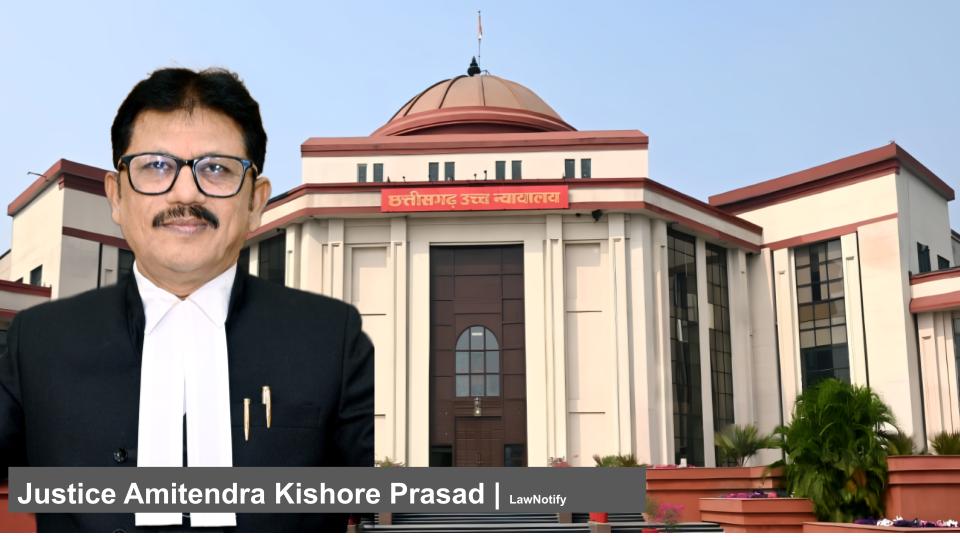 78
78 9
9 10
10
News Citation : 2026 LN (HC) 132 | 2026:CGHC:1886-DB
January 13, 2026 : The High Court of Chhattisgarh has dismissed a husband’s appeal seeking divorce on the ground of desertion, holding that he cannot take advantage of his own wrongdoing after entering into a second marriage without legally dissolving the first.
In a judgment delivered on January 13, 2026, a Division Bench comprising Justice Sanjay K. Agrawal and Justice Arvind Kumar Verma upheld the Family Court’s decision rejecting the husband’s plea under Section 13(1)(ib) of the Hindu Marriage Act, 1955.
The case arose from the marriage of Bodhi Ram Sonkar and Mohani Bai Sonkar, solemnised in March 2014 according to Hindu rites. The couple had a son. According to the husband, marital disputes led the wife to leave the matrimonial home in March 2015. He filed for divorce in May 2017, claiming she had deserted him for over two years without reasonable cause.
The wife opposed the plea, alleging that it was the husband who had deserted her. During proceedings, it emerged that he had contracted a second marriage and had two children from that relationship. The Family Court in Raipur found that this conduct showed he was not willing to resume cohabitation with his legally wedded wife and rejected his petition in June 2023.
Before the High Court, the husband argued that there were no formal pleadings about his second marriage and that the Family Court had relied improperly on statements made during cross-examination. However, the Bench examined the interplay between Section 13(1)(ib), which deals with divorce on the ground of desertion, and Section 23(1)(a) of the Act, which bars a party from taking advantage of his or her own wrong.
The Court relied on established Supreme Court precedents, including Ashok Kumar Jain v. Sumati Jain, Chetan Dass v. Kamla Devi, and Dharmendra Kumar v. Usha Kumar, which clarify that matrimonial relief cannot be granted if the petitioner’s own misconduct led to the breakdown of the marriage.
The Bench observed that desertion requires proof of both separation and an intention to permanently end cohabitation, along with the absence of reasonable cause. If a spouse is compelled to live separately due to the other’s misconduct, the ground of desertion cannot be invoked to seek divorce.
In this case, the Court found that the husband had entered into a second marriage without obtaining a decree of divorce, an act that constituted a serious legal wrong. This, the Court held, provided sufficient and reasonable cause for the wife to live separately. Granting divorce on the ground of desertion in such circumstances would effectively reward the wrongdoer, something explicitly barred under Section 23(1)(a) of the Act.
The appeal was dismissed as devoid of merit, and the Court also placed on record its appreciation for the assistance rendered by the amicus curiae in the matter.
Case Reference : First Appeal (MAT) No. 255 of 2023, Bodhi Ram Sonkar v. Mohani Bai Sonkar; For Appellant: Mr. Shivendu Pandya, Advocate; For Respondent: Mr. Amit Nayak, Advocate; Amicus Curiae: Mr. Rahul Tamaskar, Advocate.