 1112
1112 3
3 4
4 5
5 678
678 9
9 10
10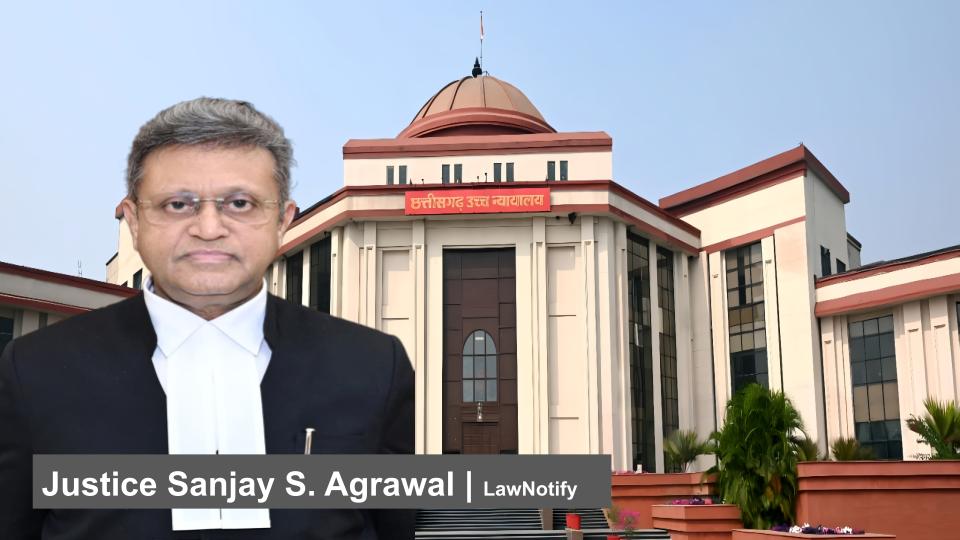
News Citation : 2026 LN (HC) 223 | 2026:CGHC:15034
April 1, 2026 : In a significant judgment clarifying the jurisdictional limits of revenue officers, the High Court of Chhattisgarh has dismissed a petition seeking the restoration of tribal land, affirming that revenue authorities do not have the power to declare a transaction “benami” under Section 170-B of the Chhattisgarh Land Revenue Code, 1959.
The case, presided over by Hon’ble Shri Justice Sanjay S. Agrawal, centered on a dispute spanning over five decades. The petitioner, Urmila Devi, the widow of an aboriginal tribal man named Muneshwar Sai, had challenged an order by the Commissioner of the Surguja Division. Her legal battle sought to reclaim 1.446 hectares of land in Village Chetva, Jashpur district, which her late husband had originally sold in 1973.
The historical facts of the case reveal that Muneshwar Sai sold the land to another tribal individual, Sadhu Sai, for ₹3,000 in March 1973. Roughly a year later, after obtaining the necessary permission from the Collector as required by law for transfers to non-tribals, Sadhu Sai sold the property to Manohar Lal Agrawal. Decades later, in 2015, the petitioner filed for restoration, alleging that the initial sale to Sadhu Sai was a fraudulent “benami” transaction essentially claiming that Sadhu Sai was merely a front for Manohar Lal Agrawal to circumvent tribal land protections.
While the Sub Divisional Officer and the Collector initially ruled in favor of the petitioner, describing the 1974 transaction as fraudulent, the Commissioner of Surguja later reversed those findings.
In his final assessment, Justice Sanjay S. Agrawal noted a critical admission from Urmila Devi during the proceedings: she acknowledged that Manohar Lal Agrawal only took possession of the land after the second sale in 1974. This admission undermined the claim that the 1973 sale was a sham to hide his immediate control.
Furthermore, Justice Agrawal relied on Supreme Court precedents to emphasize that while Collectors have some oversight regarding the nature of land transactions during the permission-granting process, that power does not extend to the avoidance of transfers under Section 170-B. The Court ruled that determining whether a tribal person was an “ostensible owner” rather than a “beneficial owner” is a complex legal question outside the jurisdiction of revenue authorities.
Concluding that the original sale was made for adequate consideration and followed proper legal channels, the High Court dismissed the petition, effectively ending the long-standing dispute over the property’s title.
Case Reference : In the matter of WPC No. 3810 of 2021 between Urmila Devi and Vikas Kumar Agrawal and Others, the legal representation included Shri Dhiraj Kumar Wankhede and Shri Sanchit Bhatt for the Petitioner; Shri B. P. Sharma, Shri M. L. Sakat, and Ms. Koushiki Kumari for Respondents No. 1 to 6; and Shri Dharmesh Shrivastava, Deputy Advocate General, for the State/Respondents No. 7 to 9.