 111
111 2
2 34
34 5
5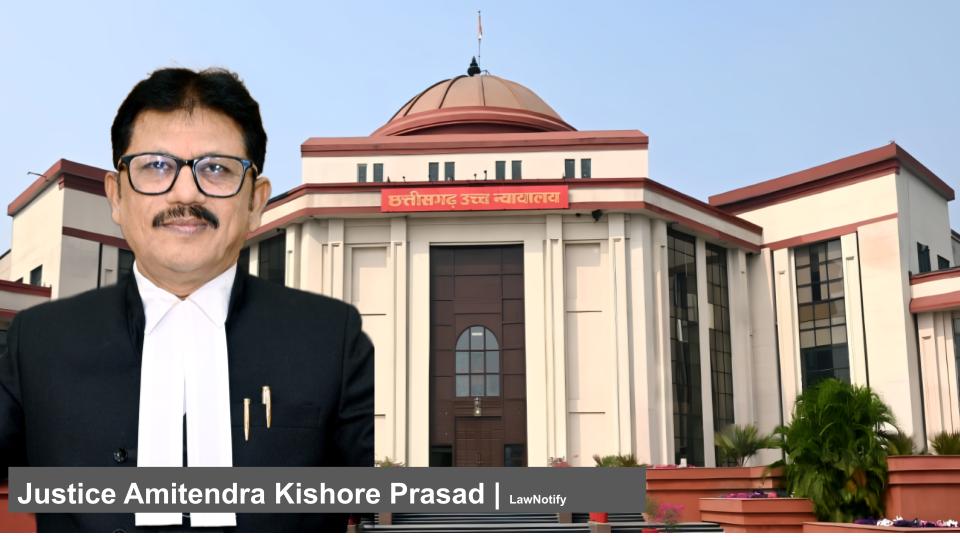 67
67 8
8 910
910
News Citation : 2026 LN (HC) 133 | 2026:CGHC:2181
January 14, 2026 : In a significant ruling on procedural safeguards, the High Court of Chhattisgarh has set aside two lower court orders in a dispute arising out of a matrimonial case, holding that the prescribed legal process must be strictly followed before initiating criminal proceedings related to alleged false statements made in court.
The order was passed on January 14, 2026, by Justice Sanjay Kumar Jaiswal in Criminal Miscellaneous Petition No. 3019 of 2025. The case stemmed from an ongoing divorce petition filed by Ashutosh Dwivedi before the Family Court in Durg. During those proceedings, his wife, Aditi Dwivedi, who had earlier been proceeded ex parte, filed an application under Order 9 Rule 7 of the Civil Procedure Code seeking to set aside the ex parte order. In support of her plea, she submitted an affidavit stating her address as Prayagraj, Uttar Pradesh.
The husband later alleged that the affidavit contained false and misleading statements and amounted to an offence punishable under Section 229 of the Bharatiya Nyaya Sanhita, 2023. He moved an application on April 28, 2025, requesting action in this regard.
On July 18, 2025, the Principal Judge of the Family Court, Durg, held that the Family Court did not have the jurisdiction to take cognizance of a criminal offence and forwarded the matter to the Chief Judicial Magistrate, Durg. The application was then registered as a criminal case before the Chief Judicial Magistrate, who, on August 4, 2025, dismissed it without examining the merits. The Magistrate observed that under Section 195(1)(b)(ii) of the Code of Criminal Procedure, cognizance in respect of offences relating to documents produced in judicial proceedings can be taken only by the court where such documents were filed.
Challenging both these orders, the petitioner approached the High Court under Section 528 of the Bharatiya Nagarik Suraksha Sanhita, 2023.
After examining the record, the High Court noted that the allegedly false affidavit had been filed in proceedings pending before the Family Court. The Court observed that in such situations, the procedure under Section 379 of the Bharatiya Nagarik Suraksha Sanhita, 2023, which is analogous to Section 340 of the Code of Criminal Procedure, must be followed.
Under this provision, the concerned court is required to form an opinion that it is expedient in the interests of justice to inquire into the offence. It may conduct a preliminary inquiry, record its satisfaction, and then file a written complaint before the competent Magistrate. The High Court found that the Family Court had not conducted any preliminary inquiry nor recorded the necessary satisfaction before forwarding the matter.
Calling this a departure from the statutory procedure, the High Court held that the Family Court’s order dated July 18, 2025, was not legally sustainable. Since the Chief Judicial Magistrate’s order was a direct consequence of that flawed order, it too could not stand.
Accordingly, the High Court set aside both the Family Court’s order dated July 18, 2025, and the Chief Judicial Magistrate’s order dated August 4, 2025. The Court directed that if the petitioner files a fresh application of this nature, the Family Court must deal with it strictly in accordance with Section 379 of the Bharatiya Nagarik Suraksha Sanhita, 2023.
The petitioner has been granted liberty to file a fresh application, if he chooses to do so. The Registry has been directed to communicate the order to the concerned courts for compliance.
Case No : Cr. M. P. No. 3019 of 2025.