News Citation : 2026 LN (HC) 201
March 16, 2026 : In a significant ruling on matrimonial law, the Chhattisgarh High Court has clarified that once permanent alimony is awarded under the Hindu Marriage Act, granting additional monthly maintenance is not legally justified.
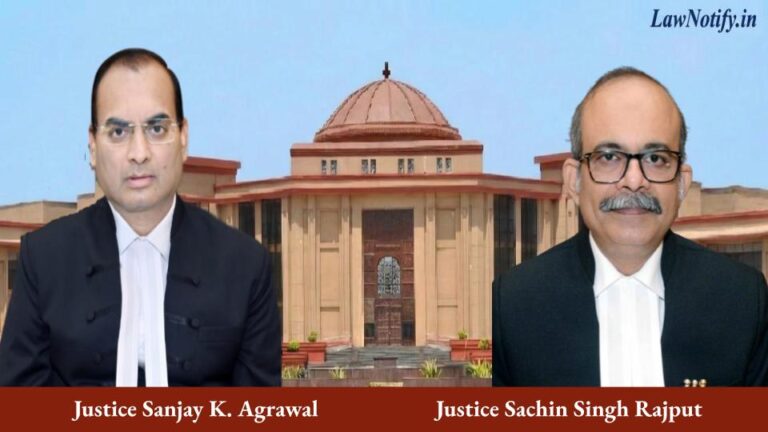
The Division Bench, comprising Justice Sanjay K. Agrawal and Justice Sachin Singh Rajput, delivered the judgment while hearing two connected appeals filed by both the husband and the wife against a Family Court order dated December 15, 2023.
The case arose from a divorce decree granted by the Family Court in Sakti, Chhattisgarh, where the husband’s petition under Section 13 of the Hindu Marriage Act, 1955 was allowed. Alongside the divorce, the court had awarded the wife ₹8 lakh as permanent alimony and an additional ₹6,000 per month as maintenance until remarriage.
Notably, both parties accepted the divorce itself and challenged only the financial aspects of the order. The husband argued that once a lump sum alimony had been granted, awarding monthly maintenance was legally impermissible. On the other hand, the wife contended that both the lump sum and monthly maintenance were insufficient and sought enhancement.
After examining the legal framework under Section 25 of the Hindu Marriage Act, the High Court focused on whether courts can simultaneously grant both forms of financial relief. The Bench observed that the provision allows either a lump sum payment or periodic maintenance, but not both at the same time.
Referring to the Supreme Court’s decision in Rakesh Malhotra v. Krishna Malhotra, the court emphasized that permanent alimony carries a degree of finality. Any subsequent changes in financial circumstances must be addressed through modification applications under Section 25(2) or 25(3), rather than by granting parallel remedies.
Applying this reasoning, the High Court held that the Family Court erred in awarding monthly maintenance after already granting permanent alimony. It ruled that the additional ₹6,000 monthly maintenance was unjustified and set aside that portion of the order.
However, the court also acknowledged the wife’s argument regarding the adequacy of the ₹8 lakh alimony. It noted that no formal application or detailed inquiry had been conducted before fixing the amount. As a result, the court granted liberty to the wife to seek enhancement of the alimony by filing a proper application before the Family Court.
The High Court directed that if such an application is filed, it must be decided within four months, in line with the Supreme Court’s guidelines in Rajnesh v. Neha, which stress a structured and evidence-based approach to maintenance determination.
Additionally, it was recorded that the husband had already deposited the ₹8 lakh alimony amount, and the wife is free to withdraw it. With these observations, both appeals were disposed of.
Case Reference : FA(MAT) No. 3 of 2024 (Tarachand Sahu vs. Smt. Akansha Sahu) and FA(MAT) No. 48 of 2024 (Smt. Akanksha Sahu vs. Tarachand Sahu); Counsel for Appellant/Husband: Mr. Ravindra Sharma, Advocate; Counsel for Respondent/Wife: Mr. K.K. Pandey and Mr. Rakesh Kumar Manikpuri, Advocates.