News Citation : LN (HC) 178 | 2026:CGHC:10718-DB
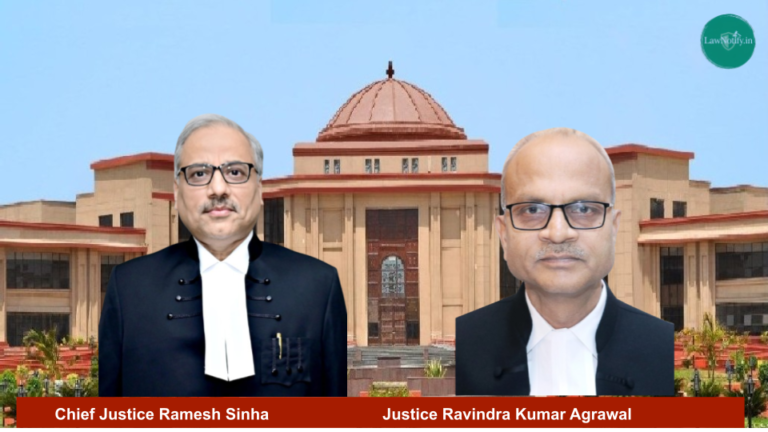
February 02, 2026 : The High Court of Chhattisgarh has ruled that once a trial court validly extends the period of investigation under the Unlawful Activities (Prevention) Act, 1967, the accused cannot claim default bail on completion of the initial 90-day period. The Division Bench of Chief Justice Ramesh Sinha and Justice Ravindra Kumar Agrawal dismissed an appeal challenging the extension of time granted to the investigating agency and the subsequent rejection of statutory bail.
The case arose from FIR No. 16/2022 registered at Police Station Amabeda in Kanker district, where the appellant, Ramesh Mandavi, was arrested on July 16, 2025. He was booked under provisions of the Indian Penal Code, the Arms Act, and several sections of the Unlawful Activities (Prevention) Act relating to alleged involvement in extremist activities. According to the prosecution, the investigation involved serious allegations connected to unlawful and insurgent operations in the Bastar region.
After his arrest, Mandavi was remanded to judicial custody. Under ordinary criminal procedure, an accused becomes entitled to “default bail” if the investigation is not completed within 90 days in serious offences. However, Section 43-D(2)(b) of the UAPA allows the court to extend this period up to 180 days if it is satisfied with a report from the Public Prosecutor indicating progress in the investigation and specific reasons for continued detention.
In this case, before the 90-day deadline expired on October 14, 2025, the Investigating Officer moved an application on October 7 seeking extension of time. The Special Judge (NIA Act), North Bastar, allowed the request and extended the investigation period to 180 days, that is, until January 6, 2026. When the accused later applied for default bail on the ground that 90 days had lapsed without filing of a charge sheet, the Special Judge rejected the plea, holding that the extension had already been granted within time.
Challenging both orders, the appellant argued before the High Court that the extension was granted mechanically and without strict compliance with statutory safeguards. It was contended that he was not physically produced before the court at the time of extension and that the Public Prosecutor had merely forwarded the Investigating Officer’s request without independent scrutiny. On this basis, it was argued that the extension was legally defective and that his right to default bail had crystallised upon expiry of 90 days.
The State opposed the appeal, submitting that the application for extension had been filed well before the deadline and was supported by a progress report detailing pending investigative steps, including arrest of absconding co-accused, ongoing search operations, and sanction under Section 45 of the UAPA. The prosecution also pointed out that the accused was represented through counsel at the time the extension was considered and that no objection had been raised then.
After examining the record, the High Court found that the Special Judge had perused the case diary and the progress report before granting the extension. The Bench observed that Section 43-D(2)(b) creates a statutory exception to the general rule governing default bail and permits enlargement of time up to 180 days, provided the court is satisfied with the prosecutor’s report. In the present case, the extension application was filed before expiry of the 90-day period and was allowed after consideration of the material placed on record.
On the issue of non-production of the accused, the Court noted that he was represented through counsel and that no objection had been raised at the relevant stage. In these circumstances, the Bench held that the extension order could not be treated as void or without jurisdiction.
The Court further clarified that the so-called “indefeasible right” to default bail arises only when the statutory period expires without a valid charge sheet or lawful extension. Since a valid extension to 180 days had already been granted before completion of the initial 90 days, no such right had accrued to the appellant. As a result, the rejection of the default bail application was found to be legally sound.
Concluding that there was no patent illegality or jurisdictional error in the orders passed by the Special Judge, the High Court dismissed the appeal. The ruling reinforces that in UAPA cases, timely and properly reasoned extensions under Section 43-D(2)(b) effectively enlarge the statutory investigation period and defer the accrual of any right to default bail.
Case Reference : CRA No. 2656 of 2025, Ramesh Mandavi v. State of Chhattisgarh; For the Appellant: Ms. Priyanka Shukla, Advocate; For the Respondent/State: Mr. Soumya Rai, Deputy Government Advocate.