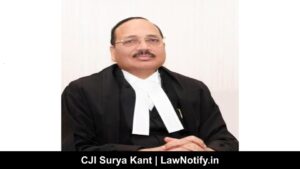
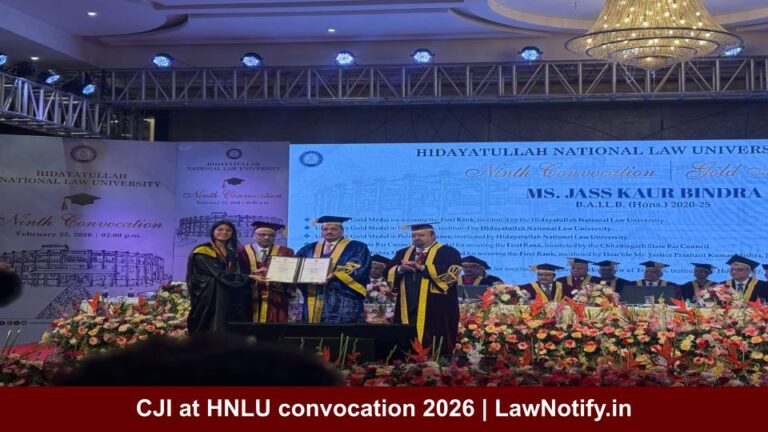
February 22, 2026 : The ninth convocation ceremony of Hidayatullah National Law University was held in a dignified and reflective setting, with CJI Surya Kant attending as the Chief Guest. Addressing the graduating batch, the Chief Justice spoke on the theme “Sustaining a Long and Fulfilling Legal Career,” urging young lawyers to embrace patience, continuous learning and a spirit of collaboration as the foundation of professional success.
Justice Surya Kant described a convocation not as the culmination of academic life, but as a transition into a far more demanding and self-directed phase. While university life is structured around syllabi and timelines, he observed, professional practice requires independent judgment and the courage to chart one’s own path. He congratulated the graduates, their parents and the faculty, calling the occasion a shared moment of pride for families and the institution alike.
Reflecting on campus life shaped by academic discussions, debates, sports and cultural engagement, he expressed confidence that these formative experiences would continue to guide students in their careers. He reminded them that the values learned within the university walls often prove as significant as technical knowledge.
Emphasising the importance of cooperation in the legal profession, the Chief Justice noted that although courtroom proceedings may appear adversarial, the justice delivery system ultimately functions on collective effort. Every argument placed before a court, he said, is the product of teamwork involving junior advocates, senior counsel, researchers and colleagues. The system, he added, rests on shared responsibility and a common commitment to upholding the rule of law.
Drawing an analogy to a great river formed by the confluence of many streams, Justice Surya Kant remarked that each member of the legal fraternity plays a role in sustaining the flow of justice. He advised students to treat peers and colleagues with respect and sensitivity, observing that today’s classmates could become future collaborators, opposing counsel or even members of the Bench.
Sharing a personal anecdote from his early years at the Bar, he recalled how extending professional guidance to a colleague led to a lasting association and friendship. In a profession that often spans decades, he said, gestures of goodwill rarely go unnoticed.
Describing law as a discipline that demands long-term commitment, the Chief Justice observed that reputation, experience and sound judgment are built gradually. Early progress may seem modest when compared to other professions, but the formative years lay the groundwork for sustained achievement. He advised graduates to measure their growth in years and decades rather than months.
Justice Surya Kant stressed that continuity, diligence and integrity ultimately define professional stature. Isolated successes may bring attention, he said, but enduring respect comes from consistent conduct and ethical commitment. He encouraged graduates to resist the temptation of instant success and instead cultivate intellectual curiosity and perseverance.
He also urged them to remain connected to the university community and support one another in their professional journeys, reminding them that time, when used wisely, becomes an ally in shaping both character and career.
On the occasion, Ramesh Sinha, Chief Justice of the High Court of Chhattisgarh and Chancellor of the university, conferred six Doctor of Philosophy degrees, eighty-eight Master of Laws degrees and one hundred and forty-eight Bachelor of Arts and Bachelor of Laws (Honours) degrees. In total, 242 students received their degrees in the presence of parents, faculty members and distinguished guests.