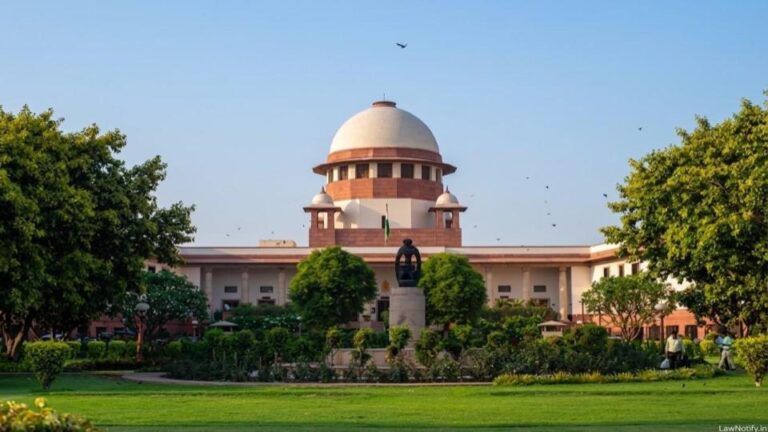
March 24, 2026 : The Supreme Court has held that a person belonging to the Scheduled Castes who converts to a religion other than Hinduism, Sikhism, or Buddhism ceases to retain SC status and cannot claim protection under the Scheduled Castes and Scheduled Tribes (Prevention of Atrocities) Act.
Upholding the judgment of the Andhra Pradesh High Court, a bench comprising Justice Prashant Kumar Mishra and Justice N.V. Anjaria ruled that conversion to Christianity results in the loss of Scheduled Caste status in view of Clause 3 of the Constitution (Scheduled Castes) Order, 1950.
The Court was dealing with an appeal filed by pastor Chinthada Anand, who had challenged the High Court’s decision quashing his complaint under the SC/ST Act. Anand had alleged that he was subjected to caste-based abuse, following which an FIR was registered. However, the accused sought quashing of the complaint on the ground that Anand had converted to Christianity and was serving as a pastor, thereby disentitling him from invoking the protections of the SC/ST Act.
The High Court accepted this contention and held that since Christianity does not recognise the caste system, a convert cannot claim SC status. Affirming this view, the Supreme Court observed that Clause 3 of the 1950 Order expressly limits Scheduled Caste status to persons professing Hinduism, Sikhism, or Buddhism.
The bench clarified that any person falling outside the ambit of Clause 3 cannot avail benefits, protections, or reservations meant for Scheduled Castes. It further noted that Anand, being a Christian pastor conducting prayer meetings at the time of the alleged incident, was not entitled to invoke the provisions of the SC/ST Act.
The Court also observed that mere possession of an SC certificate does not confer entitlement to benefits once a person has converted. While the validity of such a certificate may be examined, it cannot override the constitutional mandate under Clause 3 of the 1950 Order.