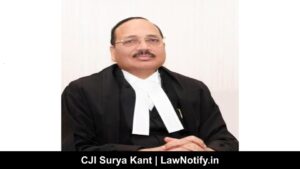
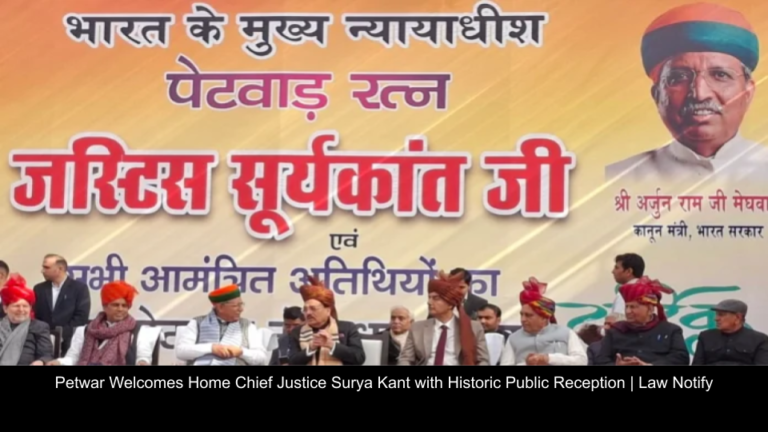
January 10, 2026 : Petwar, a modest agrarian village in Haryana’s Hisar district, turned into a centre of celebration as Justice Surya Kant, Chief Justice of India, arrived on a homecoming visit to his native place. This marked his first visit to the village after assuming the country’s highest judicial office, making the occasion both deeply personal and institutionally significant. The visit forms part of his two-day official programme in the region.
Villagers and local authorities accorded a traditional civic welcome to the Chief Justice at the government school where he received his early education. Born on February 10, 1962, Justice Kant studied at the village school during a time when it functioned with limited resources. His father, a Sanskrit teacher, is remembered locally for instilling academic discipline and strong ethical values, which many believe shaped Justice Kant’s early outlook on education and public life.
The homecoming celebrations are being attended by senior constitutional and executive figures, including Union Minister for Law and Justice Arjun Ram Meghwal and Haryana Chief Minister Nayab Singh Saini, along with villagers, students, and members of the legal fraternity.
The visit also reflects the Chief Justice’s continuing focus on strengthening judicial infrastructure at the grassroots. As part of his official engagements, Justice Kant laid foundation stones for sub-divisional judicial complexes at Narnaund and Barwala. These projects are aimed at improving trial-level infrastructure and enhancing access to justice. Such initiatives resonate with the constitutional emphasis on timely justice and equal access to legal remedies.
During his interactions with advocates and judicial officers at programmes organised by the Hisar and Hansi Bar Associations, Justice Kant reiterated that district and trial courts are the first point of contact between citizens and the justice delivery system. He stressed the need to reinforce these courts through better infrastructure, trained manpower, and technology-driven solutions such as e-filing, digital case management, and e-library facilities. He noted that the judiciary’s experience during the Covid-19 pandemic demonstrated how technology can ensure continuity and efficiency in judicial work.
The Chief Justice also spoke about the changing nature of litigation at the grassroots level, pointing to the rise in cybercrime, digital fraud, and technology-based offences. He observed that effective adjudication now requires familiarity with electronic evidence, forensic processes, and legal frameworks such as the Information Technology Act, 2000. He further highlighted the growing number of commercial disputes linked to economic expansion and foreign investment, underscoring the importance of capacity building under laws governing commercial courts and arbitration.
Security arrangements for the visit were reviewed by the district administration, with senior civil and police officials overseeing preparations to ensure smooth conduct of events. For the residents of Petwar, the Chief Justice’s return is being seen as a moment of shared pride and a powerful reminder that public education, institutional support, and merit can enable a journey from a rural village to the apex of the Indian judiciary.