 111
111 2
2 34
34 5
5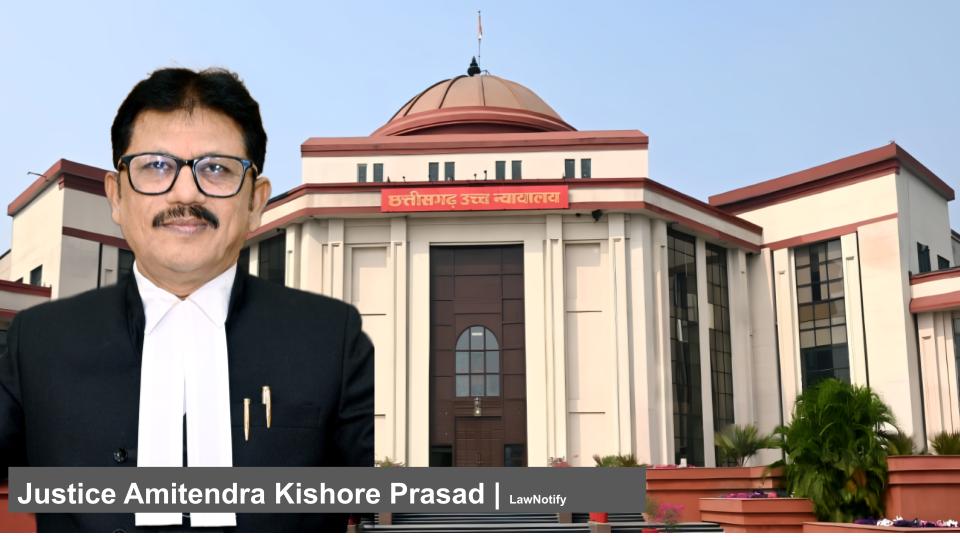 67
67 8
8 910
910
News Citation : 2026 LN (HC) 153 | 2026:CGHC:8244
February 16, 2026 : In a significant ruling delivered on February 16, 2026, the High Court of Chhattisgarh at Bilaspur upheld the conviction of three men in a 2004 case involving a late-night assault on a pregnant woman in Korba district. However, the Court reduced their jail sentence while increasing the fine amount to be paid as compensation to the victim.
The appeal arose from Sessions Trial No. 28/2004, in which the Sessions Judge, Korba, had convicted the accused under Sections 458 and 323 read with Section 34 of the Indian Penal Code. One of the original accused had died during the pendency of the appeal.
According to the prosecution, the incident took place around 2 am on May 26, 2004, in village Mudali under Police Station Kusumunda, district Korba. The victim, who was seven months pregnant at the time, was sleeping in the courtyard of her maternal uncle’s house.
The accused allegedly scaled the boundary wall, entered the courtyard, and assaulted her. The woman testified that she pleaded with them to stop, telling them she was pregnant. Despite this, she was beaten on the abdomen and became unconscious. Medical examination later revealed that the fetus had died in the womb.
An FIR was initially registered at Police Outpost Hardi Bazar and later formally recorded at Kusumunda Police Station. After investigation, a charge sheet was filed under Sections 458, 316, 323 and 304 IPC. The trial court ultimately convicted the accused under Sections 458 and 323 IPC, while acquitting them of the more serious charges.
Before the High Court, the defence argued that the accused had been falsely implicated due to a family property dispute. It was also contended that the courtyard did not constitute a “house” for the purpose of Section 458 IPC and that there was no evidence of preparation to cause hurt, a necessary ingredient of the offence.
The State countered that the testimony of the injured victim was consistent and supported by medical evidence and other witnesses. It was argued that the accused had entered the premises at night after scaling the wall and had carried weapons, clearly meeting the ingredients of house trespass by night with preparation for assault.
Justice Narendra Kumar Vyas examined the evidence in detail. The Court relied heavily on the testimony of the injured victim, observing that the evidence of an injured witness carries significant weight unless there are serious contradictions.
The Court found that the prosecution had successfully established that the accused trespassed into the courtyard at night and assaulted the victim. The presence of a stick, medical findings of contusions on the abdomen, and consistent witness statements were considered sufficient to prove the offence under Section 458 IPC.
On the issue of common intention under Section 34 IPC, the Court held that the participation of all accused was evident from the record. Their collective presence and conduct showed a shared intention to assault the victim. Accordingly, the High Court affirmed the conviction under Sections 458 and 323 read with Section 34 IPC.
While maintaining the conviction, the Court considered the long pendency of the case and the age of the surviving appellants, who are now in their 50s and 70s. Noting that this was their first offence and that they had not misused bail, the Court reduced the substantive sentence to one year of rigorous imprisonment for each appellant.
At the same time, the fine under Section 458 IPC was enhanced to ₹5,000 each, and under Section 323 IPC to ₹2,000 each. The total fine amount is to be paid to the victim as compensation under Section 357(3) of the Criminal Procedure Code. The appellants have been directed to deposit the amount within three months and surrender before the trial court to serve the remaining sentence.
The criminal appeal was thus partly allowed to the extent of modification in sentence, while the conviction stands affirmed.
Case Reference : CRA No. 378 of 2005, Antram and Others v. State of Chhattisgarh; Counsel for the Appellants: Mr. Vikash Kumar Pandey, Advocate; Counsel for the Respondent/State: Mr. Shailesh Puriya, Panel Lawyer.