March 01, 2026 : Iran awoke to shock and raw emotion on Sunday as state television announced that Supreme Leader Ayatollah Ali Khamenei had been killed in a U.S.-Israeli attack a day earlier. The broadcaster’s voice broke as the news was confirmed, marking the sudden end of a 36-year rule that shaped every facet of the Islamic Republic.
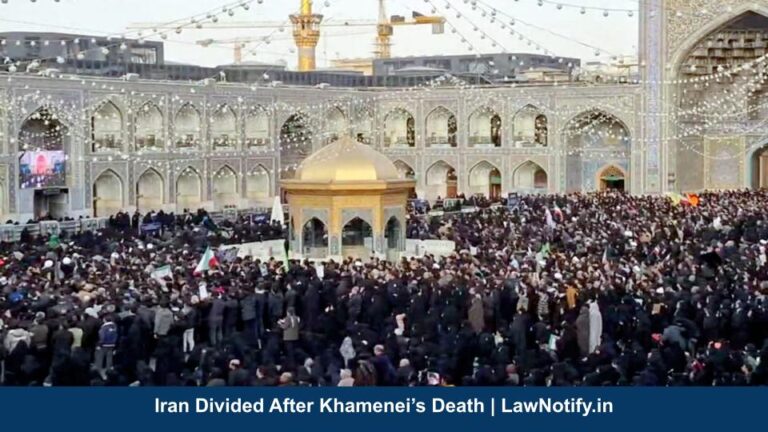
In Tehran, thousands gathered in black, filling public squares in grief. Many wept openly, some chanting vows of revenge against the United States and Israel. One mourner at a rally said the news had filled him with hatred and called for retaliation, insisting that “the blood of the leader” must be avenged. A woman speaking to reporters said she had prayed through the night that the reports were false, only to wake up to confirmation of his death.
But the response across the country was far from uniform.
In several cities, scenes of celebration unfolded. Videos circulating on social media showed crowds cheering as a statue was toppled in Dehloran in Ilam province. In Karaj, near Tehran in Alborz province, people danced in the streets. Similar scenes were reported in Izeh in Khuzestan province. In the southern town of Galleh Dar, a monument commemorating Ayatollah Ruhollah Khomeini, founder of the Islamic Republic in 1979, was pulled down. Flames rose from a traffic circle as onlookers clapped and shouted in disbelief. “Am I dreaming? Hello to the new world!” one man could be heard yelling.
Reuters said it had verified the locations of the videos.
Another clip showed residents in Lapuee celebrating outside the home of 15-year-old Pooya Jafari, who was shot dead during anti-government protests in January. The protests, which turned into the deadliest unrest since the 1979 Islamic Revolution, saw thousands killed in a sweeping crackdown.
Khamenei’s leadership spanned multiple waves of dissent, including student protests in 1999 and 2002, the disputed election unrest of 2009, and the 2022 “Woman, Life, Freedom” movement triggered by the death of a young woman in morality police custody. While his supporters viewed him as a symbol of resistance and stability, critics saw him as the face of repression.
A 33-year-old woman in Isfahan told Reuters she cried with a mix of joy and disbelief when she heard the news. She later joined others dancing in the streets, saying she hoped his death would mark the end of the Islamic Republic. She declined to give her name for fear of reprisal.
Not everyone opposed to the government welcomed the manner of his death. Atousa Mirzade, a primary school teacher in Shiraz, said she could not celebrate the killing of the country’s leader by a foreign power. She feared instability and compared the situation to Iraq’s descent into chaos after regime change. “I would prefer the Islamic Republic to that situation,” she said.
In Mashhad, 21-year-old university student Hossein Dadbakhsh vowed revenge. Speaking by phone, his voice shaking, he said he was ready to sacrifice his life for Islam and for his leader. He warned that Israel and former U.S. President Donald Trump would pay a heavy price.
Trump, who announced the attack on Saturday, had urged Iranians to seize the moment to topple their government.
The sharply contrasting reactions reveal a country deeply polarized. For some, Khamenei’s death represents an opening for profound political change. For others, it is a national tragedy and a call to confrontation. What happens next may determine whether Iran moves toward upheaval, reform, or further consolidation of power in a moment already charged with uncertainty. – Reuters