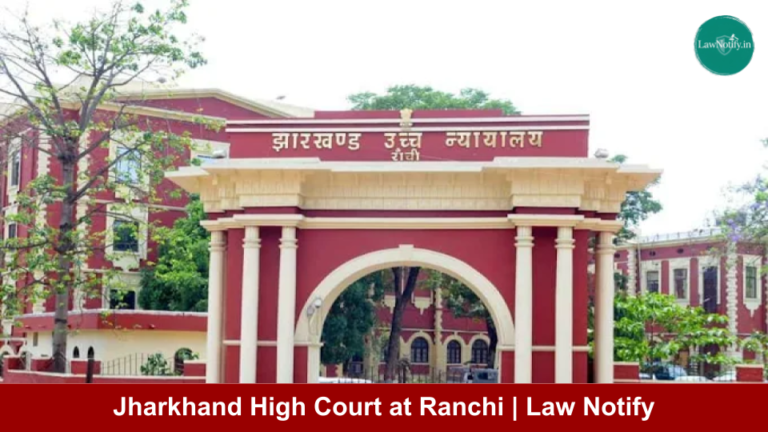
News Citation : 2026 LN (HC) 31
Ranchi, January 05, 2026 : The Jharkhand High Court has delivered a significant ruling on the scope of the State’s power to levy electricity duty, striking down key amendments that had sharply increased the financial burden on industrial and captive power consumers across the State. In a detailed judgment pronounced on January 5, 2026, a Division Bench headed by the Chief Justice held that the Jharkhand Electricity Duty (Amendment) Act, 2021 and the related Rules could not lawfully change the basis of taxation without amending the charging provision of the parent law.
The batch of writ petitions was filed by a wide range of industries, manufacturing units, captive power producers and trade associations, all challenging the 2021 amendments to the Bihar Electricity Duty Act, 1948 as applicable to Jharkhand. Prior to the amendment, electricity duty was levied at a fixed rate per unit of electricity consumed or sold. The 2021 changes replaced this system with a levy calculated as a percentage of “net charges” for electricity, leading to steep increases in duty payable by high-tension consumers and captive power plants.
Petitioners argued that this shift from a unit-based levy to a value-based levy was unconstitutional because the charging section of the 1948 Act permitted duty only on units of electricity. They also contended that the term “net charges” was undefined, giving excessive discretion to the executive and creating uncertainty and arbitrariness in tax computation. In several cases placed before the Court, industries demonstrated that their electricity duty liability had increased by nearly ten to fifteen times after the amendment.
The Court accepted the core of these arguments, holding that a taxing statute must clearly specify the taxable event and the measure of tax. It ruled that the State could not introduce an entirely new basis of levy through the Schedule or delegated legislation without first amending the charging section itself. The Bench further found that empowering the executive to alter rates and categories without clear legislative guidance amounted to excessive delegation and violated constitutional principles.
On the retrospective application of the Jharkhand Electricity Duty (Amendment) Rules, 2021, the Court held that the State lacked authority to give the Rules retrospective effect, particularly when they imposed a new liability by explaining and operationalising the concept of “net charges”. The judgment made it clear that subordinate legislation cannot travel beyond the scope of the parent Act.
The Court also examined the position of captive power producers, noting that the concept of “net charges” was inherently unworkable for units generating electricity for their own consumption. Although the State later attempted to correct this by introducing a second amendment reverting captive consumers to a per-unit levy, the Bench expressed concern over the tenfold increase in the duty rate from five paise to fifty paise per unit, describing it as arbitrary in the absence of any stated rationale.
As a consequence of these findings, the High Court declared the impugned provisions of the 2021 amendment and the associated Rules ultra vires. It further held that amounts collected under the invalid levy could not be sustained in law, opening the door for refund claims by affected consumers, subject to applicable legal principles.
The ruling is expected to have far-reaching implications for industrial taxation in Jharkhand, particularly for energy-intensive sectors, and serves as a reminder that fiscal policy, however pressing the revenue considerations, must remain within the bounds of legislative competence and constitutional discipline.
Case Reference: W.P.(T) No. 3228 of 2021 (Pali Hill Breweries Private Limited, Ranchi vs State of Jharkhand and Others), along with W.P.(T) Nos. 3374 of 2021, 3499 of 2021, 3734 of 2021, 3829 of 2021, 4035 of 2021, 4077 of 2021, 4108 of 2021, 4968 of 2021, 5429 of 2021, 120 of 2022, 409 of 2022, 411 of 2022, 433 of 2022, 434 of 2022, 435 of 2022, 436 of 2022, 437 of 2022, 447 of 2022, 454 of 2022, 552 of 2022, 553 of 2022, 554 of 2022, 555 of 2022, 687 of 2023, 5053 of 2024 and 3795 of 2025; Counsels for the Petitioners: Mr. M.S. Mittal, Senior Advocate; Mr. Kavin Gulati, Senior Advocate; Mr. Bharat Rai Chandani, Advocate; Mr. Salona Mittal, Advocate; Ms. Lavanya Gadodia Mittal, Advocate; Mr. Yashdeep Kanhai, Advocate; Ms. Divya Choudhary, Advocate; Miss Amrita Sinha, Advocate; Mrs. Shweta Suman, Advocate; Miss Pragunee Kashyap, Advocate; Mr. Indrajit Sinha, Advocate; Ms. Sweta Rani, Advocate; Mr. Ankit Vishal, Advocate; Mr. Deepak Kr. Sinha, Advocate; Mr. Vikas Pandey, Advocate; Mr. Omkar Sharma, Advocate; Mr. Piyush Poddar, Advocate; Mr. Janak Kumar Mishra, Advocate; Counsels for the State: Mr. Sachin Kumar, AAG-II; Mr. Gaurav Raj, AC to AAG-II; Mr. Srikant Swaroop, AC to AAG-II; Mr. Ashwini Bhushan, AC to Sr. SC-II; Mr. Gaurang Jajodia, AC to G.P.-II; for DVC: Mr. Srijit Choudhary, Advocate; Mr. Sanjoy Piprawall, Advocate; Mr. Prince Kumar, Advocate; for JUVNL: Mr. Ashok Kr. Yadav, S.C.; Mr. Aditya Kumar, Advocate; for TSUISL: Mrs. Varsha Ramsisaria, Advocate.