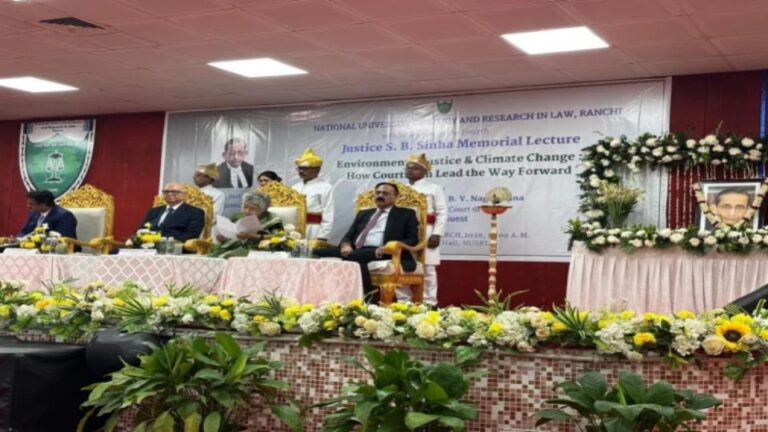
March 28, 2026 : Paying tribute to Justice Satya Brata Sinha, Justice B.V. Nagarathna on Saturday underscored the judiciary’s critical role in safeguarding constitutional values, particularly in times of governance failure. Delivering the 4th Endowment Lecture in honour of Justice Sinha at the National University of Study and Research in Law (NUSRL), Ranchi, she emphasized that courts must engage in principled interpretation to ensure accountability and uphold the rule of law.
Justice Nagarathna observed that Justice Sinha viewed the judiciary not merely as an adjudicatory body but as an institution capable of guiding the constitutional order when other branches fall short. The lecture, titled “Environmental Justice and Climate Change: How Courts Can Lead the Way Forward,” traced the evolution of environmental jurisprudence in India.
She noted that while the Constitution of 1950 did not explicitly address environmental protection, its scope expanded with the introduction of Articles 48A and 51A(g) through the 42nd Amendment in 1976. These provisions placed a duty on both the State and citizens to protect and improve the environment. Over time, the Supreme Court of India interpreted Article 21 to include the right to a clean and healthy environment.
Referring to landmark rulings such as MC Mehta v. Kamalnath, Subhash Kumar v. State of Bihar, TN Godavarman v. Union of India, Lafarge Umiam Mining Pvt. Ltd. v. Union of India, and MK Ranjitsinh v. Union of India, she highlighted how the judiciary developed foundational environmental principles. These include sustainable development, the polluter pays principle, the precautionary principle, the public trust doctrine, and intergenerational equity. These principles have also been reflected in statutory frameworks like the National Green Tribunal Act, 2010.
Justice Nagarathna emphasized that environmental justice must be understood within a broader framework of social justice. Environmental harms disproportionately affect marginalized communities, making equity, fairness, and democratic participation essential components of environmental governance. She stressed the importance of transparency, access to information, and inclusive decision-making processes.
The lecture also addressed the intersection of environmental protection with development goals and international commitments such as the Paris Agreement. Rejecting the artificial divide between humans and nature, she remarked that “humans are a part of nature, not apart from it.” Legislative measures like the National Forest Policy, 1988 and the Scheduled Tribes and Other Traditional Forest Dwellers (Recognition of Forest Rights) Act, 2006 were cited as examples of this integrated approach.
She also cautioned against unintended environmental consequences of development measures, noting that infrastructure expansion can increase consumption and ecological strain. Questioning the term “natural disasters,” she pointed out that human actions often intensify environmental vulnerabilities, citing urban flooding in cities such as Bengaluru.
On judicial leadership, Justice Nagarathna called for innovative and context-sensitive approaches. Describing environmental law as dynamic and evolving, she stressed that courts must adopt precautionary and forward-looking reasoning. She outlined three guiding principles: context-sensitive adjudication, principled balancing of competing interests, and, where necessary, declaring ecologically fragile areas as inviolable.
Addressing corporate responsibility, she remarked that economic activity must carry social and environmental obligations. Referring to Corporate Social Responsibility under Section 135 of the Companies Act, 2013, she emphasized accountability in sectors such as mining and infrastructure.
Drawing from Justice Sinha’s legacy, she concluded that environmental justice is both a legal and moral imperative, requiring the present generation to act as trustees of the Earth for future generations.
The lecture was attended by Justice M.S. Sonak, Vice-Chancellor Prof. (Dr) Ashok R. Patil, members of the faculty, researchers, students, and other dignitaries.