
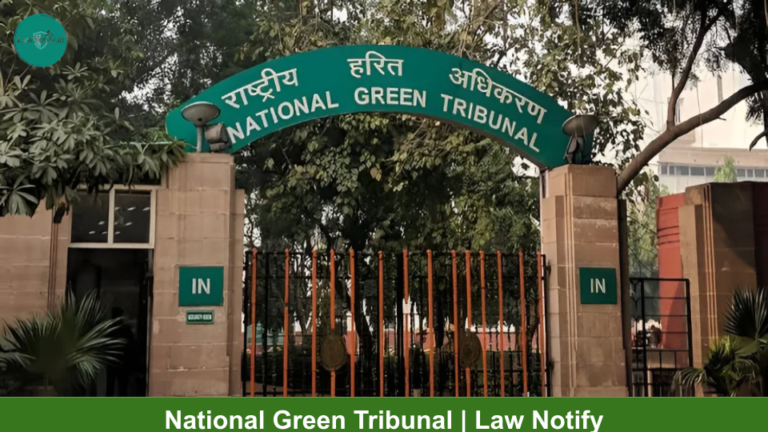
February 24, 2026 : The National Green Tribunal (NGT) has disposed of a case concerning alleged illegal felling of trees in the Taj Trapezium Zone (TTZ) area of Agra after authorities confirmed that action had already been taken against the offenders and penalties had been recovered.
The matter came before the tribunal through a letter petition sent by Manoj Jurail, who alleged that more than 100 green trees had been illegally cut in Hazuri Bagh at Dayalbagh in Agra between July 2023 and June 2024. According to the complaint, the trees included species such as neem, peepal, banyan, jamun and sheesham. The petitioner also submitted photographs showing cut branches, stumps and partially felled trees, claiming that the wood had been removed and sold.
The applicant further stated that complaints had earlier been made to the Chief Conservator of Forest in Agra and through the Chief Minister’s grievance portal, but no effective action had been taken. The petition also referred to Supreme Court directions governing the Taj Trapezium Zone, which prohibit tree felling without permission of the competent authority.
Taking cognisance of the letter, the NGT registered the matter as an original application and directed the Divisional Forest Officer in Agra to inspect the site and submit a fact-finding report.
The report submitted by the Divisional Director of the Social Forestry Division in Agra revealed that a field inspection had found evidence of illegal felling of 26 trees, not the more than 100 claimed in the complaint. The trees included species such as neem, eucalyptus, papdi, banyan, mango and jamun.
Following the inspection, forest authorities initiated legal proceedings under Sections 4 and 10 of the Uttar Pradesh Protection of Trees Act, 1976 against an individual identified as Satya Nidhaan Mukherji, a resident of Swamibagh in Dayalbagh. Departmental cases were registered in June and December 2024.
During a joint inspection conducted on November 27, 2025 with the complainant and representatives of Radha Soami Satsang, officials found no evidence of fresh tree felling. However, old stumps and timber pieces were present at the site. Statements recorded from the representatives acknowledged the violations and indicated their willingness to pay the prescribed penalty.
Authorities subsequently seized the recovered timber and imposed a compounding fee of ₹10,000 per tree in accordance with Supreme Court directions in the M.C. Mehta case relating to environmental protection in the Taj Trapezium Zone. A total penalty of ₹2,60,000 was deposited in December 2025.
In addition, ₹4,74,500 was deposited for compensatory afforestation. The forest department has planned to plant 260 saplings as part of the restoration effort and maintain them for five years.
After reviewing the report and noting that penalties had been recovered and afforestation measures initiated, the NGT bench comprising Judicial Member Justice Arun Kumar Tyagi and Expert Member Ishwar Singh concluded that no further action was required in the case.
The tribunal directed the Social Forestry Division in Agra to utilise the deposited funds for compensatory plantation during the upcoming monsoon season. It also ordered that the newly planted trees be geo-tagged and their survival documented. A compliance report must be submitted to the tribunal by September 30, 2026.
With these directions, the tribunal disposed of the original application.
Case Reference : Original Application No. 467/2025, Manoj Jurail vs State of Uttar Pradesh & Others; Counsels: None appeared for the applicant; Mr. Bhanwar Pal Singh Jadon, Ms. Disha Tiwari, Ms. Gargi Chaturvedi, Mr. Shivansh Sharma and Ms. Anjali Sharma appeared for Respondents No. 1 to 4, and Mr. Aditya Singh appeared for Respondent No. 5.