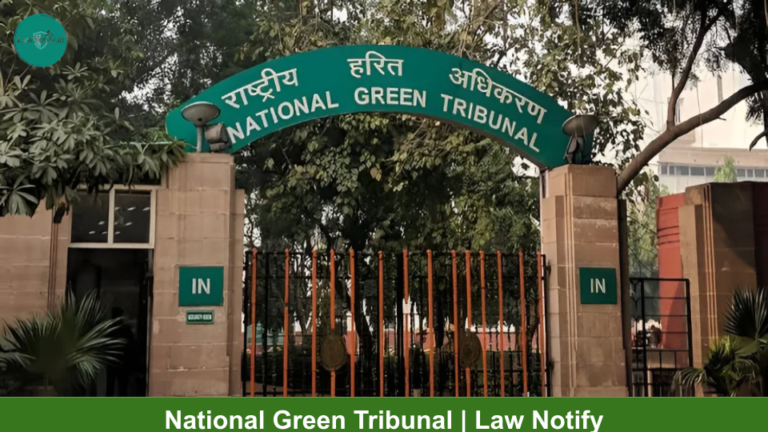
Law Notify : Taking suo motu cognisance of a newspaper report highlighting widespread illegal plastic recycling and severe public health risks in Bhopal, the National Green Tribunal, Central Zone Bench, has issued sweeping directions to the Madhya Pradesh Government, pollution control authorities, and municipal bodies to strictly enforce plastic waste management laws and curb the growing menace of multi-layered plastic and microplastics.
The order was passed by a Bench comprising Justice Sheo Kumar Singh, Judicial Member, and Sudhir Kumar Chaturvedi, Expert Member, while dealing with Original Application No. 189/2025 (CZ). The Tribunal acted on a report published by a local daily on 14 December 2025, which exposed the alarming conditions in Bhopal’s scrapyard or “junkyard” area, where more than 50 plastic recycling units were allegedly operating illegally within densely populated residential neighbourhoods.
The Tribunal noted that although single-use plastic has been officially banned in Bhopal since 2022, enforcement on the ground remains weak. Polythene carry bags, disposable cups, and plates continue to be widely used across markets, hotels, and roadside eateries. According to the report placed before the Tribunal, nearly 10 to 12 tonnes of plastic waste reach municipal transfer stations and the Adampur Cantonment every day, while a similar quantity is diverted to scrap yards where it is recycled illegally.
The Bench recorded that the junkyard area, which is otherwise known for second-hand automobile parts, has effectively turned into an unregulated plastic processing hub. Narrow lanes are choked with heaps of plastic waste, and machines converting discarded plastic into granules operate openly. These granules are then transported to industrial areas within Madhya Pradesh and other parts of the country for manufacturing polythene and related products. The Tribunal was particularly concerned by reports of frequent fires in the area, sometimes occurring twice a week, with thick smoke from burning plastic significantly degrading air quality. The congested layout often prevents fire tenders from reaching the site in time.
The order also highlighted the parallel and largely unchecked dismantling of electronic waste. Old mobile phones, laptops, and other electronic items are broken down in the same area to extract valuable metals, releasing hazardous gases and compounding the health risks faced by nearly two lakh residents living nearby.
Referring to a study conducted by the Automotive Research Association of India at the instance of the Pollution Control Board, the Tribunal noted that PM10 levels near the scrapyard had touched 225, among the highest recorded in Bhopal. Despite repeated complaints by residents about pollution and health problems, civic authorities were alleged to have failed to take effective action.
In a detailed legal analysis, the Tribunal examined the Plastic Waste Management Rules, 2016 and subsequent amendments, with particular focus on the regulation of multi-layered plastic packaging and the concept of Extended Producer Responsibility. The Bench observed that most MLP is non-recyclable, non-energy recoverable, and has no viable alternative use. It expressed concern that the 2018 amendment to Rule 9(3), which diluted the original mandate to phase out non-recyclable MLP within two years, has been misused by producers to continue large-scale use of such packaging without meaningful recovery.
The Tribunal underlined that there is no effective mechanism to ensure that producers actually retrieve MLP waste from the market, despite clear statutory obligations. It warned that burning plastic and MLP releases highly toxic and carcinogenic substances such as dioxins, furans, and mercury. While acknowledging that scientific research on microplastics is still evolving, the Bench held that the environmental and public health risks posed by plastic and microplastic pollution are serious and cannot be ignored.
In view of the gravity of the situation, the Tribunal directed impleadment of the State of Madhya Pradesh, the Madhya Pradesh Pollution Control Board, the Bhopal Municipal Corporation, and the Collectors and Municipal Corporations of Indore, Jabalpur, Gwalior, Rewa, and Ujjain. Among the key directions issued, the Bench ordered immediate steps to substitute non-degradable plastic used in MLP packaging with biodegradable alternatives, and called upon the Ministry of Environment, Forest and Climate Change to promote technologies for aluminium extraction from plastic foils and value-added reuse of MLP waste.
Municipal bodies in major cities were instructed to review and strengthen existing plastic waste disposal facilities. Recognised laboratories were directed to conduct biannual monitoring of drinking water supplies and wetlands for the presence of microplastics. The Tribunal also ordered strict action to shut down or relocate illegal plastic recycling units to designated industrial zones away from residential areas, keeping public safety in mind.
To ensure sustained oversight, the Tribunal directed the constitution of State-level and District-level monitoring committees to supervise plastic waste management and compliance with the rules. Replies have been sought from the concerned authorities within six weeks, and detailed Action Taken Reports are to be filed within four weeks thereafter, underscoring the urgency of coordinated and time-bound action to address the escalating plastic pollution crisis in Madhya Pradesh.