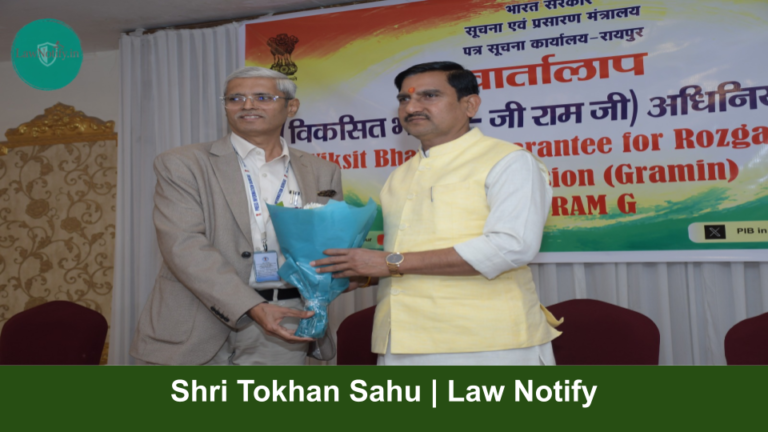
Bilaspur :A one-day regional media workshop titled Vartaalap was organized in Bilaspur under the Ministry of Information and Broadcasting, Government of India. The event focused on explaining the scope and implementation of the Viksit Bharat–Guarantee for Employment and Livelihood Mission (Gramin), popularly known as the VB-GRAM G Act, 2025.
The workshop was attended by Tokhan Sahu, Union Minister of State for Housing and Urban Affairs, as the Chief Guest. Addressing journalists and officials, he said the dream of a developed India can only be achieved by empowering villages and placing them at the centre of development planning and accountability.
The Minister explained that the VB-GRAM G Act, 2025 is not just an employment scheme but a comprehensive framework aligned with the vision of Viksit Bharat. He said the Act aims to eliminate middlemen, strengthen Direct Benefit Transfer, and vest real decision-making authority in Gram Sabhas.
Under the new framework, assured wage employment has been increased from 100 to 125 days per financial year, with wages to be paid on a weekly basis. The mission prioritizes the creation of durable and productive assets, including water conservation works and rural infrastructure, to enhance income security for the poorest households.
Referring to the national roadmap, Shri Sahu said the initiative draws inspiration from Narendra Modi’s vision of Viksit Bharat @2047. Gram Panchayats will be classified into A, B, and C categories based on development indicators and integrated with the PM Gati Shakti Mission to ensure coordinated planning across departments.
During the workshop, Anuradha Shukla, Assistant Project Officer (MGNREGA), Zila Panchayat Bilaspur, said the VB-GRAM G Mission would mark a major step toward income security in rural areas. She highlighted that the enhanced employment guarantee represents a 25 percent increase and emphasized the focus on water security, rural connectivity, and transparency through AI-based and GPS-enabled monitoring systems.
A technical presentation outlined the use of digital attendance, geo-tagging, biometric authentication, and artificial intelligence to prevent leakages and ensure accountability. The administrative fund cap has also been raised from 6 percent to 9 percent to strengthen implementation and capacity building.
The program concluded with an interactive session where journalists raised questions on regional development priorities and the rollout of the Act in Chhattisgarh. The workshop helped bridge information gaps and reinforced cooperation between the media and the administration for inclusive rural growth.