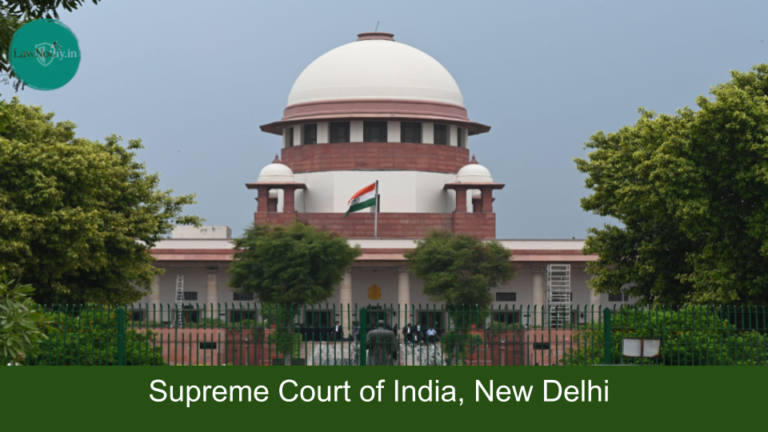
The Supreme Court has held that a candidate cannot be rejected solely because their postgraduate degree title does not explicitly mention the requisite subject, if that subject formed a principal part of their curriculum. The Court said that insisting only on degree nomenclature elevates form over substance.
A Bench of Justice Sanjay Karol and Justice Vipul M. Pancholi allowed the appeal filed by Laxmikant Sharma, overturning the Madhya Pradesh High Court decision that upheld the termination of his contractual employment as Monitoring and Evaluation Consultant with the Water Support Organization under the Public Health and Engineering Department.
The department’s advertisement required a postgraduate degree in Statistics with at least 60 percent marks. Sharma held an M.Com degree completed in 1999 that included Business Statistics and Indian Economic Statistics as principal subjects. He was appointed in 2013 after verifying his credentials but was later terminated relying on a committee report claiming he lacked the required qualification.
Multiple court proceedings followed, during which two key documents came on record: a university certificate confirming he studied Statistics as a principal subject, and an expert opinion from the department’s Director confirming he met the eligibility criteria and recommending reinstatement. Despite this, the State again terminated his services, and the High Court upheld the decision stating that he lacked a degree bearing the word Statistics.
Before the Supreme Court, the appellant argued that no government university in Madhya Pradesh offers a postgraduate degree titled “Statistics,” and that rejecting him based on nomenclature was arbitrary. The State argued that the terms of the advertisement were clear and courts cannot expand prescribed qualifications.
The Supreme Court found the committee report flawed, noting that it was issued without hearing the appellant and contradicted by later documentary proof. It said that examining only the degree title without evaluating curriculum is unreasonable. The Court also pointed out that similarly qualified candidates remained in service and the State offered no rational reason for differential treatment.
The Court emphasized that even in contractual appointments, State actions must satisfy fairness under Article 14. Once expert authorities certified eligibility, the State could not disregard it arbitrarily.
The Court set aside the High Court judgment and directed restoration of Sharma’s service within four weeks with all consequential benefits, clarifying that the ruling is confined to the facts of this case.
Case: Laxmikant Sharma v. State of Madhya Pradesh & Ors., Civil Appeal from SLP(C) No. 18907 of 2025