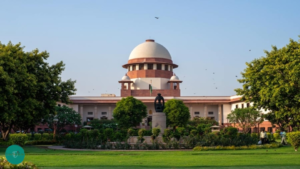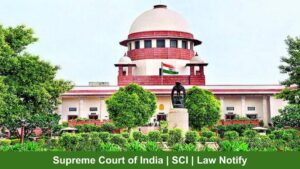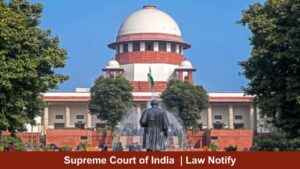
The Supreme Court has clarified that judicial officers already serving in any state judiciary will not need to fulfill the mandatory three-year bar practice requirement when applying for judicial services in other states, provided they have completed at least three years in their current post. The clarification came during proceedings in the long-running All India Judges Association matter.
A bench led by the Chief Justice of India, sitting with Justice K. Vinod Chandran, delivered the clarification while hearing applications linked to Writ Petition (Civil) No. 1022 of 1989, filed by the All India Judges Association and others. These applications stemmed from directions issued in the Court’s judgment dated May 20, 2025, which had made three years of bar practice compulsory for candidates seeking appointment as Civil Judge, Junior Division.
The bench examined the case of an applicant who had enrolled provisionally with the Bar Council of Delhi on July 28, 2018 and immediately applied for judicial service posts in multiple states, since there was no requirement of prior bar practice at that time. She was selected for the Madhya Pradesh Judicial Service and appointed as a Civil Judge (Entry Level) on November 19, 2019, and continued applying for similar posts elsewhere.
The Court acknowledged that although she has served as a judicial officer for six years, she does not meet the three-year advocate practice requirement because it did not exist when she entered service. Recognizing the unique circumstances, the bench held that the mandatory practice requirement would not apply to her.
To ensure clarity for all similarly placed officers, the Court ruled that judicial officers appointed before the May 20, 2025 judgment will be exempt from the bar practice condition when applying to other state judicial services, provided they complete at least three years of service where they are presently posted. This condition ensures adequate experience before lateral movement.
The bench also addressed issues related to the absorption and regularization of e-Courts technical staff. Senior Advocate Gopal Sankaranarayanan informed the Court that 14 High Courts have already implemented such measures. The Court directed all remaining States, Union Territories, and High Courts to file affidavits within six weeks. The Registrar has been instructed to circulate the order to Chief Secretaries, Administrators of States and UTs, and Registrars General of all High Courts.
Case Title: All India Judges Association & Others vs. Union of India & Others
Case Details : Writ Petition(s)(Civil) No(s). 1022/1989, ALL INDIA JUDGES ASSOCIATION & ORS. Petitioner(s) vs UNION OF INDIA & ORS. Respondent(s)