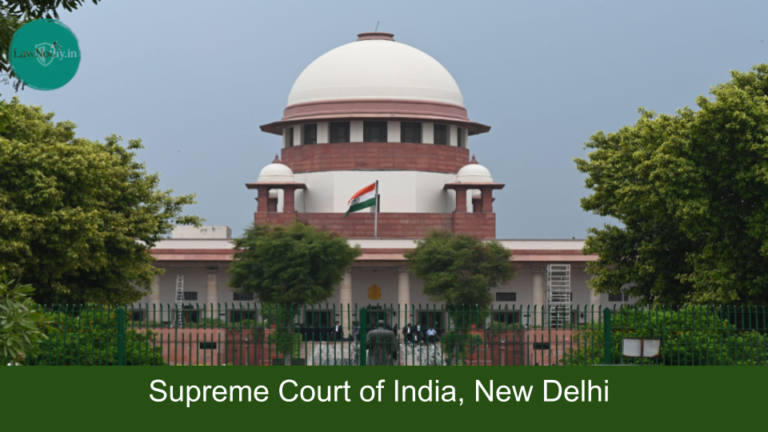
The Supreme Court has ruled that when the compensation for acquired land is decided through a negotiated agreement, that agreement is final and binding. Landowners cannot later turn to other legal provisions to claim extra money. This decision came in an appeal against a Madras High Court order that had allowed landowners to receive interest under Section 12 of the Tamil Nadu Land Acquisition Laws (Revival of Operation, Amendment and Validation) Act, 2019, even though both sides had already signed a compensation agreement under Section 7(2) of the Tamil Nadu Acquisition of Land for Industrial Purposes Act, 1997.
A bench led by Justice M. M. Sundresh and Justice Nongmeikapam Kotiswar Singh noted that once parties voluntarily choose to fix compensation through an agreement, the agreement takes the place of statutory procedures. The Court explained that the law allows compensation to be settled by mutual consent and that once such an agreement is signed, the amount must be paid exactly as agreed. Because the agreement replaces the usual statutory process, neither party can later fall back on legal provisions meant for cases where there is no agreement. According to the bench, the agreement becomes conclusive, and the connection to other statutory remedies or modes of calculation is effectively cut off.
The dispute traces back to land that had been leased to the government many years earlier. When the land eventually became part of acquisition proceedings, disagreements emerged over compensation and unpaid rent. Both sides eventually settled on a compensation rate through a negotiated agreement under Section 7(2), which was mutually accepted. The landowners later attempted to seek additional amounts by invoking Section 12, arguing that they were entitled to interest from the date the government took possession of the land. The High Court partially accepted this claim and directed the State to pay interest for a defined period. This prompted the government to appeal to the Supreme Court.
While examining the issue, the Supreme Court stressed that a party cannot accept compensation under a contract and later try to use statutory remedies that contradict the terms of that contract. The judges referred to earlier rulings, including Union of India v. N. Murugesan, to reinforce the principle that a person cannot enjoy the benefits of an agreement and later challenge its terms. The Court also referred to several other decisions, such as Ranveer Singh, Sangappa Dyavappa Biradar, NOIDA Industrial Development Authority v. Ravindra Kumar, and State of Gujarat v. Daya Shamji Bhai, all of which affirm that once compensation is accepted through a consent-based mechanism, the option to seek any statutory enhancement is extinguished.
The bench also noted that the agreement in this case was neither forced nor fraudulent. The landowners had willingly accepted a rate that was higher than the guideline value, which made their later demand for extra payment legally untenable. The Court made it clear that a writ court cannot alter or escape a concluded agreement by using its jurisdiction under Article 226, and found the High Court’s approach legally incorrect.
In the final outcome, the Supreme Court set aside the Madras High Court order. It held that the agreement under Section 7 was complete in itself and left no room for further claims, including interest under Section 12. The appeals filed by the State were allowed, and the landowners’ demand for additional payment was rejected.
The case, titled Government of Tamil Nadu and Others v. P. R. Jaganathan and Others, saw Senior Advocate Dr. Abhishek Manu Singhvi appear for the appellants, while Additional Solicitor General Aishwarya Bhati and Senior Advocate S. Nagamuthu represented the respondents.