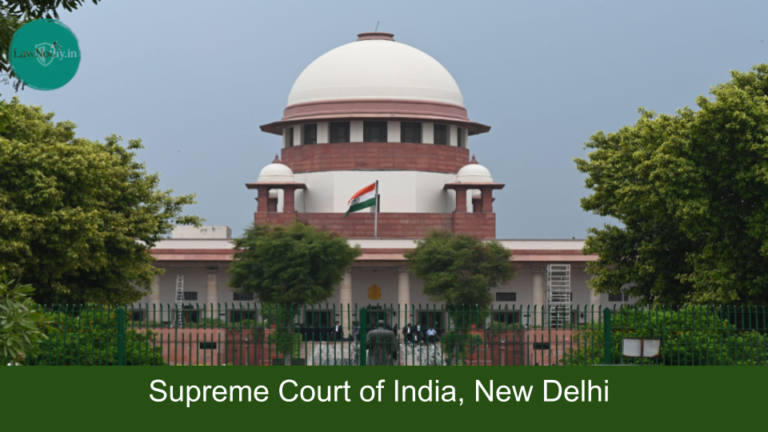
The Supreme Court has delivered an important ruling holding that the Rajasthan Government acted arbitrarily and unconstitutionally in creating two revenue villages named after individuals, in clear violation of its own 2009 policy circular. The Court held that such action breached Article 14 of the Constitution and could not be sustained in law.
The judgment was delivered by a Bench comprising Justice Alok Aradhe and Justice Sanjay Kumar while allowing a civil appeal challenging a decision of the Rajasthan High Court’s Division Bench. The High Court had earlier overturned a Single Judge order that had quashed the creation of two revenue villages named “Amargarh” and “Sagatsar” in Barmer district.
The controversy arose from a proposal by Gram Panchayat Sohda for the creation of new revenue villages carved out of Meghwalon Ki Dhani. On December 24, 2020, the Tehsildar, Gida, issued certificates stating that he had personally verified all relevant aspects and that the proposed villages were not connected with any individual, religion, caste or community, and that there was no dispute regarding their formation.
On the same day, affidavits were executed by Amarram and Badli Kunwar, the wife of Sagat Singh, offering to donate land for villages proposed to be named Amargarh and Sagatsar. Acting on these proposals, the State Government issued a notification dated December 31, 2020, under Section 16 of the Rajasthan Land Revenue Act, 1956, creating several new revenue villages, including the two in question.
Objections were subsequently raised on April 21, 2025, by villagers of Meghwalo Ki Dhani, who pointed out that the names Amargarh and Sagatsar were derived from the names of individuals. The appellants approached the High Court challenging the notification. A Single Judge, relying on earlier decisions in Moola Ram v. State of Rajasthan and Joga Ram v. State of Rajasthan, held that naming revenue villages after individuals violated the government policy and quashed the notification, while granting liberty to rename the villages.
However, the Division Bench set aside this decision, holding that the benefit of earlier judgments could not be extended as the process was not pending at the relevant time. This prompted the appellants to approach the Supreme Court.
Before the Supreme Court, the appellants argued that the Division Bench ignored the binding nature of the Revenue Department’s circular dated August 20, 2009, which expressly prohibited naming revenue villages after any person, religion, caste or sub-caste. The State contended that the circular was merely directory and that the statutory procedure under the Land Revenue Act had been followed. The private respondents also questioned the locus standi of the appellants.
Examining Section 16 of the Rajasthan Land Revenue Act alongside the 2009 circular, the Supreme Court laid particular emphasis on Clause 4 of the circular, which mandates that the name of a revenue village must not be based on any individual and should be decided with general consensus. The Court observed that the circular represented a policy decision intended to preserve communal harmony.
Reiterating settled principles of administrative law, the Court held that policy decisions, though executive in nature, are binding on the Government unless lawfully amended or withdrawn. Any action taken in violation of such a policy, without justification, would be arbitrary and offend Article 14.
Applying these principles, the Court found it undisputed that the names Amargarh and Sagatsar were derived from the names of Amarram and Sagat Singh. It held that the notification dated December 31, 2020, insofar as it related to these two villages, was in direct contravention of Clause 4 of the 2009 circular and therefore lacked legal sanctity.
The Supreme Court also criticised the Division Bench for failing to examine this core issue and for restricting its analysis to the applicability of earlier judgments. It clarified that a pending dispute must always be decided on its merits.
Accordingly, the Supreme Court set aside the Division Bench judgment dated August 5, 2025, restored the Single Judge’s order dated July 11, 2025, and allowed the appeal without costs.
Case Title:
Bhika Ram & Anr. v. State of Rajasthan & Ors., Civil Appeal No. 27965 of 2025