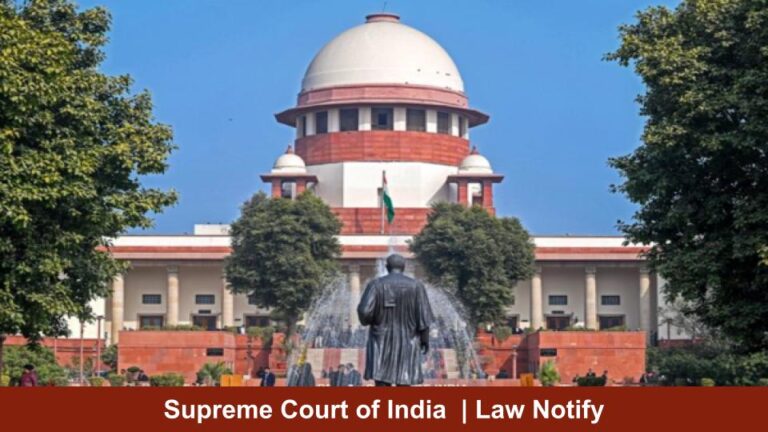
February 05, 2026 : The Supreme Court of India has quashed a rape case filed against a Chhattisgarh-based advocate, holding that the allegations stemmed from a consensual relationship that later turned bitter and did not amount to rape on the false promise of marriage.
In its judgment delivered on February 5, 2026, a Bench of Justices B.V. Nagarathna and Justice Ujjal Bhuyan set aside an order of the High Court of Chhattisgarh which had refused to quash the FIR against advocate Pramod Kumar Navratna. The apex court ruled that even if the allegations in the complaint were accepted at face value, they did not disclose an offence under Section 376(2)(n) of the Indian Penal Code.
The case arose from FIR No. 213/2025 registered at Sarkanda Police Station in Bilaspur under Section 376(2)(n) IPC, which deals with repeated rape on the same woman. The complainant, also an advocate and a married woman with a child, alleged that the accused had established physical relations with her on the false promise of marriage and later refused to marry her.
According to the complaint, the two lawyers came into contact at a social event in September 2022 and developed a close relationship. The woman alleged that the accused initially forced himself on her and later assured her that he would marry her. She further claimed that when she became pregnant, he pressured her to terminate the pregnancy and subsequently avoided discussions about marriage.
The accused denied the allegations and maintained that the relationship was consensual. He argued that the complainant was fully aware that she was legally married at the time, with divorce proceedings still pending, and therefore any promise of marriage could not have been legally enforceable.
The High Court had earlier declined to quash the proceedings, observing that whether consent was obtained under a misconception of fact was a matter for trial. However, the Supreme Court disagreed with this approach.
The Bench noted that the complainant was a 33-year-old practicing advocate who was aware of her marital status and the legal bar against a second marriage during the subsistence of the first. The court pointed out that under the Hindu Marriage Act, 1955 and the Special Marriage Act, 1954, a person cannot legally marry while a spouse is living. In such circumstances, the court found it difficult to accept that the woman was misled into believing that a valid marriage could take place.
Referring to its earlier decisions in Naim Ahamed vs. State (NCT of Delhi) and Mahesh Damu Khare vs. State of Maharashtra, the court reiterated that there is a clear distinction between a false promise made from the outset with no intention of marriage and a mere breach of promise. Only the former may vitiate consent and attract criminal liability for rape.
The court observed that in genuine cases under Section 376(2)(n), there is usually a clear pattern of coercion, deceit, or exploitation where consent is obtained through fraud from the very beginning. In the present case, however, both parties were aware of the complainant’s existing marriage from the start.
The Bench described the matter as a consensual relationship that later turned acrimonious. It cautioned that criminal law, particularly provisions dealing with rape, must not be invoked in every case where a relationship fails or does not culminate in marriage. Doing so, the court said, risks trivialising a grave offence and misusing the criminal justice system.
Relying on the principles laid down in State of Haryana vs. Bhajan Lal, the court held that where allegations do not disclose a prima facie offence, courts are empowered to quash proceedings to prevent abuse of process.
Accordingly, the Supreme Court allowed the appeal and quashed the FIR, the chargesheet, and the ensuing sessions trial proceedings pending before the District and Sessions Judge, Bilaspur
Case Reference : Special Leave Petition (Crl.) No. 4452 of 2025, Pramod Kumar Navratna v. State of Chhattisgarh & Others, 2026 INSC 124.