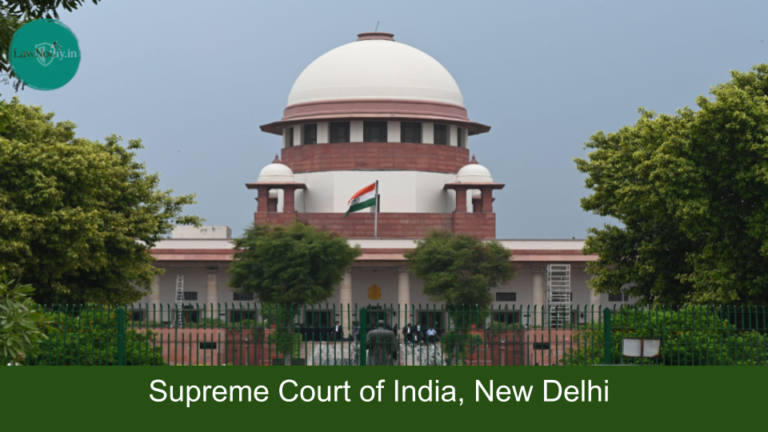
New Delhi : The Supreme Court of India has reaffirmed a settled principle of landlord-tenant law, holding that a tenant cannot dictate to a landlord which accommodation should be treated as suitable for the landlord’s bona fide requirement, nor can the tenant insist that the landlord run a business from premises suggested by the tenant. The Court also cautioned that, in revisional jurisdiction, High Courts cannot undertake microscopic scrutiny of pleadings and evidence to overturn concurrent findings of fact, unless the jurisdiction exercised by the lower courts is ex facie without authority.
A Bench comprising Justice J.K. Maheshwari and Justice Vijay Bishnoi delivered the ruling while allowing a civil appeal filed by Rajani Manohar Kuntha and others. The appeal challenged a judgment of the Bombay High Court, which had set aside concurrent eviction decrees passed by the Trial Court and the First Appellate Court.
The dispute arose from a suit seeking eviction from a non-residential premises bearing No. 4, situated on CTS No. 425, 12th Lane, Kamathipura, Nagpada, Mumbai. The landlord sought eviction on the ground of bona fide requirement for establishing a business for his daughter-in-law. The Trial Court decreed eviction, and the First Appellate Court confirmed the decree. However, the High Court interfered in revision and reversed these concurrent findings.
Before the Supreme Court, it was noted that both the Trial Court and the First Appellate Court had concurrently found the requirement of the ground-floor commercial premises to be genuine and bona fide. The other portions of the property on the second and third floors were residential in nature and unsuitable for the stated commercial purpose.
One of the factors relied upon by the High Court was that a ground-floor room, pleaded as residential by the landlord, had a commercial electricity connection obtained after the filing of the suit in 2016. The tenant also proposed alternative accommodation and argued that the landlord should accept such premises instead of evicting the tenant.
Rejecting this approach, the Supreme Court held that the High Court had exceeded the permissible limits of revisional jurisdiction by reappreciating evidence and scrutinizing pleadings in minute detail. The Court observed that such interference is impermissible unless the findings of the lower courts are shown to be wholly without jurisdiction, which was not the case here.
The Court further clarified that the mere fact of obtaining a commercial electricity connection during the pendency of proceedings could not, by itself, negate the bona fide requirement. Importantly, it reiterated that a tenant cannot dictate the suitability of accommodation to the landlord or compel the landlord to start a business from premises suggested by the tenant. In doing so, the Court relied on its earlier decision in Bhupinder Singh Bawa v. Asha Devi (2016) 10 SCC 209.
Holding that the High Court’s interference was ex facie without jurisdiction, the Supreme Court set aside the impugned judgment and restored the eviction decrees passed by the Trial Court and affirmed by the First Appellate Court.
Taking note of the fact that the respondents had been in occupation of the premises for more than fifty years, the Court granted them time until June 30, 2026, to vacate, subject to strict conditions. These included payment of all arrears within one month, regular payment of rent on a month-to-month basis, handing over peaceful vacant possession by the stipulated date, not creating any third-party rights, and filing the usual undertaking before the Registrar of the Bombay High Court within three weeks.
The Court made it clear that any violation of these conditions, or failure to file the undertaking, would entitle the landlord to execute the decree immediately, and the time granted would not stand in the way of execution proceedings.