News Citation : 2026 LN (HC) 49
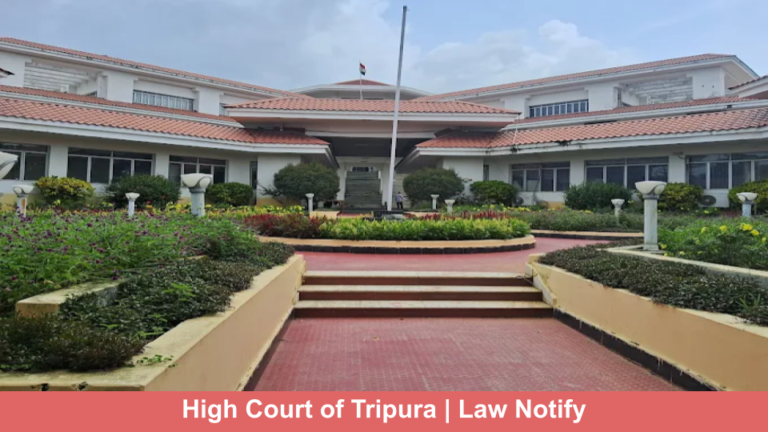
Agartala, January 6, 2026 : In a significant ruling with wide implications for businesses under the GST regime, the Tripura High Court has held that genuine purchasers cannot be denied input tax credit merely because a supplier failed to deposit the tax with the government. While upholding the constitutional validity of Section 16(2)(c) of the Central Goods and Services Tax Act, 2017, the Court ruled that the provision must be read down so that bona fide buyers are not unfairly penalised for the default of sellers.
The judgment was delivered by a Division Bench headed by Chief Justice M.S. Ramachandra Rao and Justice S. Datta Purkayastha in a writ petition filed by M/s Sahil Enterprises, a Tripura-based trader dealing in rubber products. The petitioner had challenged both the denial of input tax credit amounting to ₹1.11 crore and the constitutional validity of Section 16(2)(c), which links a buyer’s entitlement to input tax credit with actual payment of tax by the supplier to the government.
The dispute arose after GST authorities blocked the petitioner’s electronic credit ledger and issued a demand under Section 73 of the CGST Act. The authorities argued that although the petitioner had paid GST to its supplier, the supplier had failed to deposit the tax with the government while filing GSTR-3B returns. As a result, the department denied the petitioner the benefit of input tax credit and raised a demand along with interest and penalty.
The Court noted that there is no mechanism under the GST framework for a purchaser to verify whether a supplier has actually paid tax to the government. Expecting buyers to ensure compliance by suppliers, the Bench observed, would amount to asking them to do the impossible. The supplier is not under the control of the purchaser, and denial of credit in such circumstances effectively leads to double taxation.
Relying heavily on earlier decisions of the Delhi High Court in Quest Merchandising India Pvt. Ltd. and Shanti Kiran India (P) Ltd., which were later approved by the Supreme Court, the Tripura High Court held that Section 16(2)(c) cannot be applied mechanically. The provision, the Court said, must be interpreted to deny input tax credit only in cases involving collusion, fraud, or non-bona fide transactions.
The Bench also took note of the fact that the GST department had already initiated proceedings against the defaulting supplier, whose registration was cancelled and against whom criminal cases were filed. Importantly, the authorities had not alleged fraud or collusion against the petitioner, nor had they invoked Section 74 of the Act, which applies to cases involving fraud or wilful misstatement.
In its final directions, the Court set aside the demand order passed by the Assistant Commissioner and directed the GST authorities to immediately allow the petitioner input tax credit of ₹1.11 crore. At the same time, it clarified that Section 16(2)(c) itself is not unconstitutional but must be applied in a manner that does not punish honest taxpayers for the wrongdoing of others.
The ruling brings clarity and relief to businesses facing similar disputes across the country and reinforces the principle that GST input tax credit exists to prevent cascading taxation, not to create unjust enrichment for the revenue.
Case Reference : WP (C) No. 688 of 2022, Sahil Enterprises v. Union of India and Others (decided on 06.01.2026); Counsel for the Petitioner: Naveen Bindal, Advocate, Mukul Singla, Advocate, and Prabal Kumar Ghosh, Advocate; Counsel for the Respondents: Bidyut Majumder, Deputy S.G.I., Bibhal Nandi Majumder, Senior Advocate, Biplabendu Roy, Advocate, and Elembrok Debbarma, Advocate.