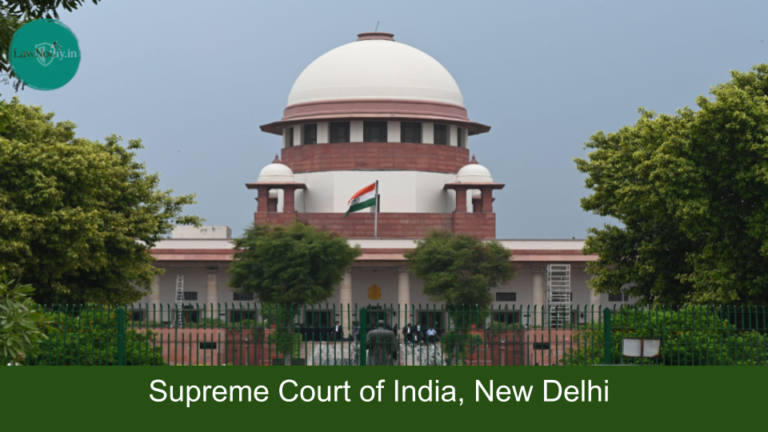
New Delhi : The Supreme Court of India has upheld the judgment of the Punjab and Haryana High Court, reaffirming a settled principle of property law: in cases of a usufructuary mortgage where no time limit is fixed for redemption, limitation does not begin from the date of the mortgage but only from the date when the mortgagor pays or tenders the mortgage money.
The ruling was delivered by a Bench comprising Justice B.V. Nagarathna and Justice R. Mahadevan while dismissing Civil Appeal No. 3358 of 2010. The case arose from a decades-long dispute over agricultural land in Punjab.
The dispute concerned the redemption of 114 kanals and 4 marlas of mortgaged land in Village Tamkot, District Bathinda. The respondents, heirs of the original mortgagors, sought redemption under the Redemption of Mortgages Act, 1913. The Collector allowed redemption in 1975.
That order was challenged by the mortgagees through a civil suit, which succeeded before the Trial Court and was later affirmed by the First Appellate Court on the ground of limitation. However, in second appeal, the High Court reversed those findings, holding that the right of redemption was not time-barred in a usufructuary mortgage where no redemption period was fixed.
The Supreme Court agreed with the High Court and relied on the Constitution Bench principle later reaffirmed in Singh Ram v. Sheo Ram. The Court held that under Section 61(a) of the Limitation Act, read with Section 62 of the Transfer of Property Act, limitation for redemption of a usufructuary mortgage begins only when the mortgage money is paid or tendered, whether from usufruct or otherwise.
The Court clarified that mere passage of time does not extinguish the mortgagor’s right of redemption, and a mortgagee cannot claim ownership solely on the basis of long possession if the mortgage amount has not been paid or adjusted.
Dismissing the appeal, the Supreme Court affirmed the High Court’s judgment, restored the Collector’s 1975 order permitting redemption, vacated the interim stay, and directed parties to bear their own costs.
The decision reinforces long-standing protections for mortgagors and brings clarity to limitation issues in usufructuary mortgage disputes.