
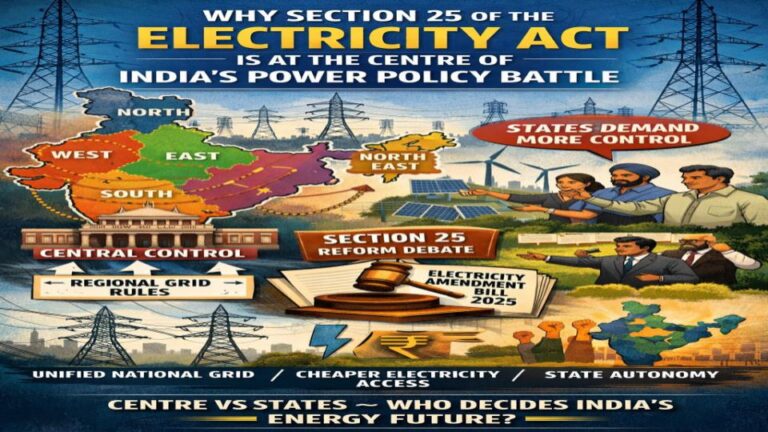
March 16, 2026 : Section 25 of the Electricity Act, 2003 has quietly become one of the most debated provisions in India’s energy policy. As the Electricity Amendment Bill 2025 undergoes revisions, several state governments are demanding greater control over how power transmission decisions are made across the country.
The issue is not just legal or technical. It affects how electricity moves across states, how easily states can access cheaper power, and ultimately what consumers pay in their electricity bills.
What Section 25 of the Electricity Act Does
Section 25 gives the Central Government the authority to divide the country into power regions and modify those boundaries whenever required. The goal is to ensure efficient and integrated transmission and supply of electricity while facilitating coordination for inter-state and inter-regional generation and transmission.
In practical terms, the Centre determines which states belong to each electricity region such as North, South, East, West and North-East. It also frames the basic structure that governs how electricity flows between these regions. State governments have very limited influence over these decisions.
Why States Are Raising Concerns
The regional power structure was created in an era when India’s electricity grid was fragmented. In the 1990s, regional grids operated largely independently and coordination was necessary to maintain stability.
Today, however, India operates a single synchronised national grid. Electricity generation has expanded significantly, especially with the growth of renewable energy in several states.
Despite this transformation, the regional framework still shapes how electricity trading and transmission are managed. States located near regional borders often argue that they cannot easily buy or sell electricity across neighbouring regions even when cheaper power is available nearby.
This means a state could experience shortages or higher costs even though surplus electricity exists just across a regional boundary.
The Electricity Amendment Bill 2025
The draft Electricity Amendment Bill 2025, introduced by the Union government in October, proposes major changes to the power sector. It is considered the most significant revision of the Electricity Act since 2003.
One of the key proposals is a new proviso to Section 25. The amendment would allow the “appropriate government” to prescribe the procedure for approval and implementation of both Inter-State Transmission Systems and Intra-State Transmission Systems.
The proposal effectively creates a clearer legal framework for delegating powers related to transmission projects. If implemented effectively, it could give states a stronger role in planning and approving transmission infrastructure within their territories.
Why Renewable-Rich States Are Pushing for Reform
States such as Rajasthan, Gujarat and Tamil Nadu have rapidly expanded renewable energy generation. These states often produce surplus electricity from solar and wind projects.
However, they argue that existing transmission and regional arrangements make it difficult to sell this power freely across the national market. State governments want to operate as independent units within a fully integrated national grid rather than as members of rigid regional blocks.
Their demand is simple. If India already has one national grid, then electricity trading and transmission rules should reflect that reality.
What Experts Say Needs to Change
Energy policy analysts believe reforms around Section 25 should focus on three broad areas.
First, the five-region framework should gradually shift toward a state-based commercial settlement system within the national grid.
Second, approval procedures for transmission projects need faster timelines and clearer regulatory processes.
Third, states should have meaningful consultation rights before the Centre alters regional boundaries or transmission frameworks.
The Larger Policy Context
Alongside the proposed amendment, the Centre has already notified the Electricity Amendment Rules 2026 to clarify regulations around captive power generation. The aim is to reduce regulatory uncertainty and support cleaner and more reliable electricity supply for industries.
While these rules address some issues in the sector, many policymakers believe that reforming Section 25 will have a much larger structural impact on India’s electricity market.
Conclusion
Section 25 was created for a time when India’s electricity network was divided into separate regional grids. Today the country runs on a unified national grid, renewable energy capacity is expanding rapidly, and states want greater freedom to trade electricity across borders.
The Electricity Amendment Bill 2025 provides an opportunity to update this framework. Whether the final legislation gives states meaningful authority or keeps power concentrated at the Centre will shape how India’s electricity market evolves in the coming years.