News Citation : 2026 LN (HC) 220 | 2026:CGHC:14468-DB
March 27, 2026 : In a significant ruling, the Chhattisgarh High Court has held that the State cannot impose excise licensing requirements on traders dealing in molasses for non-intoxicant purposes, drawing a clear constitutional distinction between industrial use and liquor regulation.
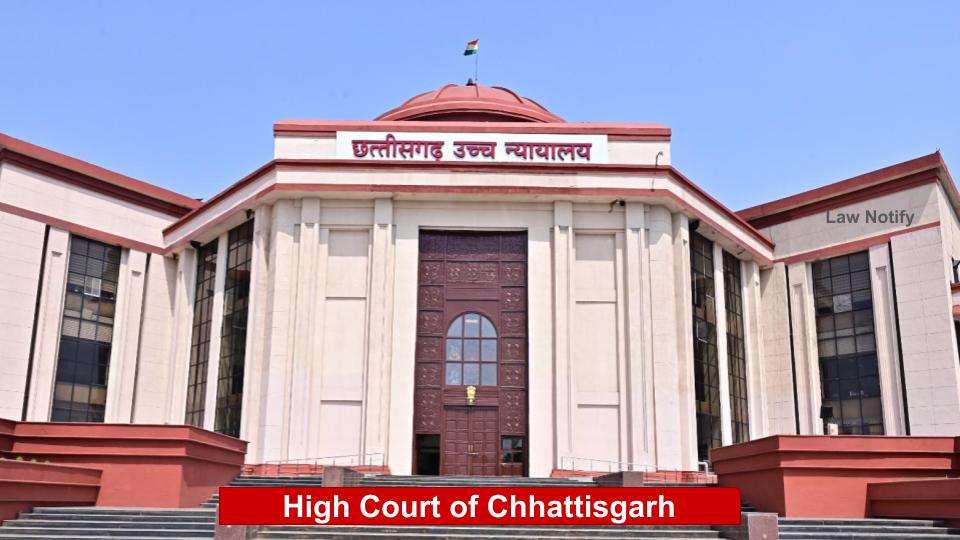
The judgment was delivered by a Division Bench comprising Chief Justice Ramesh Sinha and Justice Ravindra Kumar Agrawal while deciding a batch of writ petitions challenging the validity of the Chhattisgarh Molasses Control and Regulation Rules, 2022.
Multiple traders and companies, including firms engaged in cattle feed, gudakhu manufacturing, and other industrial activities, had approached the court challenging the 2022 Rules framed under the Chhattisgarh Excise Act, 1915. They argued that the State was compelling them to obtain excise licences and subjecting them to inspections, seizures, and penalties despite dealing exclusively in molasses for non-alcoholic uses.
The petitioners contended that molasses, in its natural form, is neither intoxicating nor fit for human consumption and is widely used in industries such as cattle feed, agriculture, and manufacturing. They further argued that bringing such trade under excise regulation violates their fundamental rights under Articles 14 and 19(1)(g) of the Constitution.
The core issue before the court was whether the State government could regulate and license all molasses trade under excise laws, even when the commodity is used for non-intoxicant purposes. The State defended the Rules, arguing that molasses is a key raw material for producing alcohol and therefore falls within its legislative competence under Entry 8 of the State List, which covers intoxicating liquors.
The High Court drew a clear distinction between molasses used for liquor production and molasses used for industrial or commercial purposes. The bench observed that while the State has the authority to regulate molasses when it is used for distillation of alcohol, that power does not extend to ordinary trade involving non-intoxicant uses such as cattle feed, agriculture, or industrial applications.
The court noted that the 2022 Rules themselves recognize two categories of usage. While regulation related to distillation may fall within the scope of excise law, extending the same regulatory framework to unrelated commercial activities goes beyond the State’s constitutional powers. It held that molasses, in its basic form, cannot be treated as an “intoxicant” or “excisable article” unless it is actually used in the manufacture of alcohol.
Relying on the scheme of legislative distribution under the Constitution, the court emphasized that the State’s powers under Entry 8 and Entry 51 of the State List are confined to intoxicating liquors meant for human consumption. By attempting to regulate general trade in molasses, the State had effectively entered a broader commercial domain that does not fall within its excise jurisdiction.
The court also took note of the fact that molasses is subject to GST, which further supports its classification as a regular commercial commodity rather than an intoxicant.
Allowing the petitions, the High Court ruled that traders dealing in molasses exclusively for non-intoxicant purposes cannot be compelled to obtain excise licences under the 2022 Rules. It further restrained authorities from taking coercive action such as raids, seizures, or penalties against such traders solely on the basis of non-compliance with excise licensing requirements.
The ruling is expected to have significant implications for industries in Chhattisgarh that rely on molasses for non-alcoholic purposes. It clarifies the limits of State regulatory power and provides relief to traders who were facing compliance burdens under the excise regime. By reinforcing the distinction between industrial commodities and intoxicants, the judgment strengthens constitutional protections for trade and business.
Case Reference : WPC No. 3580 of 2022 (M/s Kedia Trading vs State of Chhattisgarh & Anr.), WPC No. 64 of 2023 (Agrawal Gudakhu vs State of Chhattisgarh & Anr.), WPC No. 98 of 2023 (Suraj Gudakhu Karkhana & Ors. vs State of Chhattisgarh & Anr.), WPC No. 152 of 2023 (Ajanta Gudakhu Udyog vs State of Chhattisgarh & Anr.), WPC No. 211 of 2023 (M/s Raman Agro Exports Pvt. Ltd. vs State of Chhattisgarh & Ors.), WPC No. 218 of 2023 (M/s Single Point Solutions vs State of Chhattisgarh & Ors.), WPC No. 380 of 2023 (Siddhi Deal Trade Pvt. Ltd. vs State of Chhattisgarh & Anr.), WPC No. 498 of 2023 (Sun and Sun Cattle Feed Pvt. Ltd. vs State of Chhattisgarh & Anr.), WPC No. 614 of 2023 (M/s Shriaman Agrovet Pvt. Ltd. vs State of Chhattisgarh & Ors.), WPC No. 813 of 2023 (Annapurna Gudakhu Karkhana vs State of Chhattisgarh & Anr.), WPC No. 817 of 2023 (Aryan Feeds Pvt. Ltd. vs State of Chhattisgarh & Anr.), WPC No. 1106 of 2023 (Agrawal Gudakhu Factory vs State of Chhattisgarh & Anr.), WPC No. 1376 of 2023 (Rashtriya Gudakhu Factory vs State of Chhattisgarh & Anr.), WPC No. 1713 of 2023 (Vardhaman Trading vs State of Chhattisgarh & Anr.), WPC No. 1943 of 2023 (Rameshwar Cattle Feed Industries vs State of Chhattisgarh & Anr.), WPC No. 2099 of 2023 (Tirumala Balaji Alloys Ltd. vs State of Chhattisgarh & Anr.), WPC No. 2480 of 2023 (M/s Shubham Trading Company vs State of Chhattisgarh & Anr.), WPC No. 2481 of 2023 (M/s Arihant Feeds vs State of Chhattisgarh & Anr.), WPC No. 2519 of 2023 (M/s Swastik Cattle Feed Industries vs State of Chhattisgarh & Anr.), WPC No. 2533 of 2023 (M/s Sadashiv Cattle Feed Industries vs State of Chhattisgarh & Anr.), WPC No. 4430 of 2023 (M/s Maruti Feeds vs State of Chhattisgarh & Anr.), WPC No. 1032 of 2024 (M/s Sholey Coke and Briquettes vs State of Chhattisgarh & Anr.), WPC No. 2748 of 2024 (M/s Shri Surya Feeds Pvt. Ltd. vs State of Chhattisgarh & Anr.), WPC No. 1897 of 2025 (Maa Banbhori Global Ventures Pvt. Ltd. vs State of Chhattisgarh & Anr.), WPC No. 1898 of 2025 (Vardhaman Trading Company vs State of Chhattisgarh & Anr.), WPC No. 4236 of 2025 (Pasupati Agrovet Pvt. Ltd. vs State of Chhattisgarh & Anr.), and WPC No. 536 of 2026 (Shree Balaji Enterprises vs State of Chhattisgarh & Anr.); Counsels for Petitioner(s): Mr. Manoj Paranjpe, Senior Advocate assisted by Mr. K. Rohan and Mr. Kabeer Kalwani, Advocates (WPC No. 3580/2022, 4236/2025); Mr. K. Rohan, Advocate (WPC No. 152/2023, 2480/2023, 2481/2023, 1897/2025, 1898/2025); Mr. T.K. Tiwari, Advocate (WPC No. 211/2023, 218/2023, 614/2023); Mr. Amit Sharma, Advocate (WPC No. 1376/2023, 1943/2023, 2099/2023, 2519/2023, 2533/2023, 2748/2024); Mr. Manish Nigam, Advocate (WPC No. 1032/2024); Mr. Pankaj Singh, Advocate (WPC No. 536/2026); for Respondent/State: Mr. Shashank Thakur, Additional Advocate General; for Respondent/Union of India: Mr. Ramakant Mishra, Deputy Solicitor General, assisted by Mr. Roop Ram Naik, Ms. Annapurna Tiwari, Mr. Amitesh Kumar Pandey and Mr. Rishabh Dev Singh.