News Citation : 2026 LN (HC) 266 | 2026:CGHC:18260-DB
April 22, 2026 : The High Court of Chhattisgarh has delivered a detailed judgment in a batch of appeals filed by Ranu Sahu and her family members challenging property attachment proceedings initiated by the Directorate of Enforcement under the Prevention of Money Laundering Act, 2002.
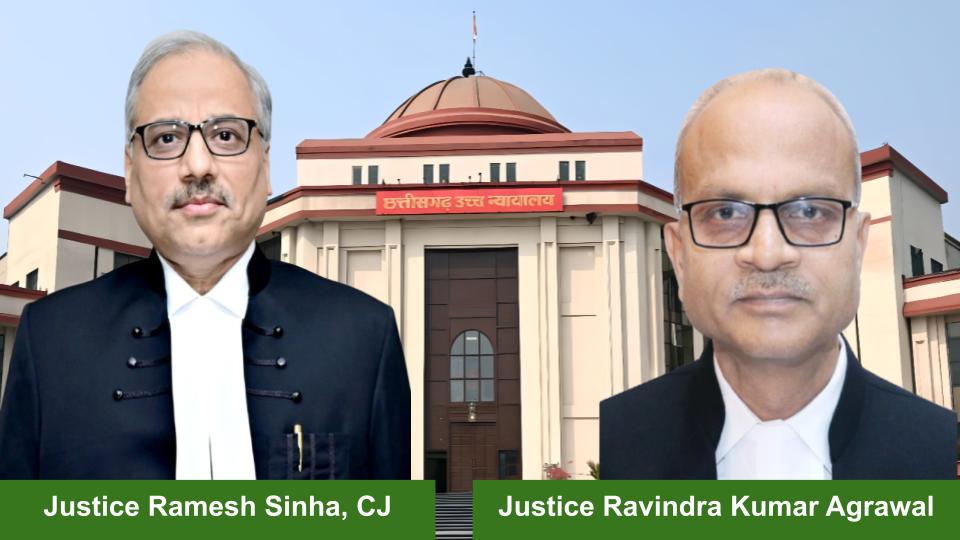
The Division Bench comprising Chief Justice Ramesh Sinha and Justice Ravindra Kumar Agrawal heard nine connected appeals arising from a common order of the Appellate Tribunal under SAFEMA. The appellants, all related to Ranu Sahu, had challenged the confirmation of a provisional attachment order issued by the Enforcement Directorate (ED) in connection with an alleged coal levy scam in Chhattisgarh.
The case traces back to an FIR registered in Bengaluru in July 2022 against alleged coal syndicate members, including Suryakant Tiwari, for obstruction and destruction of evidence during an Income Tax search. Although the FIR initially did not include scheduled offences under the PMLA, provisions such as extortion were added later. Based on this, the ED registered an ECIR and began investigating alleged money laundering linked to illegal coal transportation levies.
According to the ED, a network led by Tiwari collected illegal payments of ₹25 per tonne of coal by exploiting procedural changes in transport permits. The agency alleged that Ranu Sahu, who served as District Collector in key mining districts, facilitated this system and received proceeds of crime, which were later used to acquire properties in the names of her relatives.
The ED provisionally attached properties worth about ₹5.52 crore belonging to Sahu and her family. The Adjudicating Authority confirmed the attachment in October 2023, and the Appellate Tribunal upheld that decision in October 2025, prompting the present appeals before the High Court.
Before the High Court, the appellants argued that the entire ED case was legally unsustainable. They contended that no valid scheduled offence existed at the time of attachment, which is a prerequisite for invoking the PMLA. They also pointed out that Ranu Sahu was neither named in the original FIR nor in early prosecution complaints, and that the properties attached were acquired before the alleged offence period or lacked any demonstrable link to proceeds of crime.
The appellants further challenged the evidentiary basis of the ED’s case, arguing that reliance on handwritten diary entries and vague WhatsApp chats did not establish any concrete money trail. They also claimed that the Adjudicating Authority had passed a mechanical and unreasoned order, merely reproducing submissions without proper analysis, and that the Appellate Tribunal failed to address these deficiencies.
Another key argument was that the attachment of properties belonging to family members was based on assumptions rather than proof. The appellants maintained that there was no evidence showing that these assets were purchased using illicit funds or that the relatives acted as benamidars. They also questioned the ED’s reliance on the “value equivalent” principle to attach properties unconnected to alleged criminal proceeds.
The High Court examined the entire record, including the sequence of FIRs, prosecution complaints, and attachment orders, as well as the statutory framework governing attachment under the PMLA. The judgment addresses critical issues such as the necessity of a subsisting scheduled offence, the requirement of a clear nexus between alleged proceeds of crime and attached properties, and the obligation of adjudicating authorities to pass reasoned orders.
The ruling is significant as it engages with core safeguards under the PMLA, particularly around property attachment and procedural fairness, and evaluates whether enforcement actions met statutory thresholds in a high-profile corruption and money laundering investigation.
Case Reference : MA Nos. 21–29 of 2026 (Tushar Sahu, Pankaj Kumar Sahu, Poonam Sahu, Piyush Kumar Sahu, Arun Kumar Sahu, Ranu Sahu, Shalini Sahu, Laxmi Sahu and Revti Sahu v. Deputy Director, Directorate of Enforcement, Raipur, Government of India); for Appellants: Ms. Somaya Gupta (VC) and Ms. Khushboo Naresh Dua, Advocates; for Respondent: Dr. Saurabh Kumar Pande, Advocate.