News Citation : 2026 LN (HC) 341
April 17, 2026 : The High Court of Orissa has ruled that a second appeal against an interlocutory order passed in an appeal under Section 104 of the Code of Civil Procedure is not maintainable, clarifying a recurring procedural issue that frequently reaches higher courts.
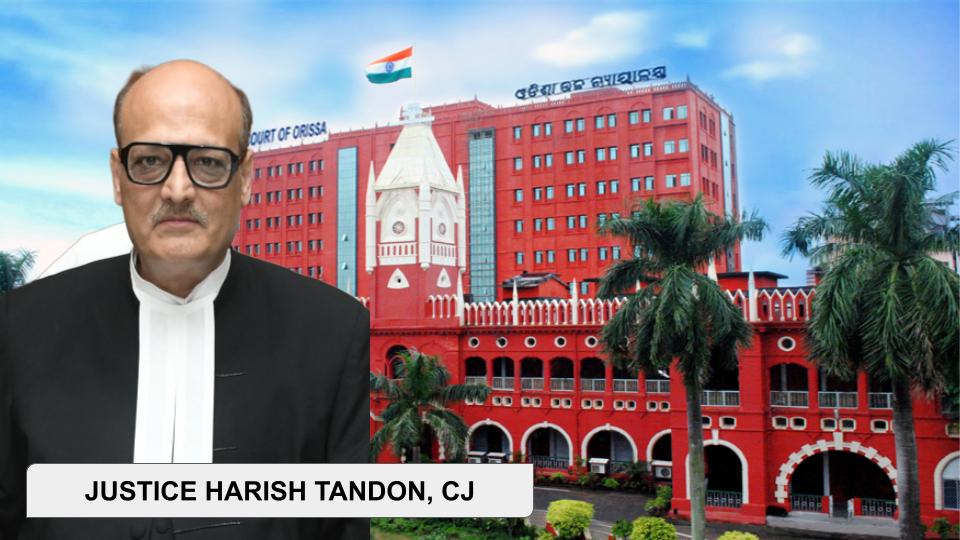
Delivering judgment in SAO No. 7 of 2024, Chief Justice Harish Tandon observed that litigants often file second appeals challenging interlocutory appellate orders, creating confusion over the scope of Section 104 and Order XLIII Rule 1 of the Code of Civil Procedure (CPC). The Court said the issue required authoritative clarification to ensure uniformity in civil procedural law.
The case arose from a dispute involving Paradeep Phosphates Limited and Chandramani Dei alias Sahoo and others. An injunction application had initially been filed before a trial court under Order XXXIX Rules 1 and 2 CPC. The appellate court later passed an ex parte status quo order in relation to the suit property. When an application seeking rehearing of the appeal under Order XLI Rule 21 CPC was dismissed, the appellant approached the High Court through a second appeal, arguing that such an appeal was maintainable under Order XLIII Rule 1(t) CPC.
Rejecting the contention, the High Court held that while Order XLIII Rule 1 specifies categories of appealable orders, the substantive right to appeal remains governed by Section 104 CPC. The Court emphasized that Section 104(2) expressly bars any further appeal from an order passed in an appeal under that provision. According to the judgment, this statutory embargo cannot be overridden through procedural provisions contained in the CPC schedules.
The Court further explained that appeals are a continuation of the “lis” between parties but not a continuation of the original suit itself. Therefore, although appellate courts may exercise procedural powers similar to courts of original jurisdiction under Section 107 CPC, such powers do not automatically create a substantive right of appeal against every interlocutory order.
Relying extensively on precedents from the Calcutta High Court, including Mira Chatterjee v. Joydeb Chatterjee and Sabyasachi Chatterjee v. Prasad Chatterjee, the Orissa High Court reiterated that Section 141 CPC extends only procedural provisions to appellate proceedings and does not confer independent substantive appellate rights.
The Court concluded that the second appeal filed by Paradeep Phosphates Limited was not maintainable under Order XLIII Rule 1(t) CPC and dismissed it accordingly. However, the Bench clarified that the appellant would still be free to pursue any other remedy available before an appropriate forum in accordance with law.
Case Reference : S.A.O. No. 7 of 2024 – Paradeep Phosphates Limited, Bhubaneswar v. Chandramani Dei @ Sahoo & Others | For Appellant: Mr. Susanta Kumar Dash, Senior Advocate, assisted by Mr. P. Das, Advocate | For Respondents: None for Respondent No. 1; Additional Government Advocate for Proforma Respondent Nos. 2 and 3.