News Citation : 2026 LN (HC) 403
July 22, 2026 : the Chhattisgarh High Court has held that while the Motor Accident Claims Tribunal was justified in accepting the deceased employee’s last salary and treating his wife, mother and three adult sons as dependents, it committed an error in calculating income tax and the multiplier applicable for determining compensation. After recalculating the compensation on settled legal principles, the High Court reduced the compensation payable to the claimants from ₹1,19,83,455 to ₹1,17,67,525.
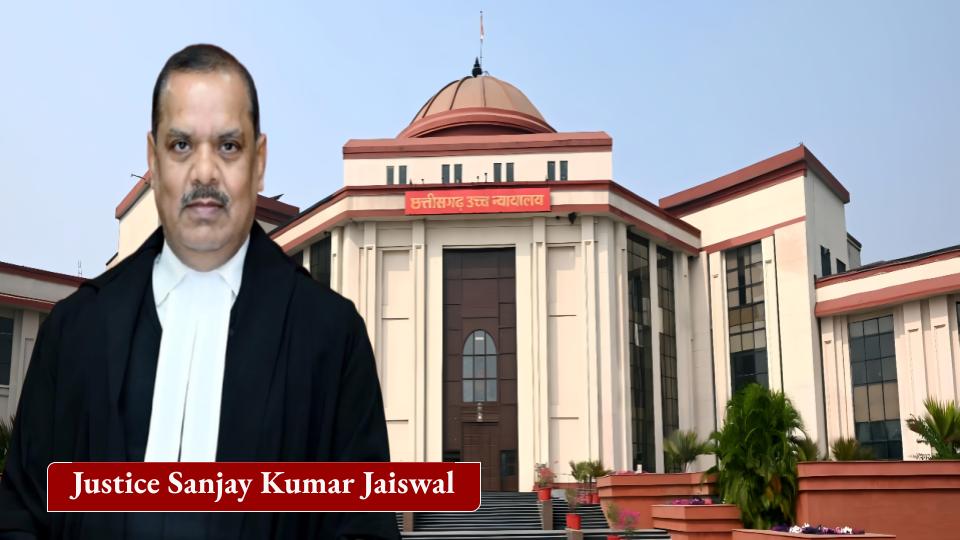
Justice Sanjay Kumar Jaiswal delivered the judgment on 22 July 2026 while deciding two connected appeals arising from the same award passed by the Second Motor Accident Claims Tribunal, Katghora, Korba. One appeal was filed by the Oriental Insurance Company challenging the compensation awarded by the Tribunal, while the other was filed by the claimants seeking enhancement of compensation. The appeals arose from the Tribunal’s award dated 8 December 2020 in a claim under Section 166 of the Motor Vehicles Act, 1988.
The case related to a road accident that occurred on 8 August 2018 near the CSEB Plant Gate in Korba. Bharat Sahu, who was travelling as a pillion rider on a motorcycle, died on the spot after a Scorpio allegedly driven rashly and negligently hit the motorcycle. Following the incident, the police registered a criminal case, conducted an investigation and filed a charge sheet against the driver of the offending vehicle. The deceased’s widow, three sons and mother thereafter approached the Claims Tribunal seeking compensation.
Before the High Court, the insurance company questioned the involvement of the Scorpio in the accident, pointing out that the vehicle number was not mentioned in the initial merg intimation and that the vehicle was seized nearly two and a half months after the accident. It also challenged the determination of the deceased’s income and argued that the three sons, being adults, should not have been treated as dependents. The claimants, on the other hand, sought enhancement of compensation, contending that the Tribunal had wrongly treated the deceased as 41 years old instead of 40 years for applying the multiplier.
Rejecting the insurer’s objections regarding the identity of the offending vehicle, the High Court relied on the testimony of the eyewitness, police investigation records and the charge sheet. Referring to the Supreme Court’s decisions in ICICI Lombard General Insurance Co. Ltd. v. Rajani Sahu, Mangla Ram v. Oriental Insurance Co. Ltd., Mathew Alexander v. Mohd. Shafi and other precedents, the Court reiterated that proceedings before the Motor Accident Claims Tribunal are decided on the principle of “preponderance of probabilities” and not on the criminal standard of proof beyond reasonable doubt. The Court observed, “The claimants have to establish their case on the touchstone of preponderance of probabilities. The standard of proof beyond reasonable doubt cannot be applied while considering a petition seeking compensation arising out of a road traffic accident.”
The Court further held that the absence of the vehicle number in the initial report or delayed seizure of the vehicle could not outweigh the consistent eyewitness testimony and documentary evidence collected during the investigation. It found no reason to interfere with the Tribunal’s finding that the accident had been caused by the offending Scorpio driven in a rash and negligent manner.
On the issue of income, the High Court upheld the Tribunal’s reliance on the deceased’s salary slip for July 2018, immediately preceding the accident, instead of earlier income tax records. Since the deceased was employed as a Fan Operator with South Eastern Coalfields Limited (SECL), the Court held that the latest salary slip represented his actual earnings at the time of death and correctly fixed his monthly income at ₹76,745.22.
The Court also rejected the insurance company’s argument that the deceased’s three sons should not be considered dependents merely because they had attained majority. Referring to the Punjab and Haryana High Court’s decision in Narinder Kaur v. Jagmeet Singh, it observed that dependency under the Motor Vehicles Act is not confined only to financial dependence. The Court noted that in Indian society, parents and children often remain emotionally, physically and economically dependent on one another. It held that, in the absence of evidence showing that the sons were independently earning and self-sufficient, the Tribunal rightly treated all five claimants as dependents and deducted one-fourth of the income towards personal expenses. The Court observed that “Dependency is not confined to financial dependency alone. It also includes emotional, physical and psychological dependence.”
However, the High Court found merit in the claimants’ contention regarding the multiplier. The deceased was born on 26 September 1977 and was aged 40 years, 10 months and 13 days on the date of the accident. Since he had not completed 41 years, the Tribunal erred in applying the multiplier of 14. Following the principles laid down by the Supreme Court in Sarla Verma v. Delhi Transport Corporation and affirmed in National Insurance Co. Ltd. v. Pranay Sethi, the Court held that the correct multiplier was 15.
Despite applying a higher multiplier, the High Court found that the Tribunal had incorrectly deducted income tax before adding future prospects. It ruled that income tax must first be computed on the annual income after adding future prospects. The Court recalculated the compensation by granting a 30% increase towards future prospects, deducting applicable income tax thereafter, applying one-fourth deduction towards personal expenses, using multiplier 15 and awarding consortium in accordance with the Supreme Court’s decision in Magma General Insurance Co. Ltd. v. Nanu Ram. After the revised computation, the Court determined the total compensation at ₹1,17,67,525, which was ₹2,15,930 less than the amount awarded by the Tribunal.
Consequently, the High Court partly allowed the insurance company’s appeal and dismissed the claimants’ appeal for enhancement. It modified the Tribunal’s award by reducing the compensation to ₹1,17,67,525 while leaving the remaining terms of the award unchanged. The Court also directed that the claimants be informed of the modified compensation, with assistance from the District Legal Services Authority and para-legal volunteers wherever necessary.
The judgment reinforces important principles governing compensation claims under Sections 166 and 173 of the Motor Vehicles Act, 1988. It reiterates that motor accident claims are decided on the basis of probabilities rather than strict criminal proof, clarifies that adult children cannot automatically be excluded from the category of dependents, and emphasises that compensation must be calculated in accordance with the structured principles laid down by the Supreme Court regarding future prospects, income tax deductions and the appropriate multiplier.
Case Reference: Oriental Insurance Company Ltd. v. Ganga Bai Sahu & Others and connected appeal, MA(C) No. 149 of 2021 with MA(C) No. 207 of 2021