News Citation : 2026 LN (HC) 394
July 14, 2026 : In a significant ruling on motor accident compensation claims, the Chhattisgarh High Court has dismissed an appeal filed by Shriram General Insurance Company Ltd. and upheld a Motor Accident Claims Tribunal (MACT) award directing payment of more than ₹46 lakh as compensation to the family of a deceased government employee. The Court held that compensation claims under the Motor Vehicles Act are decided on the principle of “preponderance of probabilities” and not on the stricter criminal standard of proof beyond reasonable doubt.
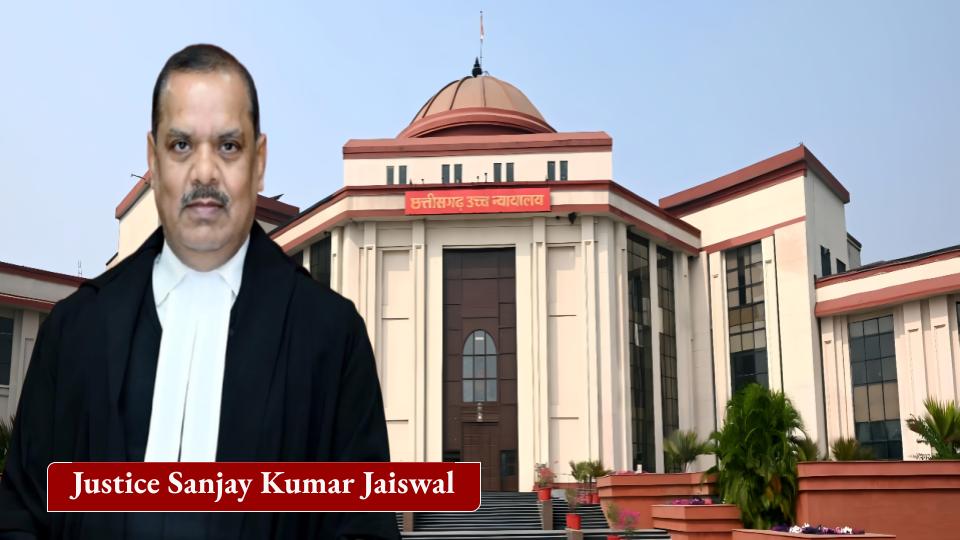
Justice Sanjay Kumar Jaiswal delivered the judgment on July 14, 2026, in MA(C) No. 1456 of 2023, affirming the MACT, South Bastar (Dantewada) award dated April 13, 2023. The Tribunal had awarded ₹46,04,456 with applicable interest to the legal heirs of late Ramesh Kumar Nayak, who died in a road accident on December 24, 2020.
According to the case record, Ramesh Kumar Nayak was returning to his village Doranapal on a motorcycle after official work in Sukma when a Scorpio vehicle allegedly being driven rashly and negligently collided with him near Bodagada Nala turn on National Highway-30. He sustained fatal injuries in the accident. Initially, the FIR and merg intimation referred to an unidentified four-wheeler, and after investigation the police identified the offending Scorpio, seized it on April 2, 2021, and filed a charge sheet against its driver under Section 304-A of the Indian Penal Code for causing death by negligence.
Challenging the MACT award under Section 173 of the Motor Vehicles Act, 1988, the insurance company argued that the offending vehicle had been falsely implicated because it was identified and seized nearly three months after the accident. It contended that since the FIR did not mention the registration number or description of the vehicle, the insurer could not be saddled with liability to satisfy the compensation award.
The High Court, however, found no merit in these submissions. The Court noted that the police investigation ultimately connected the Scorpio vehicle with the accident and culminated in filing of a charge sheet against its driver. The registered owner and driver had also not specifically denied the vehicle’s involvement in their pleadings. The Court further relied on the testimony of an eyewitness, who consistently stated that the accident had been caused by a white Scorpio vehicle. The insurer’s investigator, on the other hand, admitted that he had not witnessed the accident personally and only questioned the police investigation without producing any independent or direct evidence to discredit it.
While dismissing the appeal, the High Court relied extensively on the Supreme Court’s decisions in ICICI Lombard General Insurance Company Ltd. v. Rajani Sahu & Others (2025) 2 SCC 599, Mangla Ram v. Oriental Insurance Co. Ltd., Mathew Alexander v. Mohd. Shafi, and Dulcina Fernandes v. Joaquim Xavier Cruz. Referring to these precedents, the Court reiterated that motor accident compensation proceedings are civil in nature and claimants are only required to establish their case on the basis of probabilities rather than strict criminal proof.
The Court observed that, “The documentary evidence forming part of the police charge sheet and the testimony of the eyewitness remained unrebutted. The insurance company failed to produce any independent and direct evidence capable of disproving the police investigation or the claimants’ case.”
The judgment also emphasized that merely because the offending vehicle was identified during investigation after the initial registration of an FIR against an unknown vehicle does not automatically invalidate the findings of the investigating agency. Once the investigation establishes the involvement of a particular vehicle and the evidence supports that conclusion, the Claims Tribunal is entitled to rely upon such material while determining liability.
Legally, the decision reinforces an important principle governing compensation claims under Sections 166 and 173 of the Motor Vehicles Act, 1988. It reiterates that MACT proceedings are intended to provide just compensation to victims and their families without requiring the rigorous evidentiary standard applicable in criminal prosecutions. The ruling is expected to benefit accident victims by reaffirming that delays in identifying the offending vehicle, by themselves, cannot defeat a genuine compensation claim if the overall evidence establishes the vehicle’s involvement.
Finding no perversity or illegality in the Tribunal’s findings, the High Court refused to interfere with the compensation award and dismissed the insurer’s appeal, thereby confirming the liability of the insurance company to satisfy the award in favour of the deceased’s dependants.
Case Reference: Shriram General Insurance Company Ltd. v. Kaushalya Nayak & Others, MA(C) No. 1456 of 2023.