News Citation : 2026 LN (HC) 393
July 14, 2026 : The Chhattisgarh High Court has set aside the conviction of a Patwari and his son in a corruption case, holding that the prosecution failed to establish the essential ingredient of demand for illegal gratification. Reiterating the settled legal principle that mere recovery of money is not sufficient to secure a conviction under the Prevention of Corruption Act, the Court ruled that proof of demand and voluntary acceptance of a bribe is indispensable before a public servant can be convicted.
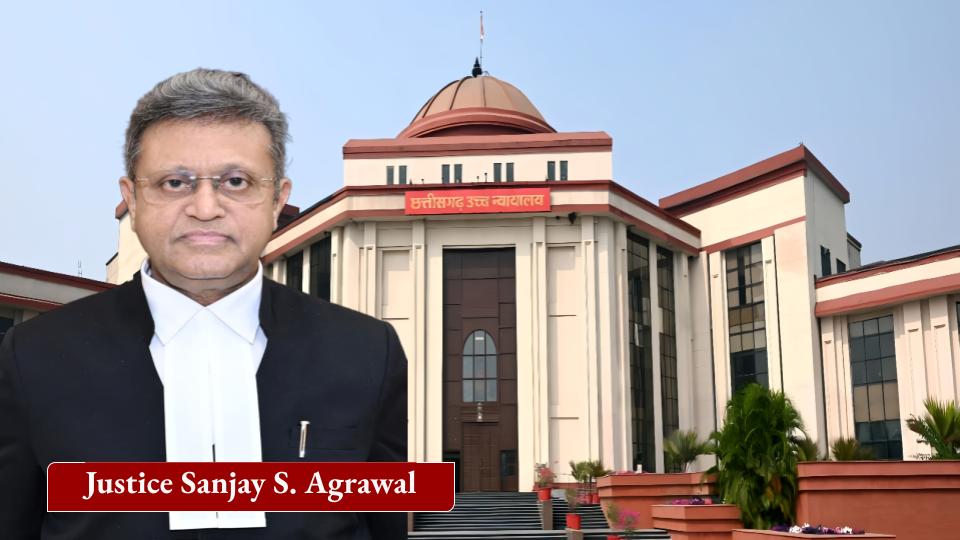
Delivering judgment in CRA No. 424 of 2006, Justice Sanjay S. Agrawal allowed the criminal appeal and acquitted the appellants by setting aside the judgment dated 25 April 2006 passed by the Special Judge under the Prevention of Corruption Act, Bilaspur. The High Court pronounced the judgment on 14 July 2026 after reserving it on 3 July 2026.
The case arose from a complaint lodged by Fekuram Patel, who had purchased agricultural land in Bilaspur district through a registered sale deed in February 2002. According to the prosecution, when he approached Patwari Rekhram Patanwar for mutation and correction of revenue records, the Patwari allegedly demanded ₹3,500 as illegal gratification. Acting on the complaint, the Lokayukt organized a trap on 18 February 2003. During the investigation, it was alleged that the Patwari accepted the money and subsequently handed it over to his son, Yogendra Kumar Patanwar. A charge sheet was then filed against both accused under the Prevention of Corruption Act, 1988, while the son was additionally prosecuted under Section 201 of the Indian Penal Code for allegedly causing disappearance of evidence.
The trial court had convicted the Patwari under Sections 7 and 13(1)(d) read with Section 13(2) of the Prevention of Corruption Act, 1988, sentencing him to one year’s rigorous imprisonment along with fines. His son was convicted under Section 201 IPC and sentenced to pay a fine with a default imprisonment clause. During the pendency of the appeal, the Patwari died in 2019, and the High Court permitted his legal representatives to continue the appeal under Section 394 of the Code of Criminal Procedure.
Before the High Court, the appellants argued that the prosecution had failed to prove that any demand for a bribe had actually been made. They relied on the complainant’s own testimony and the transcript prepared from the recorded conversation between the complainant and the Patwari. According to the defence, neither the complainant’s evidence nor the transcript reflected any demand for ₹3,500. It was further contended that the recorded conversation, being electronic evidence, was inadmissible because it was not accompanied by the mandatory certificate under Section 65B of the Indian Evidence Act, 1872.
After examining the evidence, the High Court found significant inconsistencies in the prosecution case. The Court noted that the complainant himself admitted during his deposition that the Patwari merely informed him that his name would be entered in the revenue records after the Panchayat meeting. The Court observed that this version did not support the allegation of any demand for illegal gratification.
The Court also closely examined the transcript prepared from the audio recording and found that it did not contain any conversation clearly indicating a demand for ₹3,500 as a bribe. The attesting witnesses to the transcript likewise did not state that any such demand had been made during the recorded conversation. The Court further noted that the alleged tainted money was not recovered from either the Patwari or his son in the manner suggested by the prosecution.
A significant aspect of the judgment concerns the admissibility of electronic evidence. Referring to the Supreme Court’s decision in Anvar P.V. v. P.K. Basheer, the High Court held that an electronic record cannot be relied upon unless it is accompanied by a certificate under Section 65B(4) of the Indian Evidence Act. Since the audio cassette and its transcript lacked the mandatory certification, the Court ruled that they could not be treated as admissible evidence. The Court observed that “the whole trial based on proof of electronic records can lead to travesty of justice” if statutory safeguards are ignored.
The High Court also relied upon the Supreme Court’s landmark decision in B. Jayaraj v. State of Andhra Pradesh, reiterating that “demand of illegal gratification is sine qua non” for establishing an offence under Section 7 of the Prevention of Corruption Act. The Court explained that mere recovery or possession of currency notes cannot by itself establish guilt unless the prosecution first proves beyond reasonable doubt that the money was demanded and voluntarily accepted as a bribe. It further held that the statutory presumption under Section 20 of the Prevention of Corruption Act arises only after proof of demand and acceptance has been established.
Applying these legal principles, the High Court concluded that the prosecution had failed to prove the foundational requirement of demand for illegal gratification. In the absence of this essential element, the convictions under Sections 7 and 13 of the Prevention of Corruption Act could not be sustained. Consequently, the conviction of the Patwari’s son under Section 201 IPC also became unsustainable.
Allowing the appeal, the Court set aside the conviction and sentence passed by the Special Judge and acquitted both appellants of all charges. Since the surviving appellant was already on bail, the Court directed that he need not surrender. However, his bail bond will remain in force for six months in accordance with Section 437A of the Code of Criminal Procedure.
The judgment reinforces an important safeguard in corruption prosecutions by emphasizing that allegations of bribery must be supported by legally admissible evidence proving an actual demand and acceptance of illegal gratification. It also highlights the continuing importance of complying with the statutory requirements governing electronic evidence under the Evidence Act, ensuring that convictions are based on reliable and legally admissible material rather than suspicion or incomplete proof.
Case Reference: Smt. Chanda Devi Patanwar & Others (Legal Representatives of Late Rekhram Patanwar) and Yogendra Kumar Patanwar v. State of Chhattisgarh, Criminal Appeal No. 424 of 2006.